How to Store Food So It Lasts Longer
Fridge at or below 40°F, freezer at 0°F, air out of everything, and the right food in the right place. The rules that keep food good longer, room by room.
You open the fridge to make lunch and the lettuce is limp. The strawberries you bought on Saturday have gone soft at the bottom of the box. There is a container at the back you cannot identify, and the milk smells fine but you are not quite sure. So half of it goes in the bin, and you add the same things to the shopping list again.
I cook every day for a family of four, and I used to do exactly this. Then I stopped blaming the food and started learning how to store food so it lasts longer. Most food does not go off because it is old. It goes off because it is stored in the wrong place, at the wrong temperature, with too much air around it.
Storage is not a talent. It is a short list of rules, and once you know them, the fridge mostly takes care of itself.
The short answer
The fridge should sit at or below 40°F. The freezer should sit at or below 0°F. Perishable food goes into the cold within two hours of cooking or buying, one hour on a hot day over 90°F. Raw meat goes on the bottom shelf, where it cannot drip on anything. Airtight containers beat open bowls and loose bags every time. And some foods should never go in the fridge at all.
That is the whole system in one paragraph. The rest of this article is the detail: what goes where in the fridge, the pantry, and the freezer, and why.
The fridge rules
Start with the temperature, because everything else depends on it. The fridge should sit at or below 40°F. Between 40°F and 140°F, bacteria multiply fast. They can double in as little as twenty minutes in the warm middle of that range. Below 40°F they slow right down. That is the whole reason the fridge exists.
Do not trust the dial. Fridge dials drift, and a fridge that says 38°F on the display can be running warmer on the door shelf. A small fridge thermometer costs almost nothing and takes the guessing out of it. I keep mine on the middle shelf and glance at it when I put the shopping away. If it reads above 40°F, I turn the dial down a notch and check again the next day. Aim for 37°F or 38°F, so a few door openings on a warm evening do not push the food over the line.
Once the temperature is right, the fridge has zones, and each zone has a job.
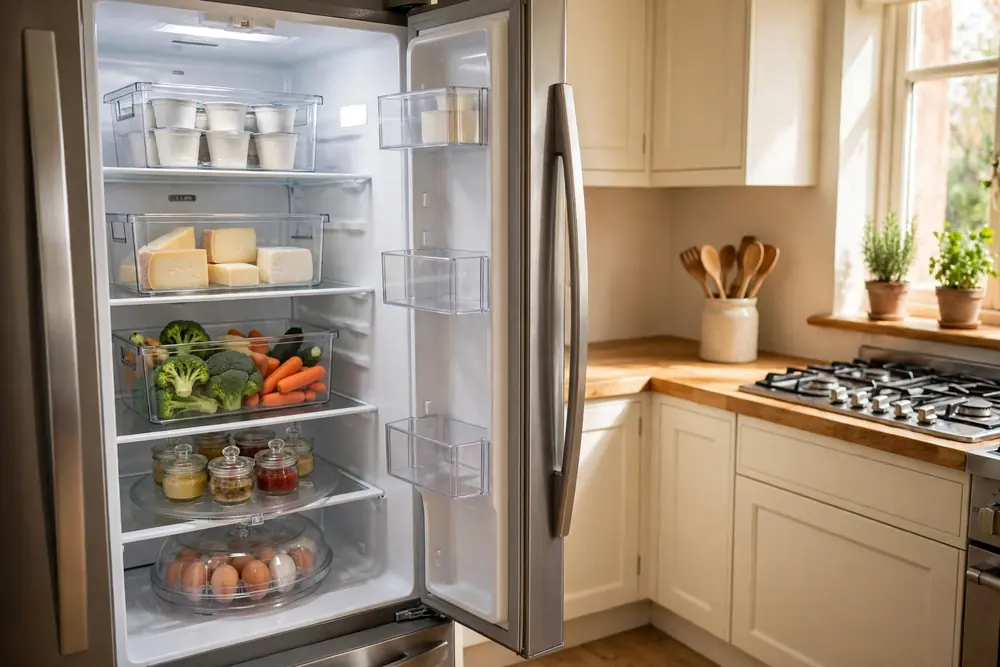
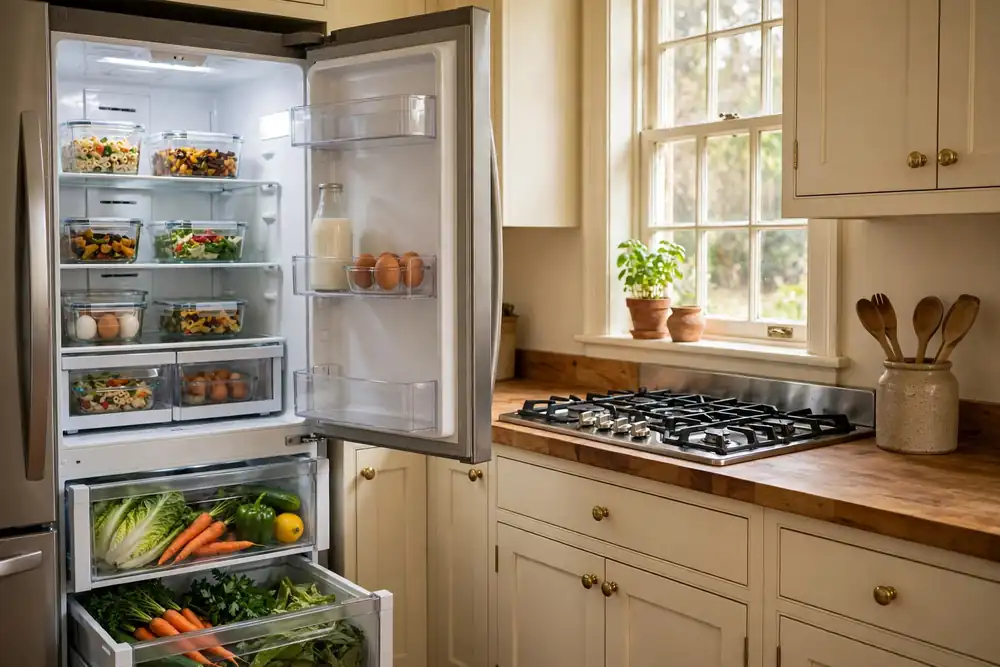
The top shelf is the warmest steady spot in most fridges, because warm air rises. It is the right place for leftovers, cooked food, drinks, and anything that is already cooked and just needs keeping cold. Put leftovers in shallow containers so they cool fast, and get them in within two hours of cooking. One hour if the kitchen is hot.
The middle shelves are the most even temperature in the fridge. Dairy lives here: milk, yoghurt, cheese, butter. Eggs too, in their carton, on a shelf. Not in the door. The door is the warmest part of the fridge, and it warms up every time someone opens it looking for a snack. Eggs and milk do not like that.
The bottom shelf is the coldest spot, and it belongs to raw meat, poultry, and fish. Always on the bottom, always on a plate or in a container, so nothing drips onto the food below. A tray under the meat catches the drips you do not see until it is too late. This is the one rule I never break. Raw meat juice on ready-to-eat food is how people get sick.
The drawers at the bottom are for produce, and most fridges let you set the humidity. Leafy greens, herbs, and anything that wilts want high humidity, vent closed. Fruit and anything that rots easily wants low humidity, vent open. One drawer for fruit, one for vegetables, if your fridge has two. The reason is ethylene, a gas some fruit gives off as it ripens. Apples, pears, bananas, and avocados give off a lot of it. Leafy greens, cucumbers, and carrots are sensitive to it, and it turns them yellow, bitter, or limp faster. Keep the givers away from the sensitive ones and everything lasts longer.
The door is for the things that can handle temperature swings: condiments, jams, sauces, pickles, salad dressing. Things in jars with vinegar or salt in them are built to survive a bit of warmth. Milk is not. Neither are eggs.
If your fridge has no obvious zones because everything is just shoved in wherever it fits, that is normal. Most fridges end up that way. A few bins and a turntable make the zones real instead of theoretical, and I have written about the ones that work in my guide to the best fridge organizers. The point is not a beautiful fridge. The point is that you can see what you have, and nothing hides at the back until it is past saving.
One more fridge habit that matters more than it sounds: do not overfill it. Cold air needs to circulate. A fridge packed solid has warm pockets, and the food in those pockets goes off faster. Leave a little space between things. And put new shopping behind the old, so the older food gets used first. It sounds obvious. It is the habit that saves the most food in my house.
For the actual days, how long food lasts once it is in the fridge, I keep that in a separate guide. This article is about where things go. That one is about how long they stay good once they are there.
The pantry rules
The pantry is the easy room, because the rules are simple: cool, dark, and dry. Heat, light, and damp are what wear dry food down. A cupboard away from the oven and the window does the job. A cupboard right next to the stove does not, because it warms up every time you cook.
Flour, sugar, rice, pasta, oats, and cereal all want airtight containers. The bags they come in are not airtight once you open them, and they tear, and they let in damp and pantry moths. Decanting into a sealed container is not about looking tidy. It is about keeping the food dry and keeping bugs out. Label the container with what is in it and when you opened it. A strip of masking tape and a pen is enough.
Canned food is the most forgiving thing in the pantry. Keep cans in a cool, dry place and they last for years. The one thing to check is the can itself. A can that is swollen, badly dented on a seam, or leaking goes in the bin, not in the pot. Rust on the outside is fine as long as the can is sound. A dent in the flat side is fine too. It is the seams that matter.
Oils and spices want the dark. Light breaks oil down and turns it rancid, and it fades spices until they taste of nothing. Keep cooking oil in a cupboard, not on the counter next to the stove. Spices go in a drawer or a cupboard with a door, in jars with tight lids. Whole spices last longer than ground ones, because less surface is exposed to air.
Potatoes and onions both live in the pantry, but never together. Onions give off moisture and gas that makes potatoes sprout. Potatoes give off moisture that makes onions go soft. Store potatoes in a cool, dark, ventilated spot, in a paper bag or a basket, not a sealed plastic bag. They want air. Onions want the same kind of spot, dry and airy, in a mesh bag or a basket. Garlic too. Keep all three out of the fridge, which is the next section but one.
Bread belongs on the counter in a bread box or a bag, eaten within a few days. The fridge makes bread go stale faster, not slower. The cold speeds up the starch changes that make bread hard and dry. If you have more bread than you will eat in a few days, freeze the rest in slices. It thaws in minutes and toasts straight from frozen.
Coffee goes in an airtight container in the cupboard. Not the fridge, and not the freezer, unless you are storing beans for months. Coffee absorbs smells, and a fridge is full of them. Ground coffee goes stale faster than whole beans, so buy whole beans and grind what you need if you can.
If the pantry itself is the problem — shelves you cannot see into, bags falling over every time you reach for the flour — the fix is a system, not a single container. Here is how to organize a pantry so it stays organized, zones and all.
The freezer rules
The freezer should sit at or below 0°F. At that temperature, food stays safe indefinitely. Bacteria cannot grow at 0°F. What changes over time is quality, not safety. A steak frozen for a year is still safe to eat. It just will not taste as good as one frozen for a month, because freezer burn and slow drying have had longer to work on it.
Freezer burn is the enemy, and it is caused by air. Air pulls moisture out of the surface of frozen food, and that dried-out patch turns grey and leathery. It is not dangerous. It tastes like cardboard. The fix is to get the air out before the food goes in. Press the air out of freezer bags. Wrap meat tightly in freezer paper or foil, then put it in a bag. Leave as little air as possible between the food and the wrapping.
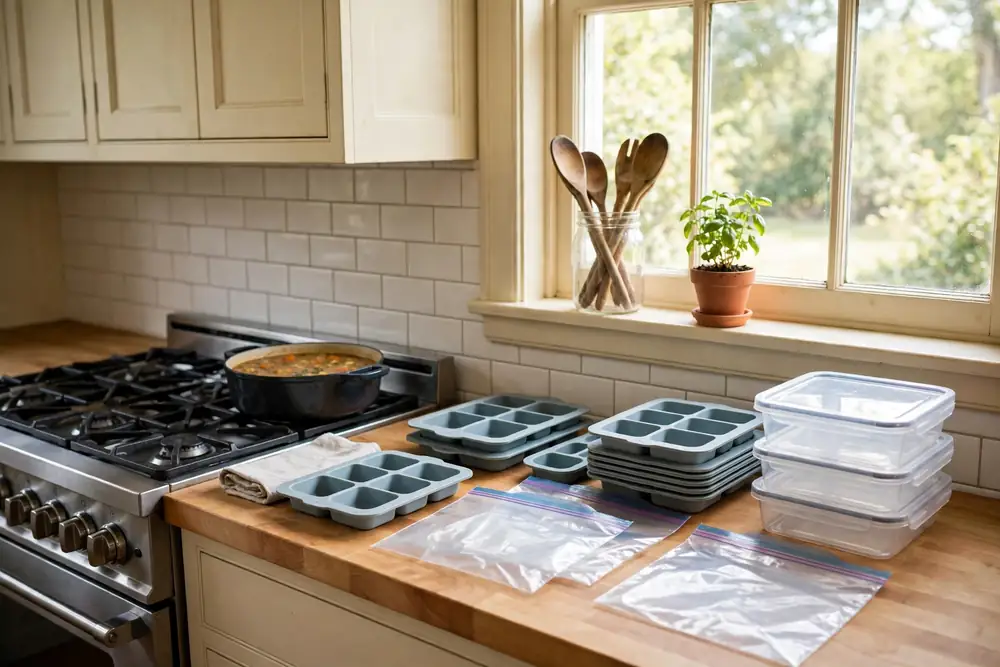
Freeze in portions you will actually use. A whole pot of soup in one giant container means thawing the whole pot for one bowl. Freeze soup flat in bags, laid down until solid, then stacked upright like files. They thaw fast, they stack neatly, and you take out exactly what you need. Same for ground meat: flatten it in a bag, press out the air, freeze it flat. It thaws in half an hour in cold water.
Label everything. A frozen bag of something brown could be chilli, could be bolognese, could be soup. Write what it is and the date on the bag with a marker before it goes in. I use a roll of masking tape and a thick pen. It takes ten seconds and saves the guessing game three months later.
Do not put hot food straight into the freezer. Let it cool on the counter first, then into the fridge, then into the freezer. Hot food raises the temperature of everything around it, and it freezes slowly, which makes bigger ice crystals and worse texture. Shallow containers cool faster than deep ones. Spread food out to cool, then pack it to freeze.
Thawing has rules too. The safe ways are in the fridge overnight, in cold water changed every half hour, or in the microwave if you are cooking it right away. The counter is not a thawing method. Food thawing on the counter spends hours in the danger zone. Thaw in the fridge, cook it, and eat it. And do not refreeze raw food that has fully thawed unless you have cooked it first.
The four enemies: air, moisture, light, and temperature swings
Every storage rule in this article comes down to four things that spoil food. Learn them and you can work out where almost anything goes.
Air is the first enemy. Air dries food out, carries smells between foods, and feeds the mould and bacteria that grow on surfaces. Every container should close properly. Cling film over a bowl is better than nothing, but a lid that seals is better than cling film. Open bags get clipped shut or moved into a container. Half an onion goes in a sealed container, not loose on a shelf. The less air touching the food, the longer it lasts.
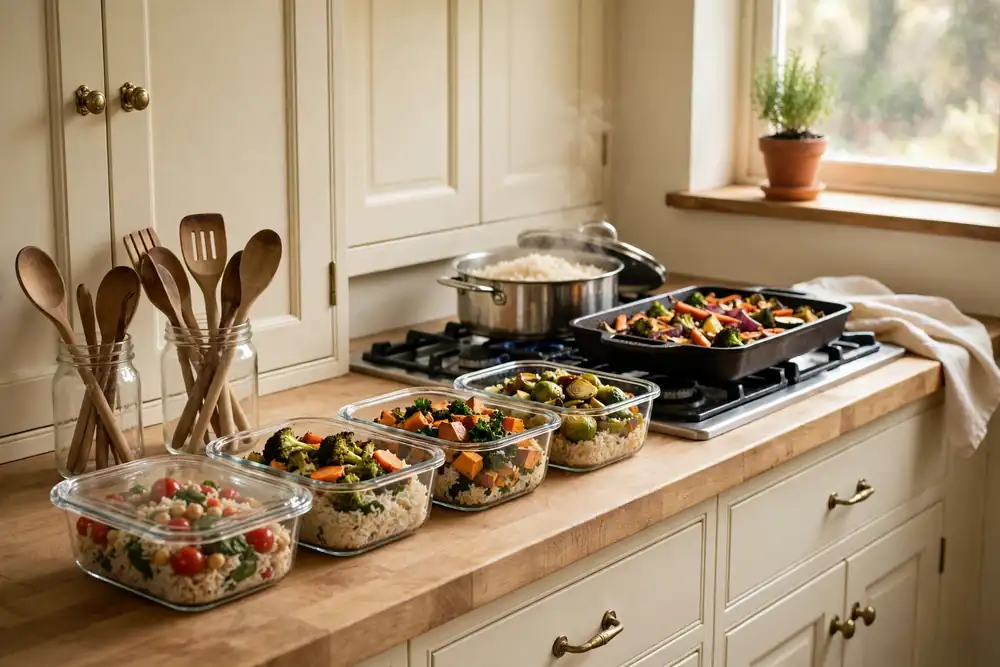
This is the one place in this article where a product genuinely earns its mention. Most of my food goes into glass containers with lids that latch on all four sides. They seal properly, they do not hold smells the way plastic does, and I can see what is inside without opening them. The set I use most is the Glasslock one, and I have written up the full comparison in my guide to the best food storage containers if you want to see how the glass and plastic options stack up.

Best overall
Glasslock Ring Taper 24-Piece Set
Tempered glass with four-latch lids that seal properly, so leftovers stay fresh and nothing leaks in the fridge.
Glass is not the only answer. Plastic is lighter, it does not break, and it is better for packed lunches and anything the kids carry. The choice between glass or plastic depends on what you are storing and who is carrying it, and I have a full comparison of the two materials if you are deciding.
Moisture is the second enemy, and it works both ways. Too much moisture grows mould. Too little dries food out. Leafy greens want a little moisture, which is why a damp paper towel in the container keeps salad crisp for days. Berries want to stay dry, which is why you wash them just before eating, not when you put them away. Wet berries in a sealed box go mouldy fast. Mushrooms want a paper bag, not a sealed plastic one, because they sweat and go slimy in plastic.
Light is the third enemy. It fades spices, turns oil rancid, and makes potatoes go green. Green potatoes have solanine in them, which tastes bitter and is not good for you. Cut the green parts off generously, and if the potato is green all the way through, throw it out. Keep potatoes in the dark and this does not happen.
Temperature swings are the fourth enemy. Every time food warms up and cools down again, condensation forms, bacteria get a window, and quality drops. That is why the fridge door is a bad place for milk. It is why you do not leave the shopping in a warm car. And it is why the freezer door is a bad place for ice cream. The back of the freezer is the coldest and most stable spot. The door is the warmest and swings the most.
What never goes in the fridge
Some foods are worse off cold. The fridge does not help them. It hurts them.
Tomatoes lose their flavour in the cold. The chill shuts down the compounds that make a tomato taste like a tomato, and the texture goes mealy. Keep whole tomatoes on the counter, stem side down, out of direct sun. Once a tomato is cut, it goes in the fridge in a sealed container, because cut fruit is perishable. But a whole tomato belongs on the counter.
Potatoes turn sweet and gritty in the fridge. The cold turns their starch into sugar, and they cook up strange. They also sprout faster if they are near onions, so keep them apart in the pantry, in the dark.
Onions and garlic go soft and mouldy in the damp cold of a fridge. They want a dry, airy spot at room temperature. A whole onion in the fridge is a wasted onion. A cut onion is different. Wrap it tightly or put it in a sealed container and refrigerate it, because a cut onion dries out and smells up the fridge.
Bananas ripen on the counter. The fridge stops them ripening and turns the skin black. A black-skinned banana from the fridge is still fine inside, and if your bananas are already ripe and you want to slow them down, the fridge does work for a few extra days. But an unripe banana in the fridge will never ripen properly.
Whole melons, citrus fruit, and stone fruit that is not yet ripe all do better on the counter. A hard peach or avocado needs room temperature to ripen. Once it is ripe, the fridge buys you a few more days. Before that, the cold just stalls it.
Bread, as I said above, goes stale faster in the fridge. Counter or freezer, never the fridge.
Honey does not need the fridge at all. It keeps indefinitely at room temperature in a sealed jar. In the fridge it crystallises and turns hard to pour. Leave it in the cupboard.
Where common foods belong
| Food | Where it goes | Why |
|---|---|---|
| Raw meat, poultry, fish | Fridge, bottom shelf | Coldest spot; drips cannot reach other food |
| Milk, yoghurt, cheese | Fridge, middle shelf | Steady temperature, away from the door |
| Eggs | Fridge, middle shelf, in the carton | Door temperature swings too much |
| Leftovers and cooked food | Fridge, top shelf, sealed containers | Already cooked; needs cold, not the coldest spot |
| Leafy greens and herbs | Fridge, high-humidity drawer | They wilt without moisture |
| Fruit | Fridge, low-humidity drawer, or counter | Keep ethylene producers away from sensitive veg |
| Condiments and sauces | Fridge door | Built to handle temperature swings |
| Tomatoes (whole) | Counter | Cold kills flavour and makes them mealy |
| Potatoes | Pantry, dark and ventilated, away from onions | Cold turns starch to sugar; onions make them sprout |
| Onions and garlic | Pantry, dry and airy | Fridge damp makes them soft and mouldy |
| Bananas | Counter | Fridge stops ripening and blackens the skin |
| Bread | Counter or freezer | Fridge makes it stale faster |
| Flour, rice, pasta, cereal | Pantry, airtight containers | Keeps out damp and pantry moths |
| Oil and spices | Pantry, dark cupboard | Light turns oil rancid and fades spices |
| Soup and cooked meals | Freezer, flat in labelled bags | Thaws fast and stacks neatly |
Questions people ask
Can you put hot food straight in the fridge?
You can, and it is safer than leaving it out. The old advice to cool food fully first is about the fridge, not the food. Hot food warms the fridge up a little. But leaving food on the counter for hours is worse. The practical answer is to let it cool for a short while, then put it in shallow containers in the fridge. Do not wait for it to reach room temperature.
Should you wash fruit and vegetables before storing them?
Not usually. Water left on produce speeds up mould. Wash berries, greens, and mushrooms just before you eat them. The exception is leafy greens you are storing in a container with a paper towel, where you wash, dry thoroughly, and then store. Dry is the key word. Wet produce in a sealed container goes off fast.
Does the fridge really need to be at or below 40°F?
Yes. Above 40°F you are in the range where bacteria multiply quickly. A fridge running at 45°F looks the same and feels the same, but the food inside is going off faster than you think. Check with a thermometer, not the dial.
Can you store onions and potatoes together?
No. Onions give off moisture and gas that makes potatoes sprout. Potatoes give off moisture that makes onions go soft. Store them in separate spots, both cool, dark, and ventilated.
How do you keep herbs fresh longer?
Treat soft herbs like a bunch of flowers. Trim the stems, stand them in a jar with a little water, and put the jar in the fridge with a loose bag over the top. Basil is the exception. Basil hates the cold and goes black in the fridge. Keep basil on the counter in water, like a plant on the windowsill.
Is it safe to eat food that has been in the freezer for a year?
Yes, if it stayed at or below 0°F the whole time. Frozen food stays safe indefinitely. What changes is quality. A year-old frozen meal is safe, but it may taste dry or stale from freezer burn. That is a quality problem, not a safety problem.
Why does my fridge smell?
Usually it is one uncovered food, or something forgotten at the back. Take everything out, throw away anything past its best, wipe the shelves with warm water and baking soda, and put things back in sealed containers. An open box of baking soda on a shelf absorbs smells. So does a small bowl of coffee grounds.
The bottom line
Food lasts longer when it is cold enough, dry enough, and sealed properly, and when it is in the right place to begin with. The fridge at or below 40°F, the freezer at or below 0°F, raw meat on the bottom shelf, produce in the drawers, and the foods that hate the cold kept out of it.
Start with the thermometer. If your fridge is running warm, nothing else you do will matter much. Then work through the zones, one shelf at a time. You do not need to reorganise the whole kitchen in one evening. Move the milk off the door today. Put the meat on the bottom shelf tomorrow. The food will notice before you do, and the bin will get lighter.