How to Organize a Pantry That Stays Organized
Most pantries fall apart because nothing has a home. Zones, decanting, labels, and a ten-minute weekly reset are what keep one tidy after the first week.
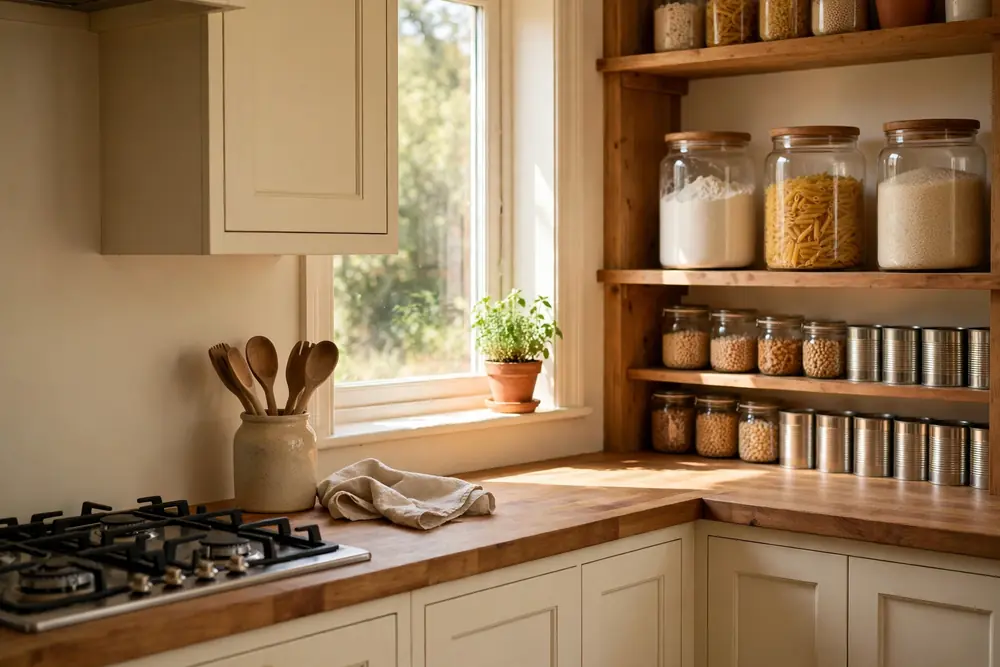
You know the cycle. On Saturday morning you pull everything out of the pantry, wipe the shelves, line the cans up in neat rows, and step back to admire it. By the following Saturday it looks like someone shook the shelves. The rice is behind the pasta. There are three half-open bags of flour. Something sticky has leaked onto the second shelf and nobody will admit to it.
I know how to organize a pantry the hard way: by tidying it up more times than I can count. I cook every day for a family of four, and our pantry gets opened about twenty times a day. For years I thought the problem was that I was not tidy enough, or that I needed more containers, or that the pantry was too small. None of that was the problem.
The problem was that my pantry had no system. Everything had a place for exactly one day, and then real life happened. A tidy pantry that falls apart in a week was never organized. It was just briefly neat.
The short answer
A pantry stays organized when everything in it has a home that matches how you cook. Group food by job, not by type. Decant the dry goods you use most into clear, airtight canisters. Label everything with what it is and when you opened it. Then spend ten minutes once a week putting things back where they belong. That is the whole system. The rest of this article is the detail.
Why pantries fall apart
A pantry does not fall apart because you are lazy. It falls apart because putting things away is harder than taking things out.
Taking something out is easy. You reach in, grab the pasta, and close the door. Putting something away means deciding where it goes. If nothing has an obvious home, the bag lands on the nearest empty patch of shelf. Do that twenty times a day for a week and the pantry is chaos again, no matter how neat it was on Saturday.
The second problem is that you cannot see what you have. Bags flop over and hide each other. Boxes get pushed to the back. So you buy a second bag of rice because you forgot about the first one, and now there are two half-open bags and no room for either.
The third problem is the packaging food comes in. Paper flour bags tear. Cereal boxes are half air. Pasta bags do not stand up. None of it stacks, none of it seals properly once opened, and none of it tells you at a glance how much is left. The pantry is fighting the packaging before you even start.
So the fix is not a bigger tidy-up. The fix is a system that makes putting things away as easy as taking them out. That system has four parts: zones, decanting, labels, and a weekly reset.
Start by emptying it
Before you organize anything, take everything out. Every can, every bag, every jar. Put it on the counter and the table. This is the only way to see what you actually have, and it is faster than trying to tidy around the clutter.
Wipe the shelves while they are empty. Check the corners for crumbs and sticky spots. If you find fine silky webbing in a bag of flour or cereal, that is pantry moths. They often arrive inside a package from the store. Throw the affected food out, vacuum the shelf corners and the little holes the shelf pins sit in, and do not spray insecticide anywhere near food. It does not work on pantry pests anyway.
Now sort what came out. Keep what you use. Toss what is stale, rancid, or past saving. A best-by date is about quality, not safety, so use your nose and your eyes on dry goods: flour that smells musty or off goes in the bin, whatever the date says. Anything you cannot identify goes too. If you do not know what it is, you are not going to cook with it.
Group what is left by job as you put it back. Baking things together. Breakfast things together. Dinner staples together. You are already building the zones. The emptying is the hard part, and you only do it properly once or twice a year.
Zones: arrange by how you cook
Most people organize a pantry by food type. All the cans together, all the grains together, all the snacks together. That looks logical on paper and fails in real life, because you do not cook by food type. You cook by meal.
When you make breakfast, you want the oats, the cereal, the honey, and the peanut butter in one place. When you bake, you want the flour, the sugar, the baking powder, and the vanilla in one place. If those things live on three different shelves, you are walking back and forth and putting things down wherever your hands happen to be.
So group by the job the food does. Here is how my pantry is zoned, and it works for most family kitchens:
| Zone | What lives there | Best spot |
|---|---|---|
| Breakfast | Cereal, oats, honey, peanut butter, jam | Eye level, easy to reach |
| Baking | Flour, sugar, baking powder, vanilla, chocolate chips | Middle shelf, near the counter |
| Dinner staples | Pasta, rice, canned tomatoes, beans, broth | Middle shelf, most used |
| Snacks and lunchboxes | Crackers, granola bars, dried fruit, nuts | Low shelf the kids can reach |
| Oils and vinegars | Olive oil, vegetable oil, vinegars, soy sauce | Near the stove side, upright |
| Cans and jars | Tinned fish, coconut milk, pickles, sauces | Lower shelf, heavy things low |
| Spices and small things | Spice jars, stock cubes, small packets | Top shelf or a door rack |
A few rules make zones work. Eye level is for the things you reach for every day. Heavy things go low, because a full can of tomatoes falling from the top shelf is a bad day. Things you use once a month go high. And the zone only works if everyone in the house knows it exists. Tell the family where the snacks live. Put the cereal back in the breakfast zone, not on the first shelf you pass.
One more thing about zones. Dry goods live in the pantry. Leftovers and anything that needs the cold live in containers built for the fridge, which is a different job with different rules. If your fridge storage is as chaotic as your pantry was, my guide to the best food storage containers covers the containers that actually seal and stack.
Decanting: what to take out of the bag
Decanting means moving food out of the bag or box it came in and into a container of your own. It is the single change that makes the biggest difference to a pantry, and it is also the one people overdo.
Decant the dry goods you scoop from regularly. Flour, sugar, rice, pasta, oats, cereal, dried beans, lentils. These are the things that come in bags that tear, flop, and spill. In a clear canister you can see how much is left, you can scoop without tearing anything, and the lid seals properly.
Do not decant everything. Small packets, spice jars, and anything you finish within a week are fine in their original packaging. Canned goods stay in their cans. Decanting is for the staples you buy in bulk and use slowly.
There are three real reasons to decant, and looking pretty is not one of them. The first is freshness. Opened white flour keeps about six to eight months in the pantry, and whole wheat flour only three to six months, because the oils in the bran turn rancid. An airtight container keeps moisture and air out, which is what makes flour go stale.
The second reason is pantry moths. Their larvae can chew through paper bags and thin cardboard, which is how an infestation spreads from one bag to the whole shelf. Glass, metal, or heavy plastic with a tight lid stops them. If you buy flour from a bulk bin, freeze the bag for three or four days before you decant it. That kills any eggs that came home from the store.
The third reason is the simplest. You can see what you have. A clear canister tells you at a glance that the rice is nearly gone. An opaque bag tells you nothing until you pick it up and find it empty.
Whether you decant into glass or plastic is worth a minute of thought. Glass is heavier and breakable, but it never stains and never holds a smell. Plastic is lighter and safer on a low shelf the kids can reach. I use both, glass for the baking staples on the middle shelf and plastic for the cereal and snacks lower down.
The canisters I reach for most are the OXO POP set. Three 4.4-quart canisters, each big enough for a full five-pound bag of flour, with a push-button lid you can open one-handed while you are holding a measuring cup. They are the best overall pick in my guide to the best pantry storage containers, which covers the full set of five canister options if you want to compare sizes and materials before you buy.

Best overall canisters
OXO Good Grips 6-Piece POP Container Bulk Set
Three 4.4-quart canisters with push-button lids you can open one-handed, each big enough for a full five-pound bag of flour.
One practical note before you buy any canisters. Measure your shelves first. A canister that is too tall for the gap between shelves is useless, and a canister that is too wide wastes the space beside it. Measure the height, the depth, and the width of one shelf, and buy to fit that shelf. Rectangular canisters use shelf space better than round ones, because they sit flush against each other with no wasted gaps.
Labels: the part everyone skips
Labels feel like the fussy finishing touch. They are actually the part that makes the system survive contact with the rest of the family.
Write two things on every canister. What it is, and when you opened it. Flour looks exactly like powdered sugar. Rice flour looks exactly like cornstarch. Baking soda and baking powder sit side by side and do very different things in a cake. A label takes five seconds and saves a ruined batch.
The date matters because the printed date on the bag stops meaning much the moment you open it and pour the flour into a canister. Once it is decanted, the bag is in the bin and the date is gone. Write the month and year you opened it on a piece of tape. Six months later you will know whether that flour is still good or whether it is time to bake with it this week.
Labels also tell everyone else where things go back. A canister that says "rice" goes back to the rice spot. A canister with no label goes back wherever someone feels like putting it, which is how the system falls apart. You do not need a label maker. Masking tape and a marker work fine and peel off cleanly when you need to change them.
Deep shelves and small pantries
Deep shelves are the hardest pantry problem. Anything at the back is invisible, and invisible food is forgotten food. The rule for a deep shelf is simple: nothing sits behind anything without a bin.
Use open bins as drawers. One bin for baking, one for snacks, one for pasta and rice. Pull the bin out like a drawer, take what you need, slide it back. The back of the shelf stops being a graveyard and starts being storage again. A turntable works the same way for oils and vinegars, which are tall and hard to reach past.
If your shelves are very deep, keep a front row and a back row on purpose. The front row is what you are using this week. The back row is the backup: the second bag of rice, the spare jar of peanut butter. When the front runs out, the back moves forward. Nothing hides behind anything by accident.
Small pantries need the same system, just tighter. Use the inside of the door for spice racks or narrow shelves. Add a shelf riser so you can stack two rows of cans where one row stood before. Decant, because canisters stack and bags do not. And be honest about what fits. A small pantry holds a week or two of food, not a month. Keep the overflow somewhere else, a box on top of a cupboard or a shelf in the garage, and refill the pantry from it.
The one-in-one-out rule helps a small pantry more than any container. When a new bag of pasta comes in, the old one should already be finished or in the bin. If it is not finished, you did not need the new bag yet.
The weekly reset
This is the part that makes it stay organized. Not the big tidy-up. Not the containers. The reset.
Pick one day a week, the day before you shop. Ten minutes, no more. Open the pantry and do four things.
First, pull everything forward. Cans to the front of their zone, canisters lined up, anything that drifted back where it belongs. Second, check what is low. Rice nearly gone, oats half full, one egg left in the carton. Third, toss anything that has gone stale or that nobody is going to eat. Fourth, write the shopping list from the shelf, not from memory. You are standing in front of the evidence. Use it.
Ten minutes a week beats three hours every three months. The big tidy-up happens because the small one never did. Do the reset on the same day every week and it becomes a habit, like wiping the counters after dinner. Nobody thinks about it. It just happens.
If you live with other people, the reset is also the moment to check whether the zones are holding. If the cereal keeps ending up on the baking shelf, the cereal zone is in the wrong place. Move the zone. The system serves the household, not the other way around.
Questions people ask
How often should I reorganize my pantry?
Do the full empty-out once or twice a year, and do the ten-minute reset every week. The reset is what keeps it organized. The big tidy-up is for the deep clean and the purge, not for maintenance.
Do I really need to decant everything?
No. Decant the dry goods you scoop from regularly: flour, sugar, rice, pasta, oats, cereal. Leave small packets, spice jars, and anything you finish within a week in the packaging it came in.
How do I keep pantry moths away?
Store dry goods in airtight glass, metal, or heavy plastic containers, because moth larvae chew through paper and thin cardboard. Freeze a new bag of flour for three or four days before decanting it, and throw out anything with webbing in it.
What is the best way to organize a small pantry?
The same zones, in less space. Use the inside of the door, add shelf risers, decant so things stack, and keep overflow somewhere else. A small pantry holds a week or two of food, and the one-in-one-out rule matters more than any container.
Should flour go in the pantry or the fridge?
White flour is fine in the pantry for six to eight months once opened, in an airtight container. Whole wheat flour goes rancid faster, three to six months, so if you bake with it rarely, the fridge keeps it fresher for longer.
How do I stop buying duplicates?
The weekly reset and clear canisters. Check the shelf before you shop, and write the list from what you can see. If you cannot see what you have, you will buy it twice.
The bottom line
A pantry that stays organized is not a prettier pantry. It is a pantry with a system: zones that match how you cook, canisters for the dry goods you scoop from, labels that say what things are and when you opened them, and a ten-minute reset every week.
Start with the empty-out. Do not buy a single container until you know what you actually have and how much space it takes. Then set the zones, decant the staples, label everything, and pick your reset day.
The test is not how the pantry looks on Saturday. The test is how it looks on Friday, after a week of real cooking. If everything is still more or less where it belongs, the system is working. If it is not, move a zone or shorten the reset interval. The pantry serves the kitchen, and the kitchen serves the family. Get that order right and the tidy takes care of itself.