Best Fridge Organizers: Bins, Turntables & Egg Holders
A fridge you can see into is a fridge that wastes less food. Five organizers that earn their shelf space: bins, a turntable, an egg holder, and pull-out drawers.
You are making dinner and you need the mustard. You know it is in the fridge. You move the milk, you move the juice, you move a container of something you do not remember cooking, and there it is, at the back, behind the jam. By the time you find it, the pan is too hot. That is the problem the best fridge organizers solve. They are not about a pretty fridge. They are about finding the mustard in two seconds and seeing the leftovers before they go bad.
I cook every day for a family of four, and my fridge holds the same things yours does: milk, eggs, leftovers, and a drawer of vegetables that looked hopeful on Sunday and tired by Thursday. A fridge without bins is a pile. Things slide to the back, get forgotten, and get thrown away. A fridge with bins is a set of drawers you can see into. You pull out the snack bin, take what you need, and push it back. Nothing hides.
One honest note before we start: this page has affiliate links. If you buy through one, the site may earn a small commission. It costs you nothing, and it never decides what I recommend. I do not list prices here, because prices move and a stale price is worse than no price. Check the current price before you buy anything.
Top 3 picks
- HOOJO Refrigerator Organizer Bins, 8-Pack — Best overall. Eight clear bins that organize a whole fridge in one order, each one 12.5 inches long with a handle. Check on Amazon
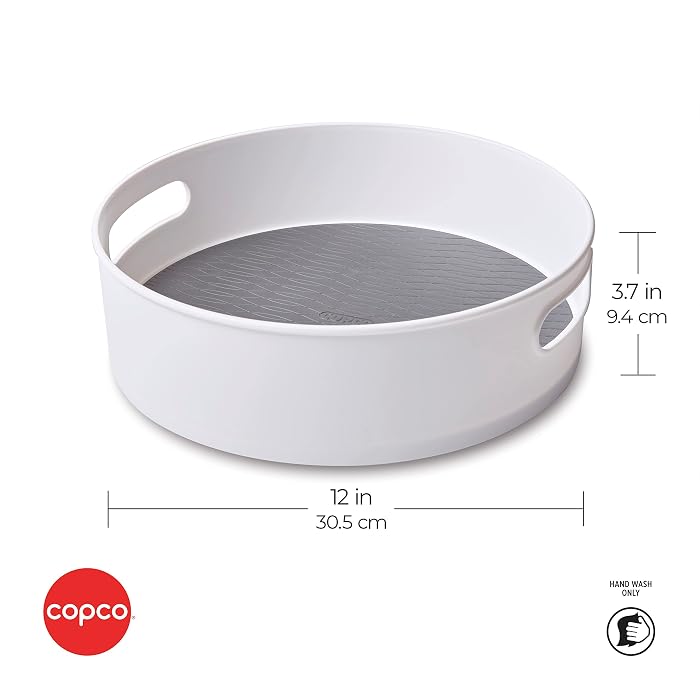
- Copco Non-Skid Turntable, 12-Inch — Best turntable. A spin ends the lost-jar hunt, and the non-skid liner keeps bottles standing while it turns. Check on Amazon
- iDesign Linus Fridge Bin, 11 x 7 Inches — Best single bin. The classic clear bin: sturdy, BPA-free, and the right size for a shelf of yogurts or a drawer of snacks. Check on Amazon
How I picked these
I have not bought and used every organizer on this list, and I will not pretend I did. I picked them from verified specs, maker details, and what I know from daily use about what a fridge organizer has to survive: cold, condensation, sticky spills, and being yanked out by a child looking for a yogurt.
An organizer earns a place here if it does four things. It fits a real fridge shelf, so I checked dimensions against standard shelves. It lets you see what is inside, because a bin you cannot see into is a second hiding place. It pulls out or spins with one hand, because the other hand is usually holding something. And it is easy to wash, because fridge spills are not a question of if. Scores are my own judgement, not a copied rating.
The best fridge organizers at a glance
| Product | Type | Best for | Check on Amazon |
|---|---|---|---|
| HOOJO Refrigerator Organizer Bins, 8-Pack | Bins | A whole-fridge reset | Check on Amazon |
| iDesign Linus Fridge Bin, 11 x 7 Inches | Single bin | One shelf, done well | Check on Amazon |
| Copco Non-Skid Turntable, 12-Inch | Turntable | Jars and condiments | Check on Amazon |
| WYT Clear Covered Egg Holder, 3-Pack | Egg holder | Eggs on a shelf | Check on Amazon |
| madesmart 2 Tier Organizer, Frost | Pull-out drawers | Deep shelves | Check on Amazon |
The bins
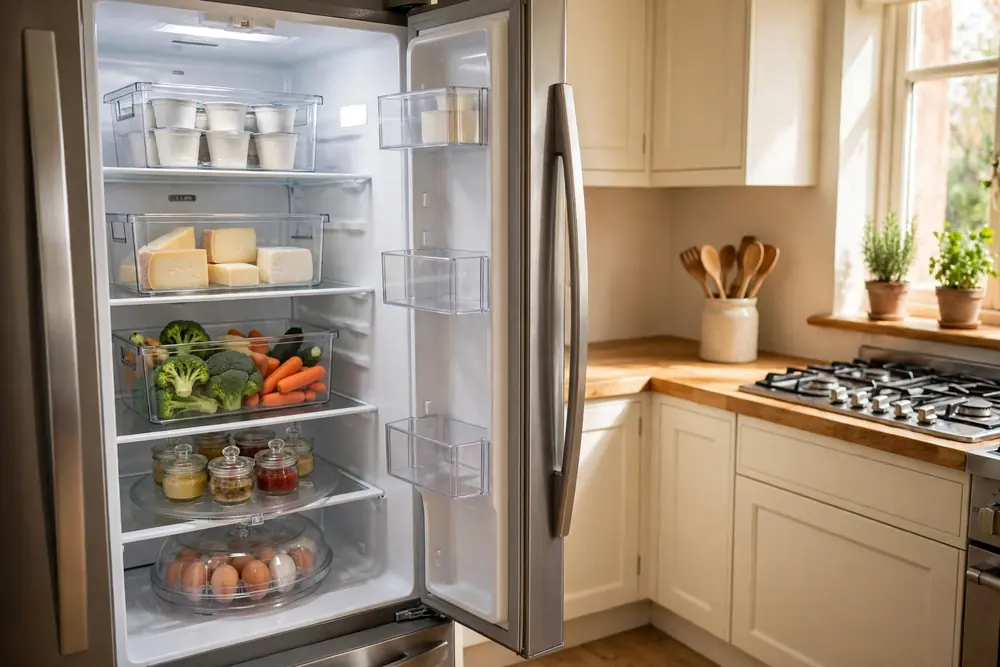
Bins are the foundation. Everything else on this list is a specialist. Bins are the generalists, and if you buy nothing else, buy bins. One bin per category: snacks, yogurts, cheese, sauces, leftovers. When a bin is empty, you know what to buy.
The HOOJO set is the one I would buy first. Eight identical bins sound boring until you are lining them up on a Sunday afternoon and every bin fits every shelf the same way.

If you do not need eight bins, buy one good one. The iDesign Linus bin is the original clear fridge bin: a little shorter than the HOOJO, a little wider, with a ribbed bottom that keeps jars from sliding around. One bin is enough for the shelf that bothers you most, and you can add more later in the sizes that fit.

The turntable
Bins solve the front-to-back problem. A turntable solves the corner problem. Every fridge has a spot where jars go to be forgotten: the back corner of a shelf, behind the milk, where you cannot reach without moving three things. A turntable turns that corner into the front. One spin, and the jar you need is facing you.
The Copco is the turntable I would buy. Twelve inches fits a standard fridge shelf with room to spin, and the raised rim keeps a tipped bottle from rolling off the edge.
Eggs and drawers
Eggs are the one thing in the fridge that comes with its own storage problem. The carton is flimsy, it tears, and it hides how many eggs are left until you open it mid-recipe. An egg holder fixes the counting problem. You can see at a glance whether you have six eggs or sixteen.
One honest thing first. The official guidance is to keep eggs in their original carton, on a shelf inside the fridge, not in the door. The carton protects the eggs from picking up fridge smells, and the door is the warmest part of the fridge, where the temperature swings every time it opens. A holder is a convenience, not a safety upgrade. If you move eggs into a holder, keep it on a shelf, and keep the lid on.

The last pick is the odd one out. The madesmart 2-tier organizer is sold for under the sink, not for the fridge. I am including it because it solves the one problem bins cannot: a deep shelf where things stack two high and the bottom layer disappears. Two slide-out baskets, one above the other, turn one shelf into two drawers.
The honest caveat is the height. It stands 10.6 inches tall, and many fridge shelves sit closer together than that. Measure the gap between your shelves before you buy it. If the gap is too small, move one shelf up a notch.

How to set up your fridge
Organizers only help if things go in the right place. A tidy fridge with raw chicken above the leftovers is worse than a messy fridge, because the mess at least made you look twice. The rules are simple, and they come before the bins.
Keep the fridge at or below 40°F. That is the number that matters. Above 40°F, bacteria grow fast. A fridge thermometer costs little and tells you the truth, because the dial on the fridge tells you a setting, not a temperature.
Raw meat goes on the lowest shelf. Always. Meat juices drip, and a drip that lands on food below is a drip on food you will eat raw. Put the meat in a bin or on a plate on the bottom shelf, where a drip has nowhere to go.
Leftovers go where you can see them. Eye level, front of the shelf, in a clear container. Leftovers you cannot see are leftovers you will throw away on Sunday. Cooked leftovers keep three to four days in the fridge. After that, freeze them or let them go. If you are unsure about something, check how long food lasts in the fridge before you eat it.
Eggs and milk go on a shelf, not in the door. The door is the warmest part of the fridge, and its temperature swings every time the door opens. Milk and eggs want steady cold. The door is for condiments, bottled water, and jam. Eggs keep three to five weeks in the fridge when they stay cold and steady.
Give every category a home. One bin for snacks, one for cheese, one for sauces. When a thing has a home, everyone in the house puts it back in the same place, including the kids.
Leave room for air. A fridge cools by moving cold air around the food. Bins packed tight against each other block that air. Leave a finger-width gap between bins and the back wall, and never cover the vents at the back of the fridge with a bin.
Bins hold the containers, and the containers hold the food. If your containers are the problem rather than your shelves, start with the best food storage containers and add bins after. For the full picture, the temperature rules, where everything goes, and why, I wrote it out in my guide to how to store food so it lasts longer.
What to check before you buy
Measure first. Measure the depth of your shelf, the width between the shelf supports, and the height to the shelf above. A bin that is half an inch too long does not fit, and a turntable that is half an inch too wide does not spin.
Clear beats frosted for finding things. A clear bin shows you what is inside from across the kitchen. A frosted bin shows you shapes. Frosted has its place: it hides the mess in a bin of small packets. But if the goal is finding the mustard, clear wins.
Handles matter more than they look. A bin without a handle is a box you lift with two hands. A bin with a handle is a drawer you pull with one. If you cook with a child on your hip or a pot in one hand, that difference is the whole point of the bin.
Check the care label. Most fridge organizers are hand wash only. The dishwasher warps thin plastic over time, and it does nothing good to a turntable's spin base. If a bin is dishwasher safe, it will say so.
Count bins, not pieces. A set of eight bins is eight bins. But a set that counts lids or dividers as pieces sounds bigger than it is. Check how many containers you actually get.
Tall items need a plan. A bin is 3.5 inches tall. A bottle of milk is 10 inches tall. Bins hold the small things. Tall bottles stand on the shelf itself, or on a turntable, or in the door.
Looking after them
Bins. Wash with warm soapy water when they are empty, or when something spills. Dry the bin before it goes back in the fridge, or condensation forms under it and the shelf gets damp. If a bin starts to smell, a paste of baking soda and water left on for an hour lifts most of it.
The turntable. Wipe the liner with a damp cloth when it gets sticky. A sticky liner grips too well: bottles stick to it instead of standing on it. Do not put the turntable in the dishwasher. The spin base is not built for dishwasher heat, and a turntable that does not spin is a tray.
The egg holder. Wash it when it is empty, and check it when you refill it. A cracked egg leaves a film you cannot see under the lid, and a film left for a week is a smell you cannot miss.
The pull-out drawers. Pull each basket out and wipe it down when you do the weekly fridge check. If a basket starts to stick, check that nothing has fallen behind it. A grape behind a basket is enough to jam the slide.
The weekly reset. Once a week, before the shopping comes home, open the fridge and look at every bin. Toss what is past it. Move what is oldest to the front. Wipe the shelf under one bin. Five minutes, once a week, is what keeps an organized fridge organized.
Questions people ask
Do fridge organizers actually help, or are they just for show?
They help, but only if things go back in the same place. A bin with a job, snacks or cheese or sauces, saves time every day, because you pull out one bin instead of moving five things.
What size bins fit a standard fridge?
A bin around 12 inches long and 6 inches wide fits most shelves, with two side by side on a standard shelf. Measure your own shelves before you buy. Fridge shelves vary more than people expect.
Can I put a turntable on a glass shelf?
Yes. A turntable sits on glass the same way it sits on wire. Check that the shelf is flat and the turntable spins freely before you load it. If the shelf has a raised lip at the front, measure past it.
Are plastic fridge organizers safe for food?
The bins on this page are BPA-free plastic, which is the standard for food storage. They hold packaged food and containers, not loose food straight on the plastic. If a bin is cracked or cloudy with age, replace it. A cracked bin is hard to clean.
How do I stop my fridge smelling?
A smell in the fridge is almost always something forgotten. Check the bins, toss what is past it, and wipe the shelf underneath. An open box of baking soda in the back of the fridge absorbs smells for a month or two.
How often should I clean the bins?
When they are empty, or when something spills. A quick wash with warm soapy water, then dry before it goes back in. A bin that never gets washed collects drips and crumbs at the bottom, and a dirty bin is worse than no bin.
The bottom line
If you buy one thing, buy the HOOJO 8-pack. Eight bins organize a whole fridge in one order, and the fridge you can see into is the fridge that wastes less food.
If you buy a second thing, buy the Copco turntable. It ends the lost-jar hunt on the shelf where jars go to be forgotten, and it is the organizer you will use every single day.
And if you buy nothing, you still have the useful part. Measure before you buy. Give every category a home. Keep raw meat low, leftovers where you can see them, and eggs and milk on a shelf, not in the door. And look in the fridge once a week, before the shopping comes home.