Best Freezer Storage Containers and Bags
A freezer full of mystery bags and freezer burn is a storage problem, not a cooking problem. Five freezer-safe picks that portion, stack, and freeze flat.
You open the freezer to find the soup you made last week, and what you find instead is a landscape of frost. A bag of something pale and unlabelled, frozen into a shape that fits nothing. A container with a lid that does not quite close, crusted with ice around the rim. A block of chili with a gray, leathery patch on top where the air got to it. Somewhere in there is good food. You just cannot tell what it is, or when you put it there.
The best freezer storage containers fix that in a boring, practical way. They freeze food in portions you can use. They stack so the drawer stays readable. They keep air out, because air is what turns good soup into freezer burn. I cook every day for a family of four, and I freeze in batches: soup on Sunday, meatballs, extra rice, berries before they go soft. A freezer that works is a second pantry. One that does not is where good food goes to be forgotten.
One honest note before we start: this page has affiliate links. If you buy through one, the site may earn a small commission. It costs you nothing, and it never decides what I recommend. I do not list prices here, because prices move and a stale price is worse than no price. Check the current price before you buy anything.
Top 3 picks
- Souper Cubes 1 Cup Silicone Freezer Tray with Lid, 2-Pack — Best overall. Two trays that freeze soup, sauce, and stew into eight neat one-cup blocks you can pop out and reheat one at a time. Check on Amazon
- Rubbermaid Brilliance 10-Piece Set — Best rigid containers. Five clear Tritan containers with latching, leak-proof lids that stack and go from freezer to microwave. Check on Amazon
- Ziploc Gallon Freezer Bags, 28 Count — Best value. The flat-freeze workhorse: a gallon bag of soup laid flat thaws in a fraction of the time a block takes. Check on Amazon
How I picked these
I cook every day for a family of four, and I have frozen food in everything from takeaway tubs to good glass: the tubs that cracked, the lids that popped off, the bags that leaked all over the drawer. I have not bought and used every product on this list, and I did not run these five through a lab. These picks come from verified specs, maker details, and what I know from daily use about what a freezer container has to survive: soup poured in hot, a drawer opened ten times a day, a lid that seals the same in January as in November.
A container earns a place here if it keeps air out, survives the freezer without cracking, freezes in a shape you can use, and covers the sizes a family freezes, from a cup of sauce to a pot of soup. Scores are my own judgement, not a copied rating.
The best freezer storage containers at a glance
| Product | Type | Size | Best for | Check on Amazon |
|---|---|---|---|---|
| Souper Cubes 1 Cup Tray, 2-Pack | Silicone tray | Eight 1-cup portions | Best overall | Check on Amazon |
| Rubbermaid Brilliance 10-Piece Set | Rigid containers | Five containers, 1.3 to 9.6 cup | Best rigid containers | Check on Amazon |
| Ziploc Gallon Freezer Bags, 28 Count | Disposable bags | Gallon, 28 bags | Best value | Check on Amazon |
| Stasher Half Gallon Silicone Bag, Aqua | Reusable bag | 64 oz, one bag | Best reusable bag | Check on Amazon |
| Freshware 16 oz Deli Containers, 50 Set | Rigid containers | 16 oz each, 50 sets | Best for batch freezing | Check on Amazon |
Freezing in portions
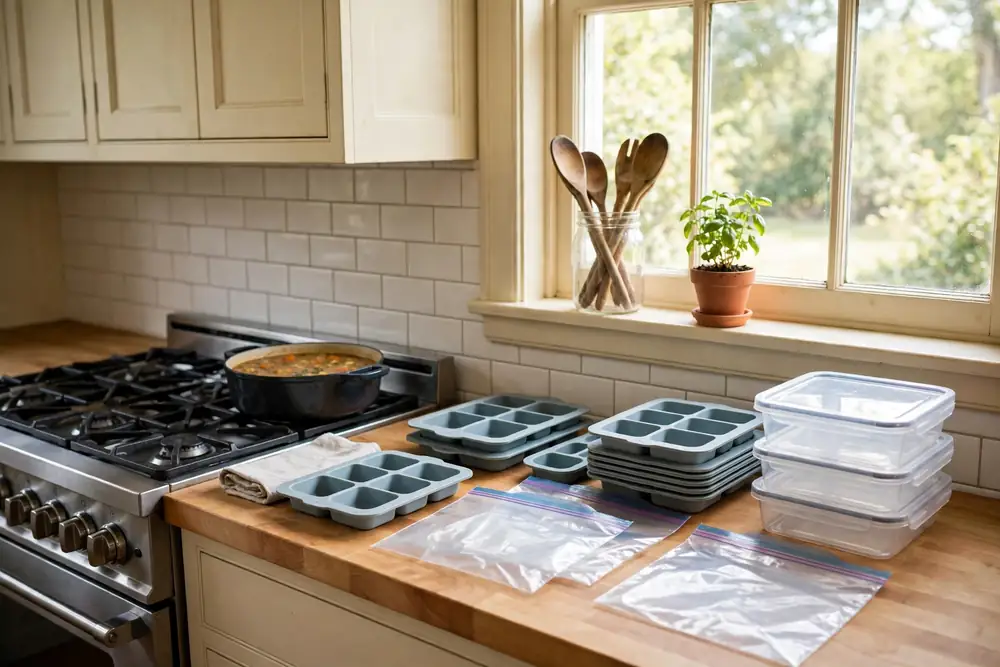
The hardest part of freezer cooking is not the freezing. It is the thawing. A whole pot of soup frozen in one block means thawing the whole pot, even when you only want two bowls. Freeze in one-cup blocks, and dinner is one block in a saucepan, or two, or four, depending on who is home. This tray is the best tool I know for that job.

The rigid containers
Trays freeze portions. Rigid containers freeze meals. A container with a lid that truly seals is the right home for a stew, a curry, or a batch of pulled pork: it holds its shape, it stacks, and it goes straight from the freezer to the microwave.

The bags
Rigid containers are not the whole answer. A freezer full of boxes wastes space, and a thick block of soup thaws slowly. A bag of soup laid flat freezes into a thin slab, stacks like a book, and thaws in a bowl of warm water in minutes. Two kinds of bag cover this job: the disposable one you reach for every day, and the reusable one that replaces it.

The Stasher half gallon bag is the reusable version of the same idea. One bag, used hundreds of times, that freezes flat, goes in the microwave, and goes in the oven up to 425°F. It costs more than a box of disposable bags, and it should: it replaces them.

The batch set
One more rigid set earns a place here, for a different job: fifty identical 16-ounce deli containers with lids, for the days you cook in bulk and need a container for every portion. They are the tubs a deli packs soup in, and they stack so neatly that fifty take up less room than you would think.

Rigid or bag: which one for which job
Rigid containers win for anything you want to reheat in the dish it froze in. A stew in a Brilliance container goes from the freezer to the microwave with the vent open, and you eat from the same container. They also stack in straight columns. The cost is space: they take up the same room full or empty, and a thick block thaws slowly.
Bags win for anything flat: soup, sauce, marinade, berries, blanched vegetables. They stack like books and thaw fast because they are thin. The cost is shape: a bag will not stand up, and a bag of stew is awkward to pour. My rule is simple. Rigid for meals, bags for everything flat. The Souper Cubes trays sit between the two: rigid portions, stored in a bag afterwards.
These are freezer containers, not everyday fridge containers. For the containers that live in the fridge and go to the table, my guide to the best food storage containers covers those.
What causes freezer burn, and how the container stops it
Freezer burn is air reaching the surface of the food. The cold air pulls moisture out, and what is left is a dry, grayish, leathery patch. It is not spoilage: freezer-burned food is still safe to eat, and you can cut the dry patches away, but the texture and flavor in that spot are gone. The cure is keeping air away from the food, and that is a packaging job.
Three things stop it: a lid that seals tight, a bag with the air pressed out before sealing, and a freezer that holds 0°F or colder, where food stays safe indefinitely and loses quality far more slowly. The full method, including what freezes well and what does not, is in my guide to freezing without freezer burn.
What to check before you buy
The seal first. A container is only as good as its lid. Latching lids with a silicone gasket seal best, and they are the only kind I trust with soup in a bag. Snap-on lids are fine for the freezer shelf, as long as you press them down all the way around. For bags, run a finger along the whole zipper before you trust it.
Headroom for liquids. Soup, stew, and sauce expand as they freeze. Leave about half an inch of empty space at the top of a small container, and about an inch in a big one. A container filled to the brim will pop its lid off in the night, and you will find soup frozen to the drawer in the morning.
The flat freeze. If you freeze in bags, freeze them flat on a baking sheet until they set, then stand them upright in the drawer like files. A flat bag freezes faster, thaws faster, and takes up less room than a round lump. Food two inches thick freezes through in about two hours; a thick block takes far longer, and slow freezing makes big ice crystals and mushy texture.
The size. A family of four freezes in three sizes most: one cup for sauce and single portions, two cups for a lunch, and four cups or more for a family meal. The trays cover one cup, the tubs cover two cups, and the big Brilliance container covers the family meal.
The label. Write what it is and the date on every container before it goes in. Masking tape and a marker do the job, and a freezer full of labeled food is a freezer you actually use. I keep the full list of times in my guide to how long food lasts in the freezer, so I know what to use first.
Looking after them
Silicone trays and bags. Dishwasher safe, top or bottom rack. Turn a Stasher bag inside out in the dishwasher, and dry it open, propped on a bottle, or it stays damp inside. A bag that smells after washing needs a soak in hot water with a spoonful of baking soda.
Tritan containers. Top rack only in the dishwasher, lids included. The bottom rack runs hotter, and heat warps plastic lids over time. Keep plastic away from the oven and the stove edge. If a container stains, a paste of baking soda and water left on the stain for an hour lifts most of it.
Deli tubs. Dishwasher safe, but they are light enough to flip over and fill with water. Wash them by hand, which takes seconds. When a tub cracks, let it go. That is what a fifty-pack is for.
Lids, all kinds. Check the silicone gasket on a latching lid now and then. If it is cracked or loose, the seal is gone. And cool food before it goes in the freezer: cooked food belongs in the fridge within two hours of cooking, and into the freezer once it has cooled.
Questions people ask
Can I put food storage containers in the freezer?
Only if they are marked freezer safe. The Rubbermaid Brilliance and Freshware containers on this list are. Cheap thin plastic can crack in the freezer, and glass needs headroom for expansion and must be freezer-safe tempered glass.
Can you freeze soup in Ziploc bags?
Yes. Cool the soup first, fill the bag three-quarters full, press the air out, and freeze it flat. Use freezer bags, not storage bags: the plastic is thicker and the seal is stronger.
How do I stop freezer burn?
Keep air away from the food: press the air out of bags, use lids that seal tight, and keep the freezer at 0°F or colder. Freezer burn is a quality problem, not a safety problem, and dry patches can be cut away.
How long does frozen soup last?
Soups and stews hold their best quality for two to three months at 0°F. They stay safe indefinitely at that temperature, but flavor and texture fade. Label the date, and eat the oldest first.
Are silicone freezer bags safe?
Platinum food-grade silicone is safe for the freezer, microwave, dishwasher, and oven up to its rated limit, 425°F for Stasher. It does not hold smells or crack in the cold. Wash it inside out and dry it open.
What size container do I need for freezing soup?
One cup for a single portion, two cups for a lunch, four cups or more for a family meal. Freezing in the portion you will eat means nothing gets thawed twice, and thawing twice ruins texture.
The bottom line
If you buy one thing, buy the Souper Cubes 1-cup trays. Portion freezing changes how a freezer works: one block for a lunch, four for dinner, nothing thawed twice, nothing wasted.
If you buy a second thing, buy the Rubbermaid Brilliance 10-piece set. It is the rigid container that does the weekly round trip, freezer to microwave to table, with a lid you can trust with soup.
And if you buy nothing, you still have the useful part. Freeze in portions, not blocks. Press the air out of every bag. Leave headroom for soup to expand. Label everything with the date. Keep the freezer at 0°F.