Toaster Oven vs Microwave: Which One Earns Your Counter?
A microwave reheats last night's pasta in ninety seconds. A toaster oven brings back the crisp and bakes a pizza. The real question is which job your kitchen needs most.
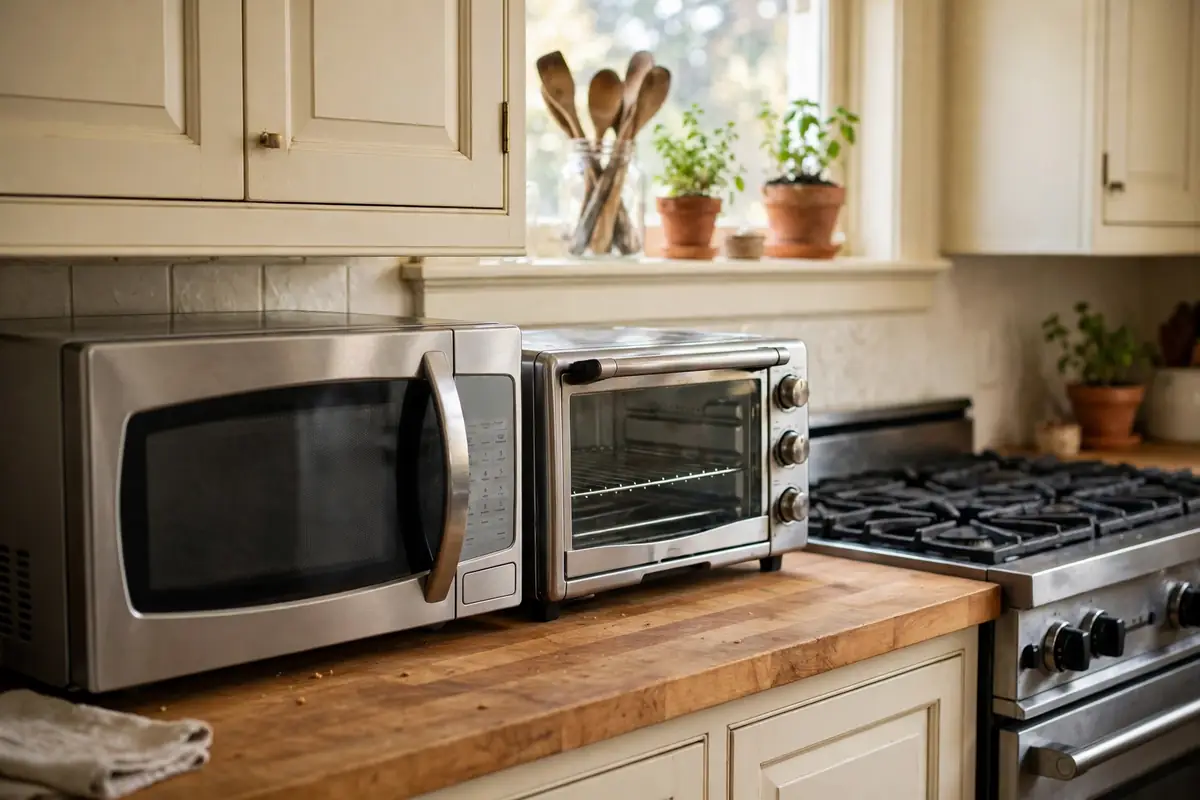
It is six in the evening. There is a container of last night's pasta in the fridge, two hungry children, and about twenty minutes before the evening falls apart. On the counter sit two boxes. One is the microwave, the box that has heated every plate of leftovers in this house for years. The other is the toaster oven, the box with the glass door and the racks inside. The toaster oven vs microwave question is the question of which box you reach for, and whether you need both of them at all.
I cook every day for a family of four, and I own both. The microwave is the one I use when the clock is the problem. The toaster oven is the one I use when the food is the problem. They are not two versions of the same machine. They cook in completely different ways, and that is why this comparison is worth doing properly.
One honest note before we start: this page has affiliate links. If you buy through one, the site may earn a small commission. It costs you nothing, and it never decides what I recommend. Prices I quote were checked on November 18, 2026, and prices move, so check the current price before you buy anything.
The short answer
A microwave heats food from the inside out with waves that excite water molecules. A toaster oven heats food from the outside in with hot air and glowing elements. The microwave wins on speed, and it is not close: ninety seconds against ten minutes. The toaster oven wins on everything that needs crisp, brown, or baked: pizza, roast chicken, toast, a tray of potatoes. Neither one replaces the other. If you have room for one box and dinner is mostly leftovers and quick reheats, keep the microwave. If you cook real meals most nights and you want one box that bakes, roasts, and toasts, buy the toaster oven. If you have room for both, that is the honest answer for a family kitchen, because each one covers the jobs the other cannot do.
What a toaster oven actually is
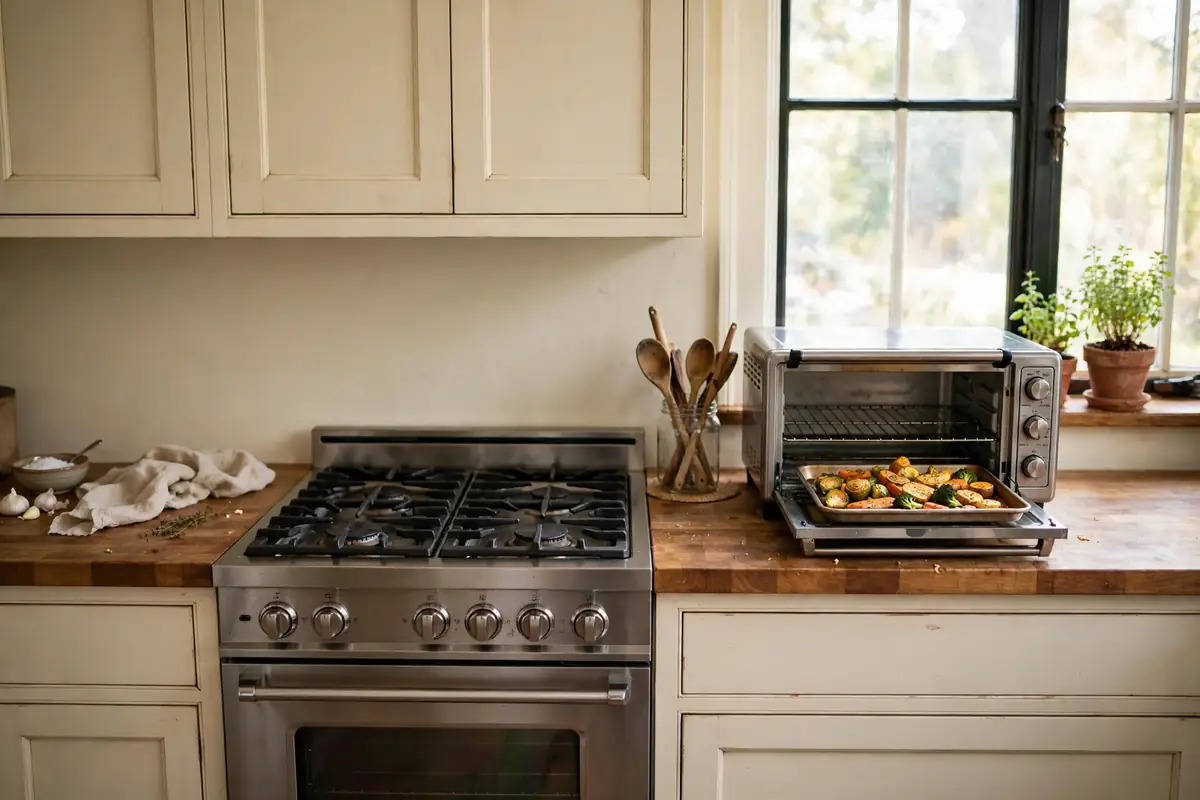
A toaster oven is a small oven that sits on the counter. Heating elements top and bottom warm the air inside, and a fan in the better ones moves that air around the food. The food sits on racks or in pans, behind a glass door. It toasts, bakes, broils, and roasts. It fits a pizza, a tray of chicken, a casserole, or six slices of toast, and it heats in a few minutes where a full oven needs fifteen.
The toaster oven I would buy first is the Breville Smart Oven BOV800XL. It is a 0.8-cubic-foot oven with five quartz elements and a system Breville calls Element IQ, which adjusts the power to each element on its own. Toast gets more heat from the top. Pizza gets more from the bottom. Nine presets cover toast, bagel, bake, roast, broil, pizza, cookies, reheat, and warm. It fits a 13-inch pizza, six slices of bread, or a 6-cup muffin tray, on 1,800 watts. I compared seven ovens in detail in my guide to the best toaster ovens, and the Breville is the one I would hand to anyone buying their first.

Best overall toaster oven
Breville Smart Oven BOV800XL
Five quartz elements with smart heat control that balances the top and bottom for each food. Nine presets, a convection fan, and an interior light. It fits a 13-inch pizza, six slices, or a 6-cup muffin tray, and it browns all of them evenly.
+ Element IQ balances heat top and bottom per food
− About 19 inches wide and 18.7 pounds. It lives on the counter.
| Capacity | 0.8 cu ft (13-inch pizza) |
| Power | 1,800 W |
| Elements | 5 quartz, Element IQ |
| Presets | 9, incl. pizza and cookies |
The toaster oven I would hand to anyone buying their first.
One thing to know about the Breville before you buy it: the inside of the cavity has a non-stick coating. That is fine for normal cooking, and it wipes clean easily. It is not the oven to pick if you want a coating-free interior. The budget pick in this article, the BLACK+DECKER extra-wide, has a zinc-coated stainless steel interior with no nonstick named, and I cover the coating question in full in my guide to are toaster ovens safe.
What a microwave actually is
A microwave is not a small oven. It does not heat the air around the food at all. Inside the box, a part called a magnetron makes electromagnetic waves at a frequency of 2.45 gigahertz. Those waves pass into the food and make the water molecules inside it vibrate. The vibration makes heat. The heat cooks the food from the inside out, which is why a microwaved plate of pasta is hot in the middle before the plate itself is warm.
That is also why a microwave never browns anything. Browning needs a hot, dry surface. A microwave heats the water inside the food, so the surface stays damp. The Maillard reaction, the chemical reaction that browns toast and sears a steak, starts when the surface of the food gets hot enough, above about 280°F. A microwave cannot get a surface that hot and dry. It can only make things hot and wet.
The microwave I would buy first is the Toshiba EM131A5C-BS. It is a 1.2-cubic-foot countertop microwave with 1,000 watts of cooking power and a 12.4-inch turntable, which is wide enough for a dinner plate with room to spare. A smart humidity sensor watches the steam coming off the food and stops the cook when it is done, instead of guessing by time alone. Twelve auto menus cover the everyday jobs: popcorn, potato, pizza, frozen vegetables, beverage, dinner plate, and more. It has a mute function, which matters more than it sounds like it should at six in the morning, and an ECO mode that cuts standby power. It was $149.99 on Amazon as of November 18, 2026.

The microwave I would buy
Toshiba EM131A5C-BS Microwave Oven, 1.2 Cu Ft
A full-size 1.2-cubic-foot cavity with 1,000 watts and a humidity sensor that stops the cook when the food is actually done. Twelve auto menus, a mute button for early mornings, and an ECO mode that cuts standby power.
+ Humidity sensor ends guesswork on reheats
− Like every microwave, it cannot brown or crisp
| Capacity | 1.2 cu ft (12.4-inch turntable) |
| Power | 1,000 W |
| Auto menus | 12, incl. popcorn and potato |
| Extras | Mute function, ECO mode |
The microwave I would buy for a family kitchen.
The thing nobody tells you: they cook in opposite directions
Read the two sections above again and the whole comparison falls into place. A toaster oven heats the outside of the food and the heat works inward. A microwave heats the water inside the food and the heat works outward. That one difference explains every strength and every weakness on this page.
Outside-in cooking dries the surface. A dry surface browns. That is why the toaster oven crisps fries, browns cheese, and toasts bread. Inside-out cooking keeps the surface damp. A damp surface steams. That is why the microwave reheats soup beautifully and turns pizza crust soggy.
Outside-in cooking is slow at the start, because the air and the elements have to get hot first. Inside-out cooking is fast at the start, because the waves start working the moment you press the button. That is the ninety-second gap, and it never closes.
Neither direction is better in the abstract. The question is which direction your dinner needs.
Which one is faster?
The microwave, by a distance that no toaster oven closes. A plate of leftovers takes ninety seconds in the microwave. The same plate takes eight to twelve minutes in a toaster oven, and that is after a few minutes of preheating. A mug of milk takes a minute in the microwave. A toaster oven cannot do it at all without a pan and a wait.
The gap comes from two places. First, preheating. A microwave has no preheat. The waves start the moment you press start. A toaster oven needs a few minutes to heat its cavity, and a full-size oven needs about fifteen. Second, the cook itself. Waves heat the food directly. Hot air has to heat the air, then the surface, then the middle.
There is one toaster oven that closes the gap partway. The Panasonic FlashXpress NB-G110P uses double infrared heat, and it needs no preheating at all. The elements glow the moment you start it, and the food starts cooking straight away. It is the closest a toaster oven gets to microwave speed, and it is the one I would point at if speed is the reason you are keeping your microwave. It was $149.99 on Amazon as of November 18, 2026, the same price as the Toshiba microwave, which makes the comparison honest: same money, one fast at reheating, one fast at everything else.
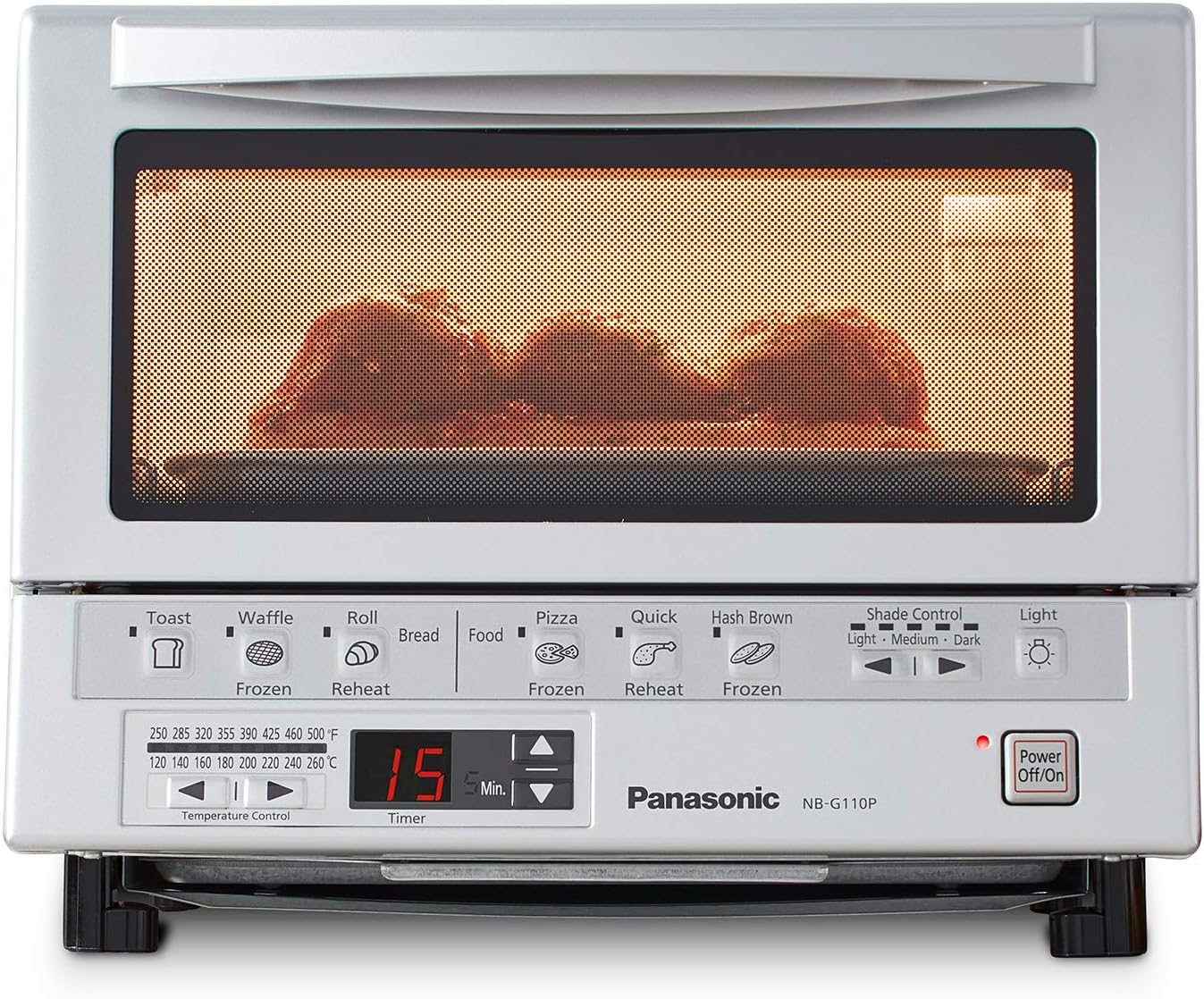
The fastest toaster oven
Panasonic FlashXpress NB-G110P
Double infrared heat with no preheating — the closest a toaster oven gets to microwave speed.
One honest caveat. The FlashXpress is small. It fits four slices of bread or a 9-inch pizza, and its top temperature is 500°F, which is the limit for its nonstick interior. Do not run it empty at maximum. For a family that reheats big plates, the Toshiba still wins on size. For a person who wants the fastest possible toaster oven, the Panasonic is the one.
Are toaster ovens better than microwaves?
For crisp and browning, yes, and it is not a close call. A toaster oven crisps. A microwave cannot. That single fact decides half the meals in a family kitchen.
Take leftover pizza. In the microwave, the cheese melts and the crust goes soft, because the waves heat the water in the dough and the steam has nowhere to go. In a toaster oven, the crust crisps back up in about five minutes at 350°F, and the cheese bubbles under the top element. Same pizza, different meal.
Take frozen fries, chicken nuggets, or roasted vegetables. The toaster oven dries the surface and browns it. The microwave steams them soft. Take a tray of nachos. The toaster oven's broiler browns the cheese in two minutes. The microwave melts it into a damp layer.
One habit matters here, in the toaster oven and in every other hot-air machine. Cook starchy food to golden, not dark brown. The darker the browning, the more acrylamide the food holds, and that is true in an oven, a deep fryer, and an air fryer alike. Light gold and crisp is the target. The microwave never has this problem, because it never browns anything, which is a strange kind of advantage.
For toast, there is no contest at all. The toaster oven toasts. The microwave does not, and never will. Six slices at once in the Breville, with a shade control that keeps them even. If toast is a daily job in your house, that alone is a reason to own the oven. The full toast comparison, oven against the dedicated slot toaster, is in my guide to toaster oven vs toaster.
Reheating quality: the job both boxes claim
Reheating is where most people actually use both machines, so it deserves a straight answer, food by food.
Soup, stew, pasta, rice, and anything wet reheats better in the microwave. The waves heat the water that is already in the food, evenly and fast. A bowl of soup is hot in two minutes. The same soup in a toaster oven needs a covered oven-safe dish, ten minutes, and a stir halfway through. There is no reason to do that.
Pizza, fried chicken, roast potatoes, anything with a crust or a coating reheats better in the toaster oven. The dry heat brings back the crisp the fridge took away. The microwave brings back the heat and takes the crisp away for good.
A whole plate of leftovers, the mixed plate with a bit of everything, is the microwave's job, because it is fast and it heats everything at once. If the plate has one crisp thing on it, a chicken thigh or a slice of garlic bread, pull that piece out and crisp it in the toaster oven while the rest reheats. Two minutes of extra work, and the meal is better.
There is a safety rule that covers both machines, and it is the same rule whatever you reheat in. Leftovers need to reach 165°F all the way through, measured with a food thermometer in the thickest part. A microwave heats unevenly, with hot spots and cold spots, so stir or rotate the food halfway through and let it stand for a minute before you eat it. A toaster oven heats more evenly, but a thick casserole still needs a thermometer check in the middle. Cold spots are where bacteria survive, and the danger zone, 40°F to 140°F, is where they multiply fastest. Food should not sit in that range for more than two hours in total. I wrote the full storage side of this, fridge zones and the two-hour rule, in my guide to how to store food so it lasts longer.
What each one cannot do
A fair comparison needs the gaps on both sides.
The microwave cannot brown, crisp, toast, bake, roast, or broil. It cannot cook a whole chicken. It cannot make a pizza. It cannot melt cheese onto nachos in a way anyone would call good. It cannot cook anything in metal, and foil in a microwave is a fire risk. It cannot heat an empty plate of food evenly without a turntable, and even with one, the edges heat faster than the centre.
The toaster oven cannot reheat a plate of leftovers in ninety seconds. It cannot melt butter in thirty seconds. It cannot steam a bag of vegetables. It cannot defrost a chicken breast in minutes. It cannot warm a baby's bottle or a mug of milk without a pan. It cannot heat soup without a dish, a lid, and ten minutes of patience. It cannot do any of the small, fast, wet jobs that make a microwave the most-used appliance in most kitchens.
Put them side by side and the pattern is clear. The microwave is a reheating machine that cooks a few things. The toaster oven is a cooking machine that reheats a few things. The overlap is smaller than the boxes suggest.
Energy: what each one costs to run
The Toshiba microwave draws 1,000 watts. The Breville toaster oven draws 1,800 watts. A full-size electric oven draws more than both, and it draws it for longer, because of the fifteen-minute preheat and the bigger box to keep hot.
The running cost of a single job is tiny in either machine, and the maths is simple. The average US residential electricity price was 18.16 cents per kilowatt-hour in August 2026. A ninety-second microwave reheat uses about 0.025 kilowatt-hours, which costs less than half a cent. A ten-minute toaster oven reheat uses about 0.3 kilowatt-hours, which costs around five cents. A twenty-minute toaster oven cook costs around eleven cents.
Over a year, the microwave is the cheaper machine to run, because its jobs are so short. Over a single meal, the toaster oven is the cheaper machine to run than the full-size oven, because it heats a small box instead of a big one and it skips the fifteen-minute preheat. Neither machine will show up on your electricity bill in a way you can see. If energy is the deciding factor, the real comparison is each machine against the full-size oven, and both of them win that one easily.
One practical note. An 1,800-watt oven on the same circuit as a kettle will trip the breaker. A standard kitchen circuit supplies about 1,800 watts. Give the big machines their own outlet, and do not run the oven and the kettle together. The microwave has the same rule: a 1,000-watt microwave plus a kettle on one circuit is asking for a dark kitchen.
Toaster oven vs microwave health
This is the section people worry about most, so here it is plainly.
Microwave radiation is non-ionizing radiation, the same family as radio waves and the light from a lamp. It has enough energy to make water molecules vibrate, which is how it heats food. It does not have enough energy to knock electrons off atoms, which is what ionizing radiation like X-rays does. Food cooked in a microwave does not become radioactive. The waves turn into heat as the food absorbs them, and the heat is the only thing left.
Federal law limits how much microwave energy can leak from an oven: no more than 5 milliwatts per square centimeter, measured about two inches from the surface, for the whole working life of the oven. An oven in good repair, with a clean door seal and a latch that clicks shut, leaks far less than that. The real microwave risks are not radiation at all. They are burns from food that comes out hotter than it looks, water heated past boiling that erupts when you stir it, and cold spots in unevenly heated food. Those are the hazards worth your attention.
The toaster oven has no radiation question, because it does not use radiation to cook. Its heat comes from glowing elements and, in the Panasonic, infrared. The real toaster oven risks are different: a crumb tray full of crumbs is a fire risk, the outside of the box gets hot enough to burn a hand, and a nonstick interior taken past 500°F starts to break down. I worked through the fire, coating, and radiation questions in full, including whether a toaster oven is safer than a microwave, in my guide to are toaster ovens safe.
On nutrients, the microwave holds up well. Short cooking times and little added water keep more vitamins in the food than long boiling does. A toaster oven cooks longer and drier, which is the price of the crisp. Neither machine is a health risk when it is used the way it is meant to be used. The honest summary is that the radiation worry about microwaves is a myth, and the fire worry about toaster ovens is real but small and easy to manage: empty the crumb tray, keep the box clear of the wall, and never leave it running while you leave the house.
Counter space and weight
Both machines want a permanent home on the counter, and together they take a lot of it.
The Toshiba microwave is a 1.2-cubic-foot box, roughly 20 inches wide and 17 inches deep. It is heavy enough that you will not lift it into a cupboard every night. It needs a few inches of clear space around it for ventilation, and the door swings open to the side, so plan for the swing.
The Breville is a piece of furniture. It measures about 19 inches wide, 14 inches deep, and 14 inches tall, and it weighs 18.7 pounds. It vents hot air, so it needs clearance above and behind it, and it is not a machine you lift in and out of a cupboard.
Two boxes side by side take about three feet of counter. In a small kitchen, that is the whole workspace. If counter space is the deciding factor, you have three honest options. Keep the microwave and skip the toaster oven. Keep a compact toaster oven like the Panasonic, which is 13 inches wide and 7.5 pounds, and skip the microwave. Or put one of them on a sturdy cart or a shelf, and accept the walk across the kitchen.
Measure your counter before you buy either machine, in three directions, and measure the space under the cabinets too. A machine that does not fit is a machine that lives in a cupboard, and a machine in a cupboard does not get used.
Cost
The Toshiba microwave was $149.99 on Amazon as of November 18, 2026. The Panasonic FlashXpress was $149.99 the same day. The BLACK+DECKER extra-wide 8-slice toaster oven was $86.87 as of November 18, 2026, which makes it the cheapest way into a good toaster oven on this page, and it is the one I would buy if the budget is tight: 1,500 watts, a convection fan, three rack positions, and room for a 12-inch pizza and a 9-by-13 pan with handles.

Best value toaster oven
BLACK+DECKER TO3250XSB 8-Slice Extra Wide
Eight slices, a 12-inch pizza, and a 9-by-13 pan, with a convection fan and a stainless interior.
I am not quoting a price for the Breville, because I could not verify a current one on the day I wrote this, and a stale or guessed price is worse than no price. Check the listing before you buy.
Over time, the microwave is the cheaper machine to run, because its jobs are so short. The toaster oven can be the cheaper machine to own, if it replaces a toaster and takes over the jobs your full oven used to do for small meals. Neither machine is a big running cost. If the budget decides it, my guide to the best toaster ovens under $100 covers the ones worth buying at that price.
Can a toaster oven replace a microwave?
This is the question behind the whole comparison, and it deserves a full answer, because a lot of kitchens are asking it right now. The short version is yes, mostly, with real losses. Here is the long version.
What you lose
The first loss is speed, and it is the biggest one. A plate of leftovers goes from ninety seconds to ten minutes. That is not a small change. It is the difference between dinner on the table before the children melt down and dinner ten minutes late. If your household reheats leftovers most nights, the microwave earns its counter every single day, and no toaster oven replaces that.
The second loss is the small fast jobs. Melting butter takes thirty seconds in a microwave and a pan on the stove otherwise. Warming a mug of milk takes a minute. Steaming a bag of frozen vegetables takes four minutes in the microwave and a pot of boiling water otherwise. Defrosting a chicken breast takes minutes in the microwave and hours in the fridge otherwise. Popcorn takes two minutes. None of these jobs is hard without a microwave. All of them are slower, and the slowness adds up across a week.
The third loss is convenience for one person. A single plate of leftovers for one person is the microwave's perfect job. Heating a whole toaster oven for one plate feels wasteful, and it is: more energy, more time, more washing up, for the same plate of pasta.
The fourth loss is the jobs a toaster oven simply cannot do. It cannot heat soup in a bowl. It cannot warm a baby's bottle. It cannot soften cream cheese in thirty seconds. It cannot do any job where the food has to stay in the container it came in.
What you gain
The first gain is crisp. Everything that comes out of a toaster oven has a texture the microwave cannot make. Pizza crust that snaps. Chicken skin that crackles. Roast potatoes with browned edges. Toast. If you eat a lot of food that should be crisp, the toaster oven changes the meal, not just the temperature.
The second gain is range. A toaster oven bakes, roasts, broils, and toasts. It cooks a whole chicken, bakes a tray of cookies, roasts a pan of vegetables, and broils the cheese on a casserole. A microwave does none of those things. Replacing the microwave with a toaster oven trades a reheating machine for a cooking machine, and the kitchen gains a second oven in the deal.
The third gain is counter space, if you go from two boxes to one. One box instead of two frees about a foot and a half of counter. In a small kitchen, that is real workspace back.
The fourth gain is the end of the radiation worry, for anyone who has it. A toaster oven does not use microwaves at all. The worry is a myth, as I wrote above, but if the worry is yours, the toaster oven ends it.
The honest verdict on replacing
If you reheat leftovers more than three nights a week, do not replace the microwave. Keep it, and add a toaster oven beside it if you have the counter. If you cook fresh meals most nights and you reheat leftovers once a week or less, a toaster oven can replace the microwave, and you will not miss it much. If you are somewhere in between, the Panasonic FlashXpress is the compromise: no preheat, infrared speed, and it crisps, which makes the loss of the microwave smaller than with any other toaster oven.
Best toaster oven to replace a microwave
If you have decided to replace the microwave, buy for speed first, because speed is what you are giving up.
The Panasonic FlashXpress NB-G110P is the best toaster oven to replace a microwave. No preheat, infrared elements that start cooking the moment you press the button, six presets, and a 13-inch footprint that fits where the microwave used to sit. It is small, so it will not roast a chicken or bake a 9-by-13 casserole, but as a microwave replacement it is the closest thing to the speed you are used to.
Best toaster oven to replace a microwave
Panasonic FlashXpress NB-G110P
No preheat, infrared speed, and it crisps — the smallest loss of speed of any toaster oven.
If you want the replacement to also be your second oven, buy the Breville Smart Oven BOV800XL instead. It is slower to start, but it does everything: pizza, roast chicken, six slices of toast, a tray of cookies. It replaces the microwave and the toaster and half the full-size oven in one box.
The second oven
Breville Smart Oven BOV800XL
Pizza, roast chicken, six slices of toast, and a tray of cookies — it replaces the microwave, the toaster, and half the full-size oven.
If the budget is tight, the BLACK+DECKER TO3250XSB does the same job for $86.87 as of November 18, 2026, with a convection fan and room for eight slices. It is the best value replacement on this page, and its stainless interior has no nonstick coating to worry about.
Best value replacement
BLACK+DECKER TO3250XSB 8-Slice Extra Wide
The same job with a convection fan and room for eight slices, and a stainless interior with no nonstick coating to worry about.
Microwave vs toaster oven: what about a full-size oven?
Most people who search this question already own a big built-in oven, so here is that answer too.
Both machines beat a full-size oven for small meals. No fifteen-minute preheat. Less energy, because they heat a small box instead of a big one. Less heat dumped into the kitchen, which matters in summer. A single tray of fries or a plate of leftovers has no business in a full-size oven.
The full-size oven wins for big meals, baking, and anything that needs more than one tray. A turkey, a double batch of cookies, three dishes at once for a holiday dinner. A conventional oven, the kind without a fan, cooks slower and less evenly than either machine on this page, with hot spots near the element and cool corners. If your big oven has a convection setting, use it. The convection question, fan against no fan, is the same one I worked through in my guide to toaster oven vs convection oven.
The honest summary: neither machine replaces your oven. Each one replaces the habit of heating your oven for a small meal. The oven stays for the big jobs. The microwave takes the fast jobs. The toaster oven takes the crisp jobs.
Toaster oven vs microwave side by side
| Breville BOV800XL Toaster Oven | Toshiba EM131A5C-BS Microwave | |
|---|---|---|
| How it cooks | Heating elements + fan, hot air | Microwaves excite water inside food |
| Power | 1,800 W | 1,000 W |
| Capacity | 0.8 cu ft (13-inch pizza) | 1.2 cu ft (12.4-inch turntable) |
| Preheat | A few minutes | None |
| Reheat a plate | 8–12 minutes | 90 seconds |
| Toasts | Yes, six slices at once | No |
| Crisps and browns | Yes | No |
| Bakes and roasts | Yes | No |
| Defrosts | No | Yes |
| Best for | Pizza, roast chicken, toast, baking | Leftovers, soup, melting, steaming |
| Biggest weakness | Slow to start, heavy, needs a permanent home | Cannot brown or crisp anything |
| Check on Amazon | Check on Amazon | Check on Amazon |
Which one for which job
Reheating leftovers: the microwave. Ninety seconds, one button, dinner on the table. Toshiba EM131A5C-BS Microwave Oven
Leftover pizza: the toaster oven. Five minutes at 350°F brings the crust back. The microwave kills it. Breville Smart Oven BOV800XL
Soup, stew, and pasta: the microwave. Wet food is what waves do best. Toshiba EM131A5C-BS Microwave Oven
Toast and bagels: the toaster oven. Six slices at once, with a shade control that keeps them even. The microwave does not toast. Breville Smart Oven BOV800XL
Frozen fries, nuggets, and wings: the toaster oven. Dry heat crisps them. The microwave steams them soft. Breville Smart Oven BOV800XL
Melting butter, warming milk, softening cream cheese: the microwave. Thirty seconds, no pan to wash. Toshiba EM131A5C-BS Microwave Oven
Defrosting: the microwave. Minutes instead of hours in the fridge. Toshiba EM131A5C-BS Microwave Oven
A whole roast chicken: the toaster oven. The bird needs room and dry heat, and the oven has racks for the sides alongside it. Breville Smart Oven BOV800XL
Pizza night: the toaster oven. A 13-inch pizza fits, with a pizza preset and a broiler to brown the cheese. Breville Smart Oven BOV800XL
Baking and casseroles: the toaster oven. A 9-by-13 pan, even heat across a tray, and a real bake setting. Breville Smart Oven BOV800XL
One appliance, small kitchen: the microwave, if you reheat most nights. The toaster oven, if you cook fresh most nights. The Panasonic FlashXpress splits the difference, because it needs no preheat and it crisps. Panasonic FlashXpress NB-G110P
One appliance, tight budget: the BLACK+DECKER extra-wide toaster oven. It toasts, bakes, roasts, and crisps, for $86.87 as of November 18, 2026. BLACK+DECKER TO3250XSB 8-Slice Extra Wide Convection Toaster Oven
Buying tips
Measure the counter before you buy either machine, in three directions. The Breville is about 19 inches wide. The Toshiba microwave is about 20 inches wide. Both need a few inches of air around them. A machine that does not fit is a machine that lives in a cupboard, and a machine in a cupboard does not get used.
Check the circuit. An 1,800-watt oven and a 1,000-watt microwave both want their own outlet. Do not run either on a power strip shared with a kettle.
Check the wattage on a microwave before you buy it. A 1,000-watt microwave reheats noticeably faster than a 700-watt one, and the cooking times on frozen food packaging assume at least 1,000 watts. A low-wattage microwave is a false saving.
Check the model number before you buy, new or second hand. Both kinds of machine have been recalled, and the recall is always tied to a specific model number, not a brand. Oster recalled its French Door toaster ovens in 2025, and Panasonic recalled one FlashXpress model in 2026. I cover both in my guide to are toaster ovens safe.
Check the coating on the toaster oven interior. Most are PTFE nonstick or ceramic-coated. PTFE is fine below 500°F and starts to break down above it, so never run a nonstick oven empty at maximum. If the coating matters to you, pick a stainless interior like the BLACK+DECKER extra-wide.
Buy the size for Tuesday, not Christmas. The biggest dinner happens twice a year. Tuesday happens every week. Size the machine to the meal you cook most often.
If you are choosing between the two boxes and you already own an air fryer, read my guide to toaster oven vs air fryer before you buy. An air fryer covers some of the toaster oven's crisping jobs, and it changes the maths on which box earns your counter.
Care cheat sheet
Microwave: wipe the inside after every use, while the splatter is still soft. A bowl of water with a squeeze of lemon, heated for two minutes, loosens anything baked on. Wipe the door seal clean, because a dirty seal is what lets a door close badly. Never put metal or foil inside. Never run it empty. Replace it if the door does not latch firmly or the seal is damaged.
Toaster oven: empty the crumb tray often, because a full tray is the fire risk. Wipe the interior while it is still warm, not hot. Wipe the glass door so you can see the food browning. Never cover the whole rack with foil, or the air cannot circulate. Skip the aerosol spray in both machines. Spray oils leave a residue that bakes onto coatings and glass and will not come off.
Both: let the machine cool before you clean it. Unplug it when you are done. Register the appliance with the maker when you buy it, so a recall notice reaches you.
Questions people ask
Are toaster ovens better than microwaves?
For crisp, brown, and baked food, yes. For speed, no. A toaster oven crisps and bakes. A microwave reheats in ninety seconds. The better machine is the one that fits the meals you cook most often.
Can a toaster oven replace a microwave?
Mostly, with real losses. You lose ninety-second reheats, melting butter, steaming vegetables, and defrosting. You gain crisp, browning, baking, roasting, and toast. If you reheat leftovers more than three nights a week, keep the microwave.
Can a toaster oven be used as a microwave?
No, not literally. A toaster oven heats with hot air and elements. It cannot do the microwave's fast, wet jobs: soup in a bowl, a mug of milk, a bag of frozen vegetables. It reheats food, but it reheats it the oven way, in ten minutes instead of ninety seconds.
Is a toaster oven healthier than a microwave?
Neither machine is a health risk when used properly. Microwave radiation is non-ionizing, it does not make food radioactive, and federal law caps leakage far below the level that could harm anyone. A toaster oven has no radiation question, but it has a real fire risk from a full crumb tray and a coating risk above 500°F.
Which uses less electricity?
The microwave, per job. A ninety-second reheat costs less than half a cent at the average US residential price. A ten-minute toaster oven reheat costs around five cents. For a big meal, the toaster oven uses less than a full-size oven.
Can you cook a whole chicken in a microwave?
You can, and you should not. The waves heat unevenly, the skin never browns, and a thick bird is hard to bring to a safe temperature all the way through. A whole chicken belongs in the toaster oven, on a rack with room around it.
Do I need both?
Most family kitchens do, honestly. The microwave takes the fast jobs. The toaster oven takes the crisp jobs. If you have room for one box, pick the one that fits the meals you cook most often, and let the other one wait.
Microwave vs toaster oven: which one should I buy first?
If you reheat leftovers most nights, buy the microwave first. If you cook fresh meals most nights and you want one box that bakes, roasts, and toasts, buy the toaster oven first. Either way, the second box is worth adding when you have the counter for it.
The bottom line
If you buy one machine, buy the one that fits the meals you cook most often. If the clock is the problem in your kitchen and dinner is mostly leftovers, buy the microwave. The Toshiba EM131A5C-BS Microwave Oven is the one I would buy first: 1.2 cubic feet, 1,000 watts, a humidity sensor that stops guessing, and a mute button for early mornings.
If the food is the problem in your kitchen and you want crisp, brown, and baked, buy the toaster oven instead. The Breville Smart Oven BOV800XL fits a pizza and a whole chicken, toasts six slices, and does the jobs the microwave cannot reach.
And if you already own one of them, you do not have a problem. You have half the system. The microwave takes the fast jobs. The toaster oven takes the crisp jobs. If the budget is tight, the BLACK+DECKER TO3250XSB covers the toaster oven half for $86.87 as of November 18, 2026, and the Panasonic FlashXpress NB-G110P is the fastest toaster oven on this page if speed is what you are giving up. Start with the box that fits Tuesday dinner, and add the other one when you have the counter.