Toaster Oven vs Convection Oven: Energy, Size, and Cost
The small oven heats in minutes and costs about half as much per meal. The big oven fits the turkey and three trays at once. Here is when each one earns its place.
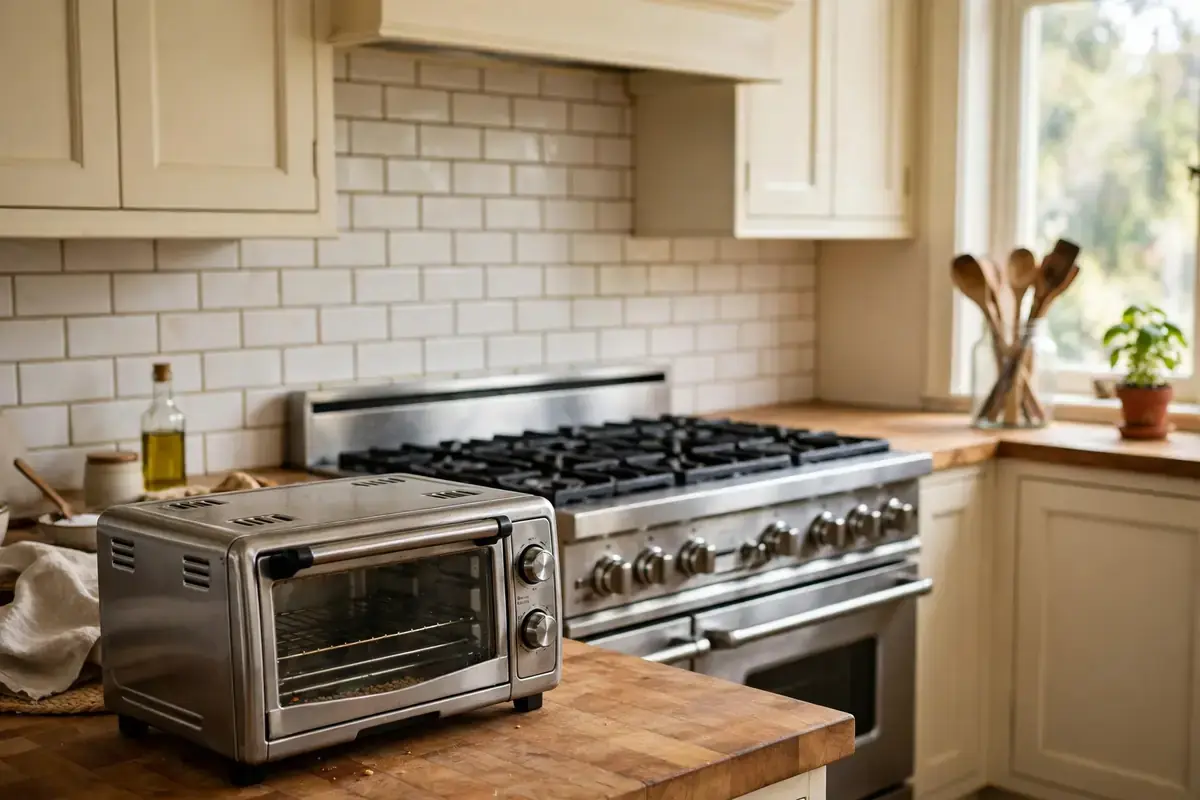
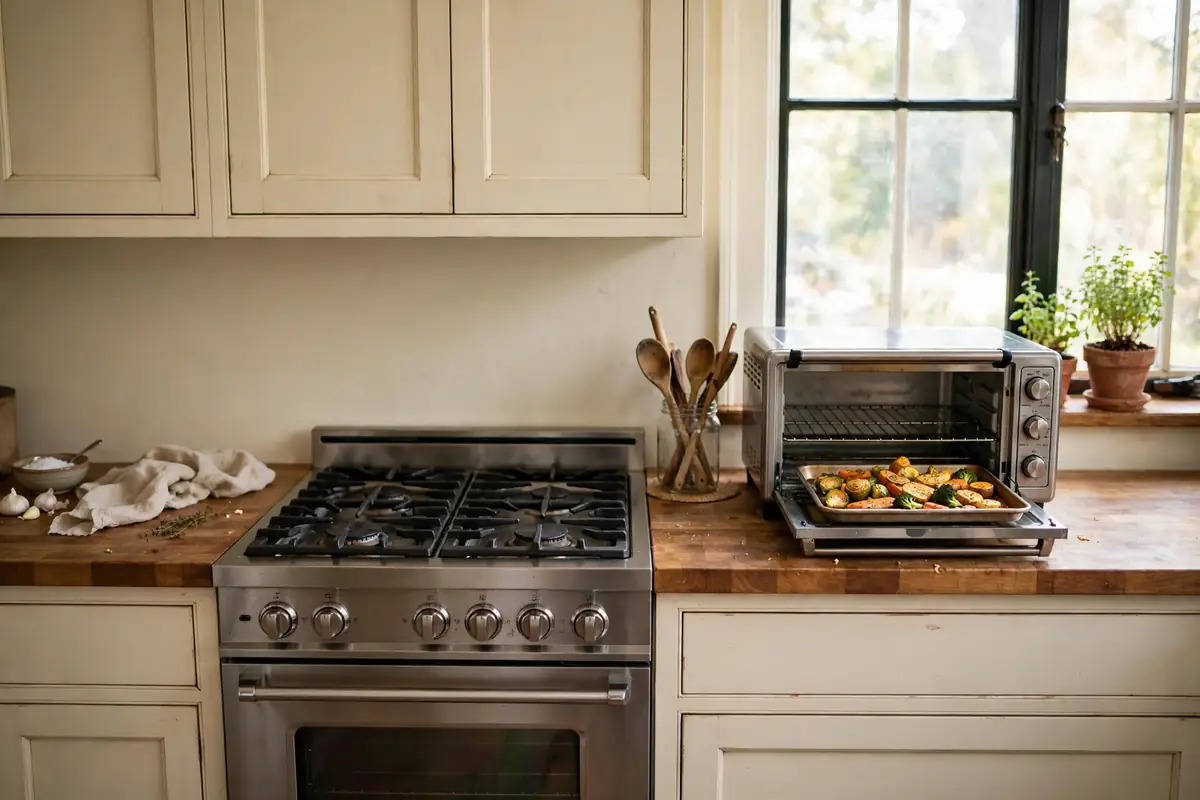
It is five o'clock and dinner is two chicken thighs. Not a tray of thighs. Two. One for you, one for whoever is home tonight, with a few potatoes alongside. You look at the big oven under the stove and you look at the small oven on the counter, and the question answers itself before you ask it: why would you heat a five-cubic-foot box for two thighs? The toaster oven vs convection oven question starts exactly here, in that moment of standing in front of two ovens and knowing one of them is far too much machine for the meal in your hand.
I cook every day for a family of four, and I have done this sum hundreds of times. Most nights, the meal is small. A couple of thighs, a tray of vegetables, four chicken breasts, a pizza. The big oven handles all of it, but it asks for fifteen minutes of preheating first, and it heats the whole kitchen while it works. The small oven is ready in a few minutes and uses about half the electricity for the same meal. But the small oven cannot fit a turkey, and it cannot bake three trays of cookies at once, and on the nights when the meal is big, the big oven is the only machine that does the job.
This page is about that trade. Not about which oven is better in general. About which one fits the meal in front of you, what each one costs to run, and where the small oven stops being enough.
One honest note before we start: this page has affiliate links. If you buy through one, the site may earn a small commission. It costs you nothing, and it never decides what I recommend. Prices I quote were checked on November 18, 2026, and prices move, so check the current price before you buy anything.
The short answer
A toaster oven and a convection oven cook the same way: heating elements warm the air, and a fan moves it around the food. The difference is the size of the box. The toaster oven heats in a few minutes, costs about half as much electricity per small meal, and keeps the kitchen cooler. The full-size convection oven holds far more food, fits tall roasts and multiple trays, and bakes more evenly across a big batch. For one to four people on a weeknight, the toaster oven wins. For a crowd, a holiday, or a baking day, the big oven wins. Most kitchens end up keeping both, because they answer different meals.
What a toaster oven actually is
A toaster oven is a small oven that sits on the counter. Heating elements top and bottom warm the air inside, and a fan in the better ones moves that air around the food. The food sits on racks or in pans, behind a glass door. It toasts, bakes, broils, and roasts. It fits a pizza, a tray of chicken, a casserole, or six slices of toast, and it heats in a few minutes where a full oven needs fifteen.
The size is the whole point. A good toaster oven holds about 0.8 cubic feet, which is roughly a sixth of a full oven. That small box is why it heats fast, why it uses less electricity, and why it cannot fit a turkey. Everything in this comparison follows from that one fact.
The toaster oven I would buy first is the Breville Smart Oven BOV800XL. It is a 0.8-cubic-foot oven with five quartz elements and a system Breville calls Element IQ, which adjusts the power to each element on its own. Toast gets more heat from the top. Pizza gets more from the bottom. Nine presets cover toast, bagel, bake, roast, broil, pizza, cookies, reheat, and warm. It fits a 13-inch pizza, six slices of bread, or a 6-cup muffin tray, on 1,800 watts. The cavity has a non-stick coating, which wipes clean easily. I compared seven ovens in detail in my guide to the best toaster ovens, and the Breville is the one I would hand to anyone buying their first.

Best overall toaster oven
Breville Smart Oven BOV800XL
Five quartz elements with smart heat control that balances the top and bottom for each food. Nine presets, a convection fan, and an interior light. It fits a 13-inch pizza, six slices, or a 6-cup muffin tray, and it browns all of them evenly.
+ Element IQ balances heat top and bottom per food
− About 19 inches wide and 18.7 pounds. It lives on the counter.
| Capacity | 0.8 cu ft (13-inch pizza) |
| Power | 1,800 W |
| Elements | 5 quartz, Element IQ |
| Presets | 9, incl. pizza and cookies |
I could not verify a current price on the day I wrote this. Check the listing before you buy.
What a convection oven actually is
A convection oven is an oven with a fan. The heating elements warm the air, and the fan moves it around the food instead of letting it sit still. That moving air cooks faster and more evenly than still air, because it keeps carrying heat to the surface of the food instead of letting a cool layer sit there.
One thing to clear up before we go further, because the words cause half the confusion on this page. When I say "convection oven" here, I mean the full-size oven in your range, the big built-in box under the stove, with a fan. Most modern full-size ovens are convection ovens. If your range has a fan setting, that is what you own. The comparison on this page is the small countertop oven against the big built-in oven. Same cooking, different size.
A standard 30-inch range holds about 5 cubic feet of oven space, usually between 4.5 and 5.8 cubic feet depending on the model. That is roughly six times the space inside a toaster oven. It has two or three racks, room for a turkey, and a bake element that typically draws around 2,400 watts, with most bake elements rated between 2,000 and 3,000 watts. The broil element draws more, often 3,000 to 4,000 watts. The oven runs on 240 volts, on its own circuit, which is why it can pull that much power without tripping anything.
The fan is what makes it a convection oven rather than a conventional one. Without the fan, hot air rises and sits in layers, hotter near the top, cooler near the bottom, with hot spots near the element. With the fan, the air mixes, the temperature evens out, and food cooks about 25 percent faster or at 25 degrees lower. That is the whole trick, and it is the same trick the toaster oven uses.
Does a toaster oven work the same as an oven?
Yes. This is the part nobody tells you, and it is the key to the whole comparison. A toaster oven and a full-size convection oven are the same kind of machine in two sizes. Both have heating elements. Both have a fan. Both cook food by moving hot air around it. The toaster oven is not a different kind of cooking. It is the same kind of cooking in a smaller box.
That means your recipes do not change. A casserole that bakes at 375°F in the big oven bakes at 375°F in the toaster oven. A roast chicken cooks the same way, with the same temperatures and the same resting time. The only thing that changes is how much food fits and how long the oven takes to get hot.
If you have already read my comparison of a basket air fryer against a full oven, this page is a different argument. That one was about air fryer vs convection oven, a small basket machine with a very fast fan against the big oven. This page is about a small oven with racks and trays against the big oven. The basket fryer crisps faster than either oven, because its fan is faster and the food sits closer to the heat. The toaster oven does not crisp faster than the big oven. It cooks the same way, in less space, with less waiting. If your question is really about crisping, read the air fryer comparison. If your question is about whether the small oven on your counter can do the big oven's job, you are in the right place.
There is one real difference in how they cook, and it is about distance. In a toaster oven, the food sits closer to the heating elements, because the box is small. That means the top of a tall dish can brown faster than the middle cooks, and a dish that rises, like a souffle or a tall loaf, can get too close to the top element. In the big oven, the food sits further from the heat, which is gentler on tall and delicate food. It is a small difference, and it only matters for a few dishes, but it is the one place where the cooking itself is not identical.
How long does each one take to heat up?
Preheating is where the toaster oven wins its biggest, most obvious victory, and it is the reason the small oven gets used every night in my kitchen.
A toaster oven heats in a few minutes. The box is small, the air inside is small, and the elements bring it to temperature fast. By the time you have seasoned the chicken and washed your hands, the oven is ready. Some toaster ovens skip preheating almost entirely for toast and short cooks. The Panasonic FlashXpress, which uses infrared heat, needs no preheating at all.
A full-size oven needs about fifteen minutes to reach temperature, sometimes ten, sometimes more, depending on the model and the temperature you set. That is fifteen minutes of waiting before the food even goes in. Fifteen minutes of the bake element running at full power, heating five cubic feet of air and a heavy steel box, for a meal that might only take twenty minutes to cook.
That waiting time changes how you cook. On a weeknight, fifteen minutes of preheating is the difference between cooking dinner and ordering it. It is the difference between roasting vegetables and boiling pasta. The toaster oven removes the waiting, and removing the waiting is what makes home cooking happen on a Tuesday.
There is a second time saving too, and it is easy to miss. The big oven stays hot long after dinner. You cannot clean it, you cannot put anything away, and the kitchen stays warm for an hour. The toaster oven cools down fast, because there is less of it to cool. Dinner is over, the oven is cool, and the kitchen is yours again.
Are toaster ovens more efficient than ovens?
Yes, for small meals, and the gap is bigger than most people expect. This is the heart of the comparison, so here is the maths, worked out in full, with nothing hidden.
First, the two numbers you need. Watts tell you how fast an appliance uses electricity. A kilowatt-hour tells you how much it used. One kilowatt-hour is 1,000 watts running for one hour. Your electricity bill charges you per kilowatt-hour, and the US average residential price is 18.16 cents per kilowatt-hour, the latest published figure when I wrote this. Your own rate will be different. Check your bill for the exact number. The comparison below still holds, because the two ovens pay the same rate.
A toaster oven draws 1,400 to 1,800 watts, depending on the model. The ones I recommend run at 1,500 or 1,800 watts. A full-size electric oven draws more, around 2,400 watts for the bake element, and it draws it for longer, because of the preheat and the bigger box to keep hot. So the small oven uses less power and runs for less time. Both advantages point the same way.
The maths for one meal
Take the meal from the top of this page: two chicken thighs, twenty minutes at 400°F.
The toaster oven heats for about three minutes, then cooks for twenty. At 1,500 watts, the preheat uses about 0.08 kilowatt-hours and the cook uses about 0.5 kilowatt-hours. Call it roughly 0.6 kilowatt-hours in total. At 18.16 cents per kilowatt-hour, that meal costs about 10 cents in electricity.
The full oven heats for fifteen minutes at full power, then cooks for twenty minutes with the element cycling on and off to hold temperature. The preheat alone uses about 0.6 kilowatt-hours, about 11 cents. The cook adds about 0.4 kilowatt-hours, about 7 cents, because the element only runs about half the time once the oven is hot. The total is about 1.0 kilowatt-hour, about 18 cents.
Read that again, because it is the most useful number on this page. The preheat alone in the big oven costs more than the entire meal in the toaster oven. Eleven cents before the food goes in, against ten cents for the whole cook. Every time you heat the big oven for a small meal, you pay a preheat tax, and the tax is bigger than the meal.
Toaster oven vs oven electric usage, in one table
| Toaster oven | Full-size convection oven | |
|---|---|---|
| Power while heating | 1,500 W | About 2,400 W |
| Preheat time | About 3 minutes | About 15 minutes |
| Energy to preheat | About 0.08 kWh | About 0.6 kWh |
| Energy for a 20-minute meal | About 0.6 kWh | About 1.0 kWh |
| Cost per small meal | About 10 cents | About 18 cents |
These are estimates, not laboratory measurements, and your oven will differ. The preheat time, the wattage, and your electricity rate all move the numbers. But the shape of the answer does not move. The small oven uses roughly half the electricity of the big oven for a small meal, and most of the gap is the preheat.
What it adds up to over a year
One meal saves about 8 cents. That sounds like nothing, and on its own, it is. But small meals happen most nights.
If you cook four small meals a week in the toaster oven instead of the big oven, you save about 32 cents a week. Over a year, that is about $17. If you cook five small meals a week that way, it is about $21 a year. If your electricity rate is higher than the national average, and many rates are, the saving is bigger. In a state where electricity costs 30 cents per kilowatt-hour, the same habit saves about $28 a year.
I will be honest with you: $17 a year is not the reason to buy a toaster oven. It is real money, and it adds up over the life of the machine, but it will not change your budget. The reasons to buy one are time and comfort. Dinner is ready fifteen minutes sooner, and the kitchen stays cool. The electricity saving is a bonus, not the argument.
The longer the cook, the smaller the gap. For an hour-long roast, the big oven uses about 2 kilowatt-hours, about 36 cents, for the whole hour of baking. A toaster oven at 1,500 watts could not use more than 1.5 kilowatt-hours in an hour even if it ran at full power the whole time, which it does not, so the ceiling is about 27 cents, and the real number is lower. The small oven still wins, but the preheat matters less when the cook is long, because the preheat is a smaller share of the total.
And there is a point where the advantage flips entirely. If the meal fills the big oven, one long cook in the big oven uses less electricity than two batches in the small one. A full tray of roasted vegetables, a double batch of cookies, a turkey with sides: the big oven cooks it all at once, and the toaster oven would need two or three rounds. When the meal is big, the big oven is the efficient one. Size decides efficiency, not the name on the box.
One more note, for gas ovens. The maths above is for electric ovens. If your big oven runs on gas, the electricity numbers do not apply, and you would need your gas rate to work out the cost. The time argument still holds, and the kitchen-heat argument still holds. A gas oven still needs fifteen minutes to preheat, and it still dumps its heat into the kitchen.
I worked through the same kind of maths for the air fryer in my guide to are air fryers worth it. The pattern is the same there. Small box, short preheat, less electricity per small meal. The air fryer wins by even more, because its box is smaller still and its fan is faster. But the toaster oven is the one that toasts, bakes, and roasts a whole chicken, which the basket cannot do.
How much food fits in each one?
This is the section that decides the purchase for most families, so here it is plainly.
The Breville holds a 13-inch pizza, a 9-by-13 baking pan, six slices of toast, or a 6-cup muffin tray. That is dinner for four, in one go, as long as the meal is one thing. A main and a side can cook together on two racks. A whole chicken fits, if it is not a large one. The bigger toaster ovens hold more. The Hamilton Beach 31103DA fits two 12-inch pizzas at once, or two 9-by-13 casseroles, and its rotisserie takes a 5-pound chicken. That is the closest a countertop oven comes to a second full oven.
The full-size oven holds about 5 cubic feet, roughly six times the Breville. It fits a turkey, three trays of cookies at once, a casserole and a roast side by side, or a full sheet pan. It has two or three racks, and the racks are deep enough for a 9-by-13 pan with room to spare on every side. On a holiday, when three dishes need the oven at once, there is no substitute for that space.
The trade is simple. The toaster oven cooks less food, faster and cheaper. The big oven cooks more food, slower and dearer. If your household is one to four people and dinner is usually one thing on a tray, the toaster oven never makes you wait. If your household is five or more, or if Sunday dinner is a roast with two sides, the small oven will frustrate you every week.
Buy the size for Tuesday, not Christmas. The biggest dinner happens twice a year. Tuesday happens every week. Size the machine to the meal you cook most often, and let the big oven handle the exceptions.
What the big oven does that the small one cannot
There are jobs the toaster oven cannot do, and it is better to know them before you buy than after.
Tall roasts are the first. A turkey, a standing rib roast, a tall ham: none of them fit in a countertop oven. The Breville is about 14 inches tall inside, and a turkey needs more than that. The rotisserie in the bigger toaster ovens takes a 5-pound chicken, which is a family chicken, not a holiday bird. If you roast a turkey once a year, the big oven is the only machine for it.
Multiple racks are the second. The big oven holds two or three racks with real space between them, so a roast, a tray of potatoes, and a dish of vegetables can cook together. The toaster oven has two or three rack positions too, but the space between them is tight, and a tall dish on the bottom rack crowds the one above it. Holiday cooking is a three-rack job, and the small oven is a one-rack machine in practice.
Big trays are the third. A full sheet pan is 18 by 26 inches. It does not fit in any countertop oven. A half sheet pan, 13 by 18 inches, fits in the biggest toaster ovens and not in the smaller ones. If you bake in full sheet pans, or if you roast vegetables for a crowd on a big tray, the big oven is the machine.
Delicate baking is the fourth, and it is the subtle one. A tall loaf, a souffle, a cake that rises high: all of them need room above the food, and all of them cook better further from the heating element. In a toaster oven, the food sits close to the top element, and the top can brown before the middle is done. A layer cake fits, and it bakes well, but a tall, delicate bake belongs in the big oven, where the heat is gentler and the air has room to move.
None of this is a flaw in the toaster oven. It is a small oven doing small-oven jobs. The mistake is expecting it to be a second full oven. It is a first oven for small meals, and a second oven for the big ones, and that is exactly the job it is good at.
Which one heats up your kitchen?
The big oven, by a lot, and in summer this matters more than the electricity bill.
Every watt an oven draws ends up as heat, and most of that heat ends up in the kitchen. A full-size oven draws about 2,400 watts and runs for forty minutes or more, preheat included. A toaster oven draws 1,500 watts and runs for twenty-five. The big oven puts roughly twice the heat into the room, and it keeps putting it out after dinner, because the heavy steel box stays hot for an hour.
In winter, that heat is free warmth, and nobody minds it. In summer, it is the reason the kitchen feels like a sauna by seven o'clock, and it is the reason the air conditioner runs harder. If you cook in a hot kitchen in July, the toaster oven is not a luxury. It is the difference between cooking dinner and giving up on it.
The toaster oven still warms the kitchen. It is an oven, and ovens make heat. But the heat is smaller, it lasts less time, and it fades fast once the oven is off. On a hot night, that is the difference that matters.
Which one browns more evenly?
Both ovens have a fan, so both brown more evenly than a still-air oven. The difference between them is small, and it comes down to space and distance.
In the big oven, the food sits further from the heating elements, and the fan has a large box of air to mix. The temperature evens out across the cavity, and a tray of cookies browns evenly from corner to corner, as long as you rotate the tray halfway through. The big oven is the better machine for a full tray of anything, because every piece has room and the heat reaches every piece the same way.
In the toaster oven, the food sits closer to the elements, and the box is small, so the fan mixes the air fast. The browning is even across a small tray, and the top element gives a good finish to cheese, breadcrumbs, and pastry. The risk is the top of a tall dish browning too fast, because it sits close to the top element. The fix is simple: cover the top loosely with foil if it browns before the middle is done, or move the rack down a position.
One habit matters in both machines. When you adapt a conventional oven recipe for a fan oven, reduce the temperature by 25°F, or check the food about 25 percent sooner. Do one or the other, not both at once. The fan cooks faster, and a recipe written for still air will overcook if you change nothing.
Cook starchy food to golden, not dark brown, in either machine. The darker the browning, the more acrylamide the food holds, and that is true in an oven, a deep fryer, and an air fryer alike. Light gold and crisp is the target.
Which one is easier to clean?
The toaster oven, and it is not close.
The toaster oven is small. The racks come out and wash like any rack. The crumb tray slides out from the front. The non-stick interior wipes down with a damp cloth, and the glass door needs a wipe to stay clear. Grease splatter inside a small box is a small job. Ten minutes, once a week, keeps it clean.
The big oven is a big job. The racks are heavy and awkward in the sink. The interior is a large box of baked-on grease, and the self-clean cycle, if your oven has one, heats the cavity to nearly 900°F for hours and fills the kitchen with smoke and smell. Most people clean the big oven rarely, which is why most big ovens are dirty. A dirty oven smokes, and a smoking oven sets off the alarm, and a smoking oven also cooks unevenly, because the baked-on grease insulates the walls.
Skip the aerosol spray in both machines. Spray oils leave a residue that bakes onto coatings and glass and will not come off. If food needs oil, toss it in a bowl with a teaspoon of oil before it goes in.
Clean either oven while it is warm, not hot, and never use steel wool inside. A paste of baking soda and water, left for twenty minutes, lifts most baked-on grease without scratching anything.
Can a toaster oven replace your oven?
For a small household, mostly. For a big household, no. Here is the honest answer, household by household.
If you cook for one or two people, a toaster oven can do nearly everything the big oven does. Your meals fit on one tray. A chicken fits. A pizza fits. A casserole fits. The big oven becomes a holiday machine, used a few times a year, and the toaster oven takes every weeknight. In a small kitchen, or a kitchen with no built-in oven at all, a good toaster oven is a real replacement, not a compromise.
If you cook for a family of four, a toaster oven takes most weeknights and leaves the weekends to the big oven. Dinner for four fits in one go, as long as it is one thing on a tray. A roast with two sides needs the big oven, or two rounds in the small one. Sunday dinner, birthday dinners, and anything with guests belong to the big oven. The toaster oven earns its counter every weeknight, and the big oven earns its place every weekend.
If you cook for five or more, or if you bake in batches, or if you host often, a toaster oven is a helper, not a replacement. The big oven is the machine your cooking is built around, and the small one takes the overflow: the second tray, the reheated side, the small meal on a night when the big oven is already busy.
The best toaster oven to replace an oven is the biggest one you can fit on the counter. The Elite Gourmet ETO-4510M is the one I would pick for that job. It holds 47.5 quarts, fits two 14-inch pizzas at once, and has French doors, four rack positions, a rotisserie, and separate temperature controls for the top and bottom elements, so you can brown the top without burning the bottom. It runs at 1,800 watts. It is not part of the Oster French Door recall. Different maker, different design, and the recall does not apply to it.

The big one that comes closest to a second oven
Elite Gourmet ETO-4510M French Door Convection Oven
A 47.5-quart oven with French doors, four rack positions, and a rotisserie. It fits two 14-inch pizzas at once, and separate top and bottom temperature controls let you brown the top without burning the bottom.
+ Fits two 14-inch pizzas, 18 slices, or a rotisserie chicken
− 1,800 watts, so give it its own outlet. French doors need clearance on both sides.
| Capacity | 47.5 qt (two 14-inch pizzas) |
| Power | 1,800 W |
| Doors | French doors, 4 rack positions |
| Controls | Separate top/bottom temperature |
In stock as of November 18, 2026. I could not verify a current price, so check the listing.
If the budget is tight, the BLACK+DECKER TO3250XSB is the budget wide oven I would pick. It fits eight slices and a 9-by-13 pan with handles, has a convection fan and three rack positions, and runs at 1,500 watts. It was $86.87 on Amazon as of November 18, 2026. The interior is zinc-coated stainless steel, with no nonstick coating named, which matters if you want to avoid nonstick. It will not replace a full oven for a big family, but for one or two people it does nearly everything, for less than a hundred dollars.
One more option sits between the two. The oven-style air fryers are toaster ovens with a faster fan and an air fry basket, and they close the gap between a toaster oven and a basket fryer. I compared five of them in my guide to the best air fryer ovens. If crisping matters as much as baking to you, start there instead.
Toaster oven vs conventional oven: what about a regular oven?
Some people searching this question do not own a convection oven at all. They own a regular oven, a conventional oven, the kind without a fan. The comparison changes a little, and the toaster oven wins by more.
A conventional oven has still air. Hot air rises and sits in layers. The top is hotter than the bottom, the corners are cooler than the middle, and food cooks unevenly unless you rotate the tray. A conventional oven also cooks slower than a fan oven at the same temperature, because still air transfers heat to the food more slowly than moving air.
Against a conventional oven, a toaster oven with a fan wins on speed, on evenness, and on energy, all at once. The fan is the difference. The food cooks faster, browns more evenly, and the small box heats in minutes. The only thing the conventional oven keeps is size.
So if your question is really toaster oven vs regular oven, the answer is the same as this whole page, with the gap widened. The small oven wins more. And if your big oven has a convection setting you never use, turn it on. It is free, it is already in your kitchen, and it cooks better than the still-air setting for almost everything except delicate cakes.
Which one for which job
Weeknight dinner for two: the toaster oven. Two thighs, twenty minutes, dinner on the table while the big oven stays cold. Breville Smart Oven BOV800XL
Weeknight dinner for four: the toaster oven, if the meal fits on one tray. Four chicken breasts, a tray of vegetables, one cook, one clean-up. Breville Smart Oven BOV800XL
Pizza night: the toaster oven. A 13-inch pizza fits, with a pizza preset and a broiler to brown the cheese. For two pizzas at once, the big Elite Gourmet fits both. Elite Gourmet ETO-4510M
A whole roast chicken: the toaster oven, for a family-sized bird. The rotisserie in the bigger ovens turns it evenly. For a turkey, the big oven, always. Hamilton Beach 31103DA
Baking and casseroles: the toaster oven for one pan, the big oven for two or more. A 9-by-13 pan fits in both. Two of them fit only in the big oven. Breville Smart Oven BOV800XL
Toast and bagels: the toaster oven. Six slices at once, with a shade control that keeps them even. The big oven does not toast. If toast is the whole question, my comparison of toaster oven vs toaster works through whether you need a toaster at all. Breville Smart Oven BOV800XL
Reheating leftovers: the toaster oven. It brings back the crisp that a microwave takes away, in a few minutes. If reheating is the job you care about most, my comparison of toaster oven vs microwave covers it properly. Breville Smart Oven BOV800XL
Crispy fries and wings: the toaster oven does a good job, but a basket air fryer does it faster. If crisping is your main job, my comparison of toaster oven vs air fryer is the one to read. Breville Smart Oven BOV800XL
Holiday cooking: the big oven. A turkey, three sides, and a pie need five cubic feet and three racks. No countertop oven does that job.
Baking day: the big oven. Two or three trays of cookies at once, or a tall loaf that needs room to rise, belong in the big box.
Summer cooking: the toaster oven. Less heat in the kitchen, faster cool-down, and dinner without the sauna. BLACK+DECKER TO3250XSB
Toaster oven vs convection oven side by side
| Breville BOV800XL Toaster Oven | Full-size convection oven | |
|---|---|---|
| How it cooks | Heating elements + fan, small cavity | Heating elements + fan, large cavity |
| Capacity | 0.8 cu ft (13-inch pizza, whole chicken) | About 5 cu ft (turkey, three trays) |
| Power | 1,800 W | About 2,400 W bake element |
| Preheat | A few minutes | About 15 minutes |
| Energy per small meal | About 0.6 kWh, about 10 cents | About 1.0 kWh, about 18 cents |
| Toasts | Yes, six slices at once | No |
| Best for | Weeknight meals for 1–4 people | Big meals, baking days, holidays |
| Biggest weakness | Cannot fit a turkey or multiple big trays | 15-minute preheat, heats the kitchen |
| Check on Amazon | Check on Amazon | You already own it |
Buying tips
Measure the counter before you buy, in three directions. The Breville is about 19 inches wide, 14 inches deep, and 14 inches tall, and it weighs 18.7 pounds. The bigger ovens are wider still. A toaster oven that does not fit is a toaster oven that lives in a cupboard, and a machine in a cupboard does not get used. Leave a few inches of air on every side, because the oven vents hot air and the walls get hot.
Check the circuit. An 1,800-watt oven wants its own outlet. A standard kitchen circuit supplies about 1,800 watts, so an 1,800-watt oven and a kettle on the same circuit will trip the breaker. Do not run the oven on a power strip shared with anything else. The 1,500-watt ovens are kinder to the circuit, and for most meals the extra 300 watts makes no difference you can taste.
Check the fan. A toaster oven without a fan is a small conventional oven, and it cooks slower and less evenly than one with a fan. Every oven I recommend on this page has a convection fan. If the listing does not mention a fan, assume there is not one, and keep looking.
Check the coating on the interior. Most toaster ovens have a non-stick cavity coating, which wipes clean easily. A few have bare stainless steel, which takes more scrubbing but has no coating to wear out. The BLACK+DECKER TO3250XSB is the budget pick with a zinc-coated stainless interior and no nonstick named. Never heat a non-stick coating past 500°F, and never run a coated oven empty at full heat.
Check the model number before you buy, new or second hand. Toaster ovens have been recalled, and the recall is always tied to a specific model number, not a brand. Oster recalled its French Door toaster ovens in 2025 because of the spring-loaded doors. The Elite Gourmet French door oven on this page is a different maker and a different design, and the recall does not apply to it, but check any model you buy against the recall lists before you pay.
Buy the size for Tuesday, not Christmas. The biggest dinner happens twice a year. Tuesday happens every week. Size the oven to the meal you cook most often, and let the big oven handle the exceptions. If Tuesday is dinner for two, a compact oven is enough. If Tuesday is dinner for four with sides, buy the big one.
Care cheat sheet
Toaster oven: empty the crumb tray often, because crumbs in the tray are the main fire risk. Wipe the interior while it is still warm, not hot. Wipe the glass door so you can see the food browning. Never cover the whole rack with foil, or the air cannot circulate and the food cooks unevenly. Unplug it when you are done, and let it cool before you clean it.
Full-size oven: wipe up spills while the oven is warm, before they bake on. Run the self-clean cycle rarely, and only with the windows open and the house empty of pets, because it heats the cavity to nearly 900°F and fills the kitchen with smoke and smell. A paste of baking soda and water, left for twenty minutes, lifts most baked-on grease without the self-clean cycle. Wipe the door seal gently. A torn seal leaks heat and costs you money on every cook.
Both: skip the aerosol spray. Spray oils leave a residue that bakes onto coatings and glass and will not come off. Register the appliance with the maker when you buy it, so a recall notice reaches you.
Questions people ask
Does a toaster oven save electricity?
Yes, for small meals. A twenty-minute meal costs about 10 cents in a toaster oven and about 18 cents in a full-size oven, at the US average electricity price. The saving is about 8 cents per meal, or about $17 a year if you swap four small meals a week. The time saving matters more than the money.
Do toaster ovens use less electricity than ovens?
Yes, per meal, for anything that fits in one go. A toaster oven draws 1,400 to 1,800 watts and heats in a few minutes. A full oven draws about 2,400 watts and needs fifteen minutes to preheat. For a meal that fills the big oven, the big oven uses less overall than two toaster oven batches.
Is a toaster oven more efficient than an oven?
For a small meal, yes. It heats a sixth of the space, so it wastes less heat on empty air. For a big meal that fills the big oven, the big oven is more efficient, because one cook beats two batches.
What is the energy use of a toaster oven vs oven?
A twenty-minute meal uses about 0.6 kilowatt-hours in a toaster oven and about 1.0 kilowatt-hour in a full-size oven, preheat included. An hour of baking uses about 2 kilowatt-hours in a full oven. A toaster oven at 1,500 watts could not use more than 1.5 kilowatt-hours in an hour even at full power, and it cycles, so the real number is lower.
Can a toaster oven replace an oven?
For one or two people, mostly yes. For a family of four, it takes the weeknights and leaves the weekends to the big oven. For five or more, or for holiday cooking and baking days, no. The big oven still owns the turkey, the tall roasts, and the three-tray bakes.
What is the best toaster oven to replace an oven?
The biggest one you can fit on the counter. The Elite Gourmet ETO-4510M holds 47.5 quarts, fits two 14-inch pizzas, and has a rotisserie and separate top and bottom temperature controls. It comes closest to a second full oven. For everyday cooking, the Breville Smart Oven BOV800XL is the one I would buy first.
Does a toaster oven work the same as an oven?
Yes. Same heating elements, same fan, same moving hot air. Your recipes do not change. The only difference is size: less food fits, and the oven heats in minutes instead of fifteen.
Toaster oven vs oven: which one should I use tonight?
If the meal fits on one tray, use the toaster oven. It is ready in minutes, costs about half as much to run, and keeps the kitchen cool. If the meal needs two trays, a tall roast, or a turkey, use the big oven. The meal decides, not the machine.
The bottom line
If you cook small meals most nights, buy the toaster oven. It is the machine that gets dinner on the table on a Tuesday, without fifteen minutes of waiting and without heating the whole kitchen. The Breville Smart Oven BOV800XL is the one I would buy first: five quartz elements, nine presets, a convection fan, and room for a 13-inch pizza or a whole chicken.
If you want the toaster oven that comes closest to replacing the big oven, buy the Elite Gourmet ETO-4510M. Two 14-inch pizzas at once, four rack positions, a rotisserie, and separate top and bottom temperature controls. It is the big one, and for a small household it does nearly everything.
And if the budget is tight, the BLACK+DECKER TO3250XSB was $86.87 on Amazon as of November 18, 2026, with a convection fan, three rack positions, and a stainless interior with no nonstick named. It does the weeknight job for less than a hundred dollars.
The big oven is not going anywhere. It owns the turkey, the holiday, and the baking day. But most nights are not holidays. Most nights are two chicken thighs and a few potatoes, and for those nights, the small oven is the right machine.