How to Clean an Air Fryer: The Basket, the Coil, and the Grease
The basket takes five minutes after every cook. The heating coil takes a brush once a week. The baked-on grease takes a paste and some patience. Here is the whole routine, part by part.
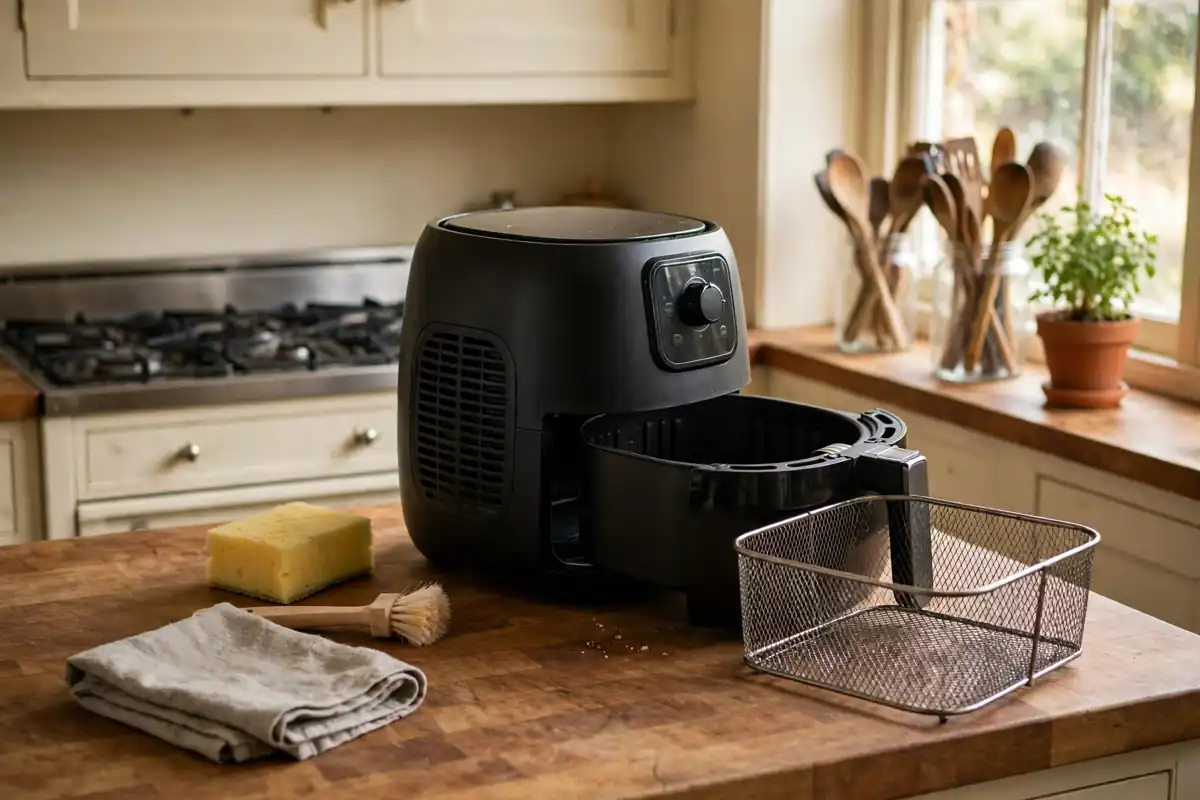
You open the basket to cook dinner and last Tuesday's chicken wings look back at you. The grease has gone brown and sticky around the edges. There is a smell when the fryer heats up, and a wisp of smoke that was not there the first month. The food still cooks, but it tastes faintly of everything you have ever cooked in it.
That is what a dirty air fryer does, and it is why knowing how to clean an air fryer matters. It does not stop working. It gets louder about it, little by little, until dinner smells like the last three dinners. The fix is not a new fryer. The fix is twenty minutes with a sponge, and then five minutes after every cook from now on.
I cook every day for a family of four, and my air fryer runs three or four times a week. This is the routine that keeps it clean: the everyday wash, the weekly deep clean, and the rescue clean for the grease that has already baked on. Part by part, with nothing that damages the coating.
The short answer
Clean the basket and the crisper plate after every cook, with hot soapy water and a soft sponge. Wipe the inside once a week with a damp cloth. Brush the heating coil once a week with a soft brush, with the fryer unplugged and cool. For baked-on grease, use a baking soda paste and let it sit, then wipe it away. Never use oven cleaner, steel wool, or a scouring pad on the coating, and never put water near the electrics or submerge the main unit.
That is the whole method. The rest of this article is the detail: which part gets what, what the manuals actually say, and the three things worth buying if your fryer has been neglected for a while.
If you are still choosing a fryer, or wondering whether yours is past saving, my guide to the best air fryers compares the five I would buy first. A basket with a flaking coating is not a cleaning problem any more. It is a replacement problem.
What you need, and what never to use
You need less than you think. Hot water, dish soap, a soft sponge, a dish towel, and baking soda. A soft brush for the coil and the corners. White vinegar for smells and grease film. That is the whole kit for a fryer that gets cleaned regularly.
The "never" list matters more, because one wrong tool does damage no amount of careful washing undoes. Every item on it comes from the maker manuals, not from internet opinion. Ninja's owner's guide for the AF101 says it plainly: do not clean with abrasive cleaners, steel wool, or scouring pads, and never immerse the main unit in water or put it in the dishwasher. COSORI's manuals say the same, and add a reason I had not thought of: metal fragments can break off a scouring pad and touch electrical parts.
Never use oven cleaner. Oven cleaner is made for bare metal oven walls. It is caustic, and it strips a nonstick or ceramic coating off the metal underneath. Once the coating is gone, food sticks to everything, the bare metal can rust, and the basket is finished. Dish soap, baking soda, and vinegar handle every job oven cleaner promises to do, without eating the surface they are cleaning.
Never use steel wool, a metal scouring pad, or a gritty powder. These scratch the coating in seconds. A scratched coating flakes, and flakes end up in food. The basket's coating is thin by design. Treat it like a nonstick pan, because that is what it is.
Never submerge the main unit, and never put it in the dishwasher. The basket and the crisper plate come out and can be washed. The body of the fryer holds the heating element, the fan, and the wiring. Water in there is an electrical risk, and no manual for any fryer I have read permits it. Wipe the body with a damp cloth. That is all it ever needs.
Never spray cleaner directly inside the fryer. Liquid drips onto the heating element and into the vents, and it gets behind the control panel. Spray the cloth, not the appliance. The same goes for the coil: it gets a dry brush and a barely damp cloth, never a spray and never a soak.
Never use bleach or ammonia inside the fryer. Both leave residues on a surface that touches food, and both attack the coating. There is no cleaning job in an air fryer that needs either one.
One more rule, and it is the one that saves the most baskets: let the fryer cool before you clean it. Unplug it, pull the basket out so the heat escapes, and wait until you can hold your hand near the coil without flinching. Cold water on a hot basket warps thin metal and cracks ceramic coatings. Ten minutes of patience is cheaper than a new basket.
The everyday clean: five minutes after every cook
The best way to clean an air fryer is to never let it get dirty. That sounds like a joke, and it is also the whole secret. Grease that is washed off tonight comes off with a sponge. Grease that is washed off next week needs a paste and twenty minutes. The everyday clean is the habit that makes the deep clean easy.
Here it is, the way I do it after dinner.
Unplug the fryer and let it cool for ten minutes. Pull the basket out. Tip any loose crumbs and grease from the bottom of the basket into the bin, not down the sink. Grease in the sink is a plumber's bill waiting to happen.
Wash the basket and the crisper plate in hot, soapy water with a soft sponge. The crisper plate lifts out of the basket on most models, and food hides under it, so wash the two pieces separately. Rinse them, and dry them with a towel or leave them on the rack to air-dry. Water left sitting on the coating is what starts rust where the coating has worn thin.
Wipe the inside of the fryer with a damp cloth while the basket dries. The inside walls collect a fine film of grease even on a clean cook, and that film is what turns brown and starts to smell. One wipe now is worth ten minutes of scrubbing later.
Wipe the outside with the same damp cloth, including the control panel. Fingerprints and grease splashes wipe off easily when they are fresh. Push the basket back in only when everything is dry. A basket put away damp grows a smell of its own.
That is five minutes, and it is the whole everyday routine. Do it after every cook and the weekly deep clean below takes ten minutes instead of forty.
How to clean an air fryer basket
The basket is where the food lives, so it takes the most punishment. On most fryers the basket is aluminum with a nonstick or ceramic coating, and the crisper plate sits inside it to lift the food above the grease. Both pieces get the same treatment.
For a normal wash, hot soapy water and a soft sponge is all you need. Wash the basket, wash the crisper plate separately, rinse, and dry. If food has stuck to the crisper plate's holes, a soft brush gets into them better than a sponge does. Push the brush through the holes from the top, not from underneath, so you are lifting the food out rather than packing it in.
If residue is stuck on, soak it. Fill the sink with warm soapy water and leave the basket and the plate in it for fifteen minutes. Ninja's manual recommends exactly this for stuck food, and COSORI's says ten to fifteen minutes. The soak does the work. After fifteen minutes, most stuck food wipes off with the sponge, and what is left comes off with the brush. Soaking is always better than scrubbing. Scrubbing is how coatings die.
Can you put the basket in the dishwasher? On most fryers, yes. Ninja says the AF101 basket and crisper plate can be washed in the dishwasher. COSORI says the same for its baskets. But dishwasher-safe is not the same as dishwasher-proof. Dishwasher detergent is harsher than hand soap, and the high heat and long cycle wear a coating faster than hand washing does. I hand wash my basket and save the dishwasher for the nights when the sink is already full. A basket washed by hand lasts longer, and it takes three minutes.
There is one exception to the soft-sponge rule. If your fryer has a glass basket or glass container, like the Ninja Crispi, the rules loosen. Glass does not have a coating to damage, so it can take a firmer sponge, and it goes in the dishwasher without the coating worry. Glass is the easiest air fryer surface to keep clean, and it is one of the reasons I like the Crispi for reheating.
When the coating is flaking or peeling, stop cleaning and start shopping. A flaking basket sheds coating into food, and no cleaning routine fixes it. If the coating question is what worries you, I compared the coating-free options in my guide to the best non-toxic air fryers, including glass and stainless steel fryers that sidestep the whole problem.
How to clean the air fryer tray and pan
The tray and the pan mean different things on different fryers, so here is the map. On a basket fryer, the "pan" is the drawer the basket sits in, and the "tray" is usually the crisper plate. On an oven-style fryer, the tray is the flat pan that catches drips, and the drip pan is the tray at the very bottom.
The drawer on a basket fryer collects grease under the crisper plate. It gets the same hot soapy wash as the basket. Grease pools in the corners, so run the sponge around the inside edges and rinse well. If the drawer has a nonstick coating, and most do, the same no-abrasive rule applies.
The drip pan on an oven-style fryer is the easiest part to forget and the worst part to neglect. Grease drips onto it from every cook, and if it is not emptied it smokes the next time the oven heats up. Slide it out, tip the grease into the bin, wash it in hot soapy water, and dry it. If your oven fryer has a crumb tray as well, empty that too. Crumbs in the bottom of an oven fryer burn, and burnt crumbs are the smell people blame on the fryer.
Wire racks and grill trays, the kind oven fryers use, need a brush. Food bakes onto the wires, and a sponge slides over the top of it. Soak the rack in hot soapy water for fifteen minutes, then run a brush along the wires. A nylon brush is fine on stainless racks. On coated racks, use the soft side of the sponge and the soak, not the brush, unless the brush is soft nylon.
How to clean the inside of an air fryer
The inside of the fryer is the part people skip, because it looks clean when the basket is out. It is not. Every cook sends a fine mist of grease onto the inside walls, and the heat bakes it on in a thin layer. That layer is invisible at first, then yellow, then brown, then the smell.
Wipe the inside walls with a damp cloth after every few cooks, and once a week as part of the deep clean. For the weekly wipe, dampen the cloth with warm soapy water, wring it out well, and wipe the walls, the floor of the cavity, and around the door or basket opening. Then wipe again with a clean damp cloth to take the soap off, and leave the basket out so the inside air-dries.
The inside top is the hard part. The heating coil lives up there, and grease spatters onto the roof of the cavity every time you cook anything fatty. Cleaning the inside top means working upside down, and it means the coil, which has its own rules. Turn the fryer upside down on a towel on the counter, so the roof faces you. Now you can see what you are doing. Wipe the roof with a damp cloth, working around the coil rather than across it. For stuck spots on the roof, a baking soda paste on a cloth, left for ten minutes, lifts the grease without scratching.
Never pour water into the cavity, and never use a wet cloth that drips. The cloth should be damp enough to clean and dry enough that no water runs anywhere. Water that reaches the fan or the wiring is a problem you cannot see until the fryer misbehaves.
How to clean the air fryer heating element
The heating element, the coil at the top of the fryer, is the part that worries people most, and it is the part with the simplest routine. The coil is a metal tube, usually with a fan behind it. Food spatters onto it, grease bakes onto it, and the baked grease smokes the next time you cook. Cleaning it is a dry job, not a wet one.
First, unplug the fryer and let it cool completely. The coil holds heat longer than the basket does, so give it a full half hour after cooking. Working on a warm coil is how burns happen.
Turn the fryer upside down on a towel so the coil faces up. Brush the coil gently with a soft brush to knock off loose crumbs and baked-on flakes. Ninja's manual says to clean the heating element with a cleaning brush, and COSORI's says to clean the heating coil to remove food debris. A soft brush is the tool both manuals point to. Brush along the coil, not across it, and let the crumbs fall onto the towel.
For grease that is baked onto the coil itself, wipe it with a cloth that is barely damp, wrung out until almost dry. Do not put soap, baking soda, vinegar, or any cleaner on the coil. The coil is an electrical part, and cleaners leave residues that smoke and smell when the element heats. A dry brush and a barely damp cloth are the whole method. If the coil still looks stained after that, leave it. A stained coil works fine. A coil cleaned with chemicals does not.
Do not try to remove the coil, and do not poke anything into the fan behind it. The fan is not a user-serviceable part on any basket fryer I know. If the fan is noisy or the fryer is not heating evenly, that is a fault, not a cleaning job, and it needs the maker, not a screwdriver.
The brush matters here, because a kitchen sponge cannot reach the coil and a toothbrush is too small to do it quickly. I use a kit made for this job: a long-handled nylon brush for the coil, a sponge brush for the basket, and crevice brushes for the corners where grease hides.

The brush set for the coil
XANGNIER Air Fryer Cleaner Brush Kit, 6 Pieces
A long-handled nylon brush for the heating coil, a sponge brush for the basket, and crevice brushes for the corners. Nylon bristles, so nothing scratches the coating.
The nylon bristles are the point. A wire brush would clean the coil faster and scratch everything else it touched. Nylon is firm enough to knock baked crumbs off the coil and soft enough to use on the basket and the crisper plate without worrying about the coating.
The fan and the filter: what you can and cannot clean
Two parts of the fryer get asked about a lot, and the honest answer for both is that there is less to do than people expect.
The fan sits behind the heating coil, and on a basket fryer you cannot reach it without taking the fryer apart. Do not take the fryer apart. The fan is not meant to be cleaned by hand, and opening the housing voids the warranty and risks the wiring. What you can do is keep the coil clean, because a clean coil means less grease reaching the fan, and wipe the air intake vent on the back of the fryer with a dry cloth so dust does not get pulled in. If the fan rattles or squeaks, that is a fault. Call the maker.
The filter is simpler still: most basket air fryers do not have one. There is no filter to clean, replace, or wash. Some oven-style fryers have a removable grease filter or a mesh screen near the fan, and a few models have a carbon filter for smells. If your fryer has one, your manual will name it and say how to wash it, usually in warm soapy water, dried completely before it goes back. If your manual does not mention a filter, your fryer does not have one, and there is nothing to do.
The rescue clean: baked-on grease and build-up
This is the section for the fryer that has been neglected. The basket has a brown ring that will not wash off. The inside walls are yellow. The coil has black spots. It smokes when it heats. Everything in this section assumes you have already done the everyday wash and the grease is still there.
Start with the soak. Fill the sink with hot water and a good squirt of dish soap, and put the basket, the crisper plate, and any racks in it. Leave them for half an hour, not fifteen minutes. Hot soapy water softens baked-on grease, and time does more than elbow grease ever will. While they soak, wipe the inside of the fryer with a damp cloth.
Next, the baking soda paste. Mix three parts baking soda to one part water, until it is thick enough to spread and stay put. Three tablespoons of soda to one of water is about right for a basket. Spread the paste over the brown spots and the baked-on grease, and leave it for fifteen to twenty minutes. Baking soda is mildly abrasive, which is why it works, and mild enough that it does not scratch a coating when you rub gently. Rub with a soft sponge, not a scouring pad, and let the paste do the work. Rinse well. Baking soda left on the basket affects the taste of the next meal.
For grease film and smells, use vinegar separately. Mix equal parts white vinegar and warm water in the sink and soak the basket for ten to fifteen minutes. Vinegar cuts grease film and takes smells with it. Do not soak the basket overnight, and do not use undiluted vinegar on a coating for long. Vinegar is an acid, and a long soak can dull a finish. Ten to fifteen minutes, then rinse and dry.
Do not mix the baking soda and the vinegar together. The fizz looks like it is doing something, and it is doing the opposite. Baking soda is a base and vinegar is an acid. Mixed together, they cancel each other out and leave salty water that cleans nothing. Use the paste for the stuck grease and the vinegar soak for the film and the smell, one after the other, never in the same bowl.
For grease that has beaten the paste, a degreasing spray earns its place. The one I reach for is a dish spray, not an oven cleaner and not a harsh degreaser. Spray it onto the basket, not into the fryer, leave it for a few minutes, and wash as normal. It cuts through baked-on grease faster than dish soap alone, and it rinses clean.

The degreaser for baked-on grease
Dawn Platinum Powerwash Dish Spray, Starter Kit + Refill
Spray it on the basket, leave it a few minutes, wash as normal. It cuts baked-on grease that dish soap alone leaves behind, and it rinses clean.
One thing I do not do, and you will see it recommended online: the steam clean. Some guides tell you to put water in the basket and run the fryer for a few minutes so the steam loosens the grease. I do not do it. Water sloshing around inside a running appliance, near a heating element and a fan, is not a trade I make for a slightly easier wipe. The soak and the paste do the same job with the fryer unplugged.
If the rescue clean does not fix the smoke, the problem is usually the coil. Grease baked onto the coil smokes every time the fryer heats, and the coil is the one part the soak cannot reach. Brush it, wipe it with a barely damp cloth, and run the fryer empty for three minutes at 400°F afterwards to burn off anything left. If it still smokes, the grease has reached the fan, and that is a job for the maker.
How to clean an air fryer oven
An air fryer oven is a different shape with the same rules, and a few extra parts. Instead of a basket that pulls out, it has racks, a tray, and a drip pan inside a boxy cavity, and the heating elements are exposed at the top and sometimes the bottom. The full form-factor comparison is in air fryer oven vs basket air fryer, and the ovens worth buying are in my guide to the best air fryer ovens.
The routine is the same shape as the basket routine, with the parts swapped. After every cook, pull the racks, the tray, and the drip pan out, and wash them in hot soapy water. Wipe the inside walls with a damp cloth. Empty the crumb tray. The oven shape collects more crumbs than a basket fryer, because food falls through the racks, and crumbs in the bottom are the first thing to burn and smell.
The weekly deep clean takes longer on an oven, because there is more interior to wipe and the racks need a brush. Soak the racks in hot soapy water, brush along the wires, and wipe the cavity walls with a damp cloth. For the heating elements, the rule is stricter than on a basket fryer: wipe them only with a soft, damp cloth, and use no cleaner at all. Breville's care instructions for its oven fryers say to clean the quartz heating elements with a soft damp sponge or cloth and no cleanser or cleaning agent, and that is the right rule for any exposed element.
Oven fryers are harder to keep clean than basket fryers. That is a real trade-off of the shape, and it is worth knowing before you buy. A basket goes in the sink. An oven cavity has to be wiped by hand, upside down, around two elements. If easy cleaning is high on your list, the basket shape wins.
A note on Ninja fryers
Ninja is the brand most people ask about, because it is the brand most people own. The cleaning rules for a Ninja are the same as for any fryer, with a few brand details worth knowing.
Ninja baskets are ceramic-coated, and the coating is the part to protect. Ninja's manual says the basket and crisper plate can go in the dishwasher, and that stuck food should be soaked in warm soapy water rather than scrubbed. The main unit is never immersed and never goes in the dishwasher. The heating element gets a cleaning brush. Those four rules are the whole Ninja routine.
The Ninja Foodi DualZone has two baskets, which means two baskets to wash, and the sync cooking means both get dirty at once. Wash both the same way. The Ninja Crispi is the easy one in the range: its glass containers wash like any glass dish, in the sink or the dishwasher, with no coating to worry about. The full review is in Ninja Crispi air fryer review.
One Ninja-specific warning: do not overfill the basket. Ninja's manual says overfilling lets food touch the heating elements, and food on the elements is the fastest way to a smoking fryer. A single layer, with space between the pieces, cooks better and keeps the coil cleaner.
How to keep an air fryer clean
Cleaning is the cure. Prevention is cheaper. Four habits keep a fryer clean between deep cleans, and the first one does most of the work.
Use a liner for greasy food. A silicone liner pot sits in the basket and catches the grease before it reaches the basket walls. Chicken thighs, ribs, anything with a glaze or a marinade: cook it in the liner, and the basket stays clean. The liner washes in the sink or the dishwasher, and the basket gets a wipe instead of a scrub. Liners do not suit everything. Fries and nuggets need the hot air reaching the bottom, so they crisp better without a solid liner, or on a perforated mat. The full comparison, pots against mats against parchment, is in my guide to the best air fryer liners and accessories.
The liner I use most is a collapsible silicone pot. It fits fryers of 5 quarts and up, the sides are high enough to catch real grease, and it folds flat in the drawer when it is not in use. As of November 16, 2026, the two-pack was $13.99 on Amazon.

The prevention pick
Lotteli Kitchen Collapsible Silicone Air Fryer Liners, 2 Pack
A silicone pot that catches the grease before it reaches the basket. Two pots, sides high enough for real grease, and they fold flat in the drawer.
Do not use cooking spray in the basket. Aerosol cooking sprays contain additives that bake onto a nonstick coating and build up into a sticky layer no sponge removes. That layer is the brown ring people think is grease. It is spray residue, and it is harder to clean than grease. Brush oil on the food instead, or use a refillable oil mister with plain oil.
Shake the basket, do not stack the food. Food piled in two layers steams on the bottom and drips grease where it should not go. A single layer cooks evenly and keeps the grease where the basket can handle it. If your basket is too small for a single layer, the fryer is too small for the household, and I have put the size guide in what size air fryer.
Wipe the inside while it is still warm. Not hot, warm. A cloth wiped over the inside walls while the grease is still soft takes it off in one pass. The same grease, left to cool and harden, needs a paste. The five minutes after dinner are worth more than the forty minutes on Saturday.
The cleaning schedule
| When | What | How long |
|---|---|---|
| After every cook | Basket, crisper plate, wipe inside walls | 5 minutes |
| Once a week | Inside top, heating coil, exterior, drip pan | 10 minutes |
| Once a month | Rescue check: paste on any brown spots, vinegar soak for smells | 20 minutes |
| When it smokes | Coil brush and wipe, then run empty 3 minutes at 400°F | 10 minutes |
A fryer cleaned on this schedule never needs a rescue clean. A fryer cleaned on no schedule needs one every month. The schedule is the difference between five minutes after dinner and an hour on a Saturday.
Questions people ask
How do I clean an air fryer basket?
Wash it in hot soapy water with a soft sponge after every cook. For stuck food, soak it in warm soapy water for fifteen minutes, then wipe. Most baskets are dishwasher-safe, but hand washing wears the coating less.
How do I clean the heating element?
Unplug the fryer, let it cool completely, turn it upside down, and brush the coil gently with a soft brush. Wipe it with a barely damp cloth if needed. Never put soap, baking soda, vinegar, or any cleaner on the coil.
How do I clean the inside top of an air fryer?
Turn the fryer upside down on a towel so the roof faces you. Wipe the roof with a damp cloth, working around the coil. For stuck grease on the roof, a baking soda paste on a cloth, left for ten minutes, lifts it without scratching.
Can I use baking soda to clean an air fryer?
Yes. Mix three parts baking soda to one part water into a paste, spread it on baked-on grease, leave it fifteen to twenty minutes, and rub gently with a soft sponge. Rinse well. It is mildly abrasive, so rub gently and never use it with a scouring pad.
Can I use vinegar to clean an air fryer?
Yes, diluted. Mix equal parts white vinegar and warm water and soak the basket for ten to fifteen minutes. It cuts grease film and takes smells with it. Do not use vinegar on the heating element, and do not soak the basket overnight.
Can I use water to clean an air fryer?
Water is fine on the removable parts: the basket, the crisper plate, the racks, and the drip pan. It is not fine inside the main unit. Wipe the inside with a damp cloth, never a wet one, and never pour water into the fryer.
Can I put my air fryer in the dishwasher?
The basket and crisper plate, yes, on most models. The main unit, never. Check your manual for your exact model, and hand wash when you can, because dishwasher detergent wears the coating faster.
How do I clean air fryer grease build-up?
Soak the parts in hot soapy water for half an hour, then use a baking soda paste on the brown spots and a degreasing dish spray on the worst of it. Grease that has baked on for months may take two rounds. Prevention, a liner and a wash after every cook, is what stops it coming back.
How do I clean the air fryer fan?
You do not, not by hand. The fan sits behind the heating coil and is not user-serviceable on a basket fryer. Keep the coil clean, wipe the air intake vent on the back with a dry cloth, and call the maker if the fan rattles or squeaks.
Does my air fryer have a filter to clean?
Probably not. Most basket air fryers have no filter. Some oven-style fryers have a removable grease filter or mesh screen. If your manual names a filter, wash it in warm soapy water and dry it completely before it goes back.
Why does my air fryer smoke?
Grease, almost always. Grease on the coil, grease pooled in the drip pan, or grease baked onto the inside walls. Clean the coil, empty the drip pan, and wipe the inside. If it still smokes after that, the grease has reached the fan, and that needs the maker.
How often should I clean my air fryer?
The basket after every cook. The inside and the coil once a week. A full check once a month. A fryer used three or four times a week needs the weekly clean. A fryer used once a week can stretch the deep clean to every two weeks.
The bottom line
An air fryer is easy to clean when it is cleaned often, and hard to clean when it is not. That is the whole truth of it. Five minutes after every cook keeps the basket clean. Ten minutes once a week keeps the coil and the inside clean. The rescue clean exists for the fryer that missed both, and it works, but it is an hour you never get back.
If your fryer needs the rescue clean, get the three things that make it easy. The XANGNIER brush kit for the coil and the corners, because a sponge cannot reach either. The Dawn Powerwash spray for the baked-on grease that dish soap alone leaves behind. And the Lotteli silicone liner pots, so the grease never reaches the basket again.
Then wash the basket tonight, after dinner, while the grease is still soft. It takes five minutes, and it is the habit that makes every other part of this article unnecessary.