Air Fryer Ninja Crispi Review: Glass Cooking, Honest Verdict
The Ninja Crispi cooks dinner in a glass dish that goes from fryer to table to fridge. No coating touches the food. But it is a small-batch machine at a full-size price, and that trade-off decides everything.
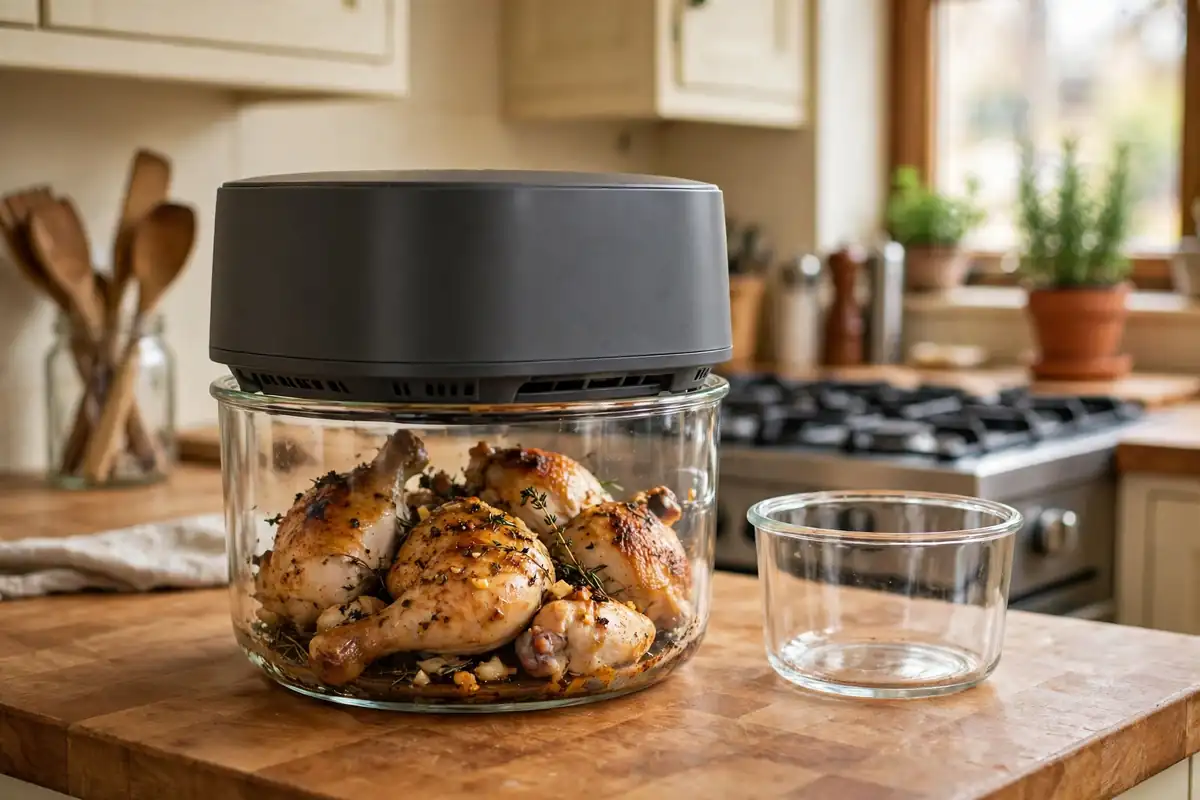
Last night's chicken is in a glass dish in the fridge. You want it for lunch, and you want it crisp again, not steamed soft the way a microwave leaves it. So you tip it into the air fryer basket, wait, tip it back onto a plate, and wash the basket. Three dishes for one portion of leftovers. That is the small annoyance the air fryer Ninja Crispi was built to remove. The dish you cook in is the dish you eat from and the dish you store in. One dish, three jobs.
I cook every day for a family of four, and I have spent a long time with this machine on paper: the manual, the spec sheet, the measurements, and everything Ninja publishes about it. I have not cooked a week of dinners in one yet, and I will say so plainly where it matters. What follows is an honest review from what is known and verified, including the parts where this fryer is genuinely clever and the parts where it is not the right buy.
One honest note before we start: this page has affiliate links. If you buy through one, the site may earn a small commission. It costs you nothing, and it never decides what I recommend. Prices move, so check the current price before you buy anything. The prices on this page were checked on November 16, 2026.
The short answer
The Ninja Crispi is the best air fryer for anyone whose main question is what their food touches. It cooks in borosilicate glass containers with no coating touching the food, and the same container serves dinner and stores the leftovers. For reheating, small batches, and cooking for one or two, it is genuinely clever and hard to beat.
It is not the best air fryer for a family dinner. The 4-quart container holds a whole chicken, but it holds one dish at a time, and a family of four eating a main and a side will cook in rounds. At $159.95 as of November 16, 2026, it also costs more than a good 6-quart basket fryer. Buy it for the glass and the portability. Buy a basket fryer for the weeknight dinner rush.
What the Crispi actually is
Most air fryers are a box with a drawer. You pull the drawer out, put food in a basket, push it back in, and a heater and fan above the basket do the work. The Crispi turns that shape inside out. The heater and fan live in a small handheld unit called the PowerPod, about the size of a dinner plate and light enough to carry in one hand. The food lives in a glass container underneath it. You snap the pod onto the container, press start, and the pod blows superheated air down onto the food.
The box holds seven pieces: the PowerPod, a 4-quart CleanCrisp glass container, a 6-cup CleanCrisp glass container, two crisper plates, an adapter, and two storage lids. The pod clicks straight onto the small container. For the big container you set the adapter on top first, then the pod clicks onto the adapter. The lids snap onto the containers with a leak-proof lock, so the container that cooked dinner becomes the container that holds the leftovers in the fridge.
The pod runs at 1,500 watts on a standard 120-volt outlet, and it reaches 450°F. That is the same top temperature as the best basket fryers, and it matters, because 450°F is what crisps chicken skin and finishes fries properly. The controls are simple: one button cycles through the four functions, plus and minus buttons set the time and temperature, and a start and stop button runs the cook. It beeps when it is done. There is no app, no presets to scroll through, and nothing to learn before the first cook.
The whole kit weighs 13.67 pounds, and the assembled fryer with the big container measures about 13.4 inches deep, 12 inches wide, and 13.6 inches tall. That is roughly the footprint of a basket fryer, but the shape is different in a way that matters for storage: the pieces nest inside each other, so the whole system packs down into a cabinet instead of sitting on the counter as one big box.
The review card

The glass air fryer
Ninja Crispi 4-in-1 Portable Glass Air Fryer
A 1,500-watt heating pod that snaps onto borosilicate glass containers, so food cooks in glass with no coating touching it. The same dish cooks, serves, and stores the leftovers. Best for reheating and small batches; a family dinner takes two rounds.
+ Glass containers, PFAS-free and PTFE-free, go from freezer to fryer to table to fridge
− One dish at a time, and the 4-quart container is small for a family dinner
| Containers | 4 qt + 6-cup borosilicate glass |
| Power / max temp | 1,500 W / 450°F |
| Functions | Max Crisp, Bake, Air Fry, Recrisp |
| Warranty | 1-year limited |
Reviewed from verified specs and the manual; not a hands-on test week. Price checked November 16, 2026.
The glass question, answered properly
The reason most people look at the Crispi is the coating question. A normal air fryer basket has a nonstick coating. That coating is usually PTFE, the chemical sold as Teflon, which is a member of the PFAS family. It is stable and safe at normal cooking temperatures, below 500°F, and it only starts to break down above that line. But it wears. Every coating wears. A basket that is slick in year one sticks in year three, and a flaking basket is a basket past its best.
The Crispi removes the question instead of answering it. The food sits in glass. Glass is glass. There is nothing to flake, nothing to wear through, and nothing that changes with heat at cooking temperatures. The containers are borosilicate glass, the heat-resistant kind, and they are thermal-shock resistant, which means they handle the swing from a cold fridge to a hot fryer without cracking. They are also free from PFAS and PTFE, stated plainly on the spec sheet.
The crisper plates are the one part that is not glass. They carry a nano-ceramic coating, not PTFE. Ceramic is PFAS-free, and it is the same trade-off ceramic always is: it releases food well when it is new and it wears faster than PTFE over time. The plates are small, flat, and easy to replace, and you can cook without them entirely if you would rather the food sat on bare glass. The food-contact surface that matters most, the container itself, has no coating at all.
Glass has a second advantage that has nothing to do with safety. You can see dinner cooking through the side of the dish. A basket fryer hides the food in a drawer, and you pull it out to check. With glass, you watch the browning happen and pull the food when it looks right. For anyone who has ever overcooked a batch because they guessed wrong on the timer, that window matters.
There is a third advantage, and it is the one I keep coming back to. Glass does not stain and does not hold smells. Tomato sauce, curry, garlic, all the things that mark a plastic container or a coated basket forever, wash out of glass like they were never there. I wrote about glass vs plastic for food storage, and the material argument is the same one here: glass asks nothing of your trust and gives nothing back to your food.
If the coating question is what decides your purchase, read my full comparison of the best non-toxic air fryers too. The Crispi is the glass answer there. Ceramic baskets and stainless steel baskets are the other two answers, and each one suits a different kitchen.
The two containers in real cooking
The 4-quart container is the family-size piece, and it is worth being exact about what that means. It fits a whole 4-pound chicken. It holds a batch of wings for four people, or a tray of roasted vegetables, or a full side of fries. What it does not hold is a main and a side at the same time. A family dinner in the Crispi is either one dish, or two rounds with the first round kept warm. That is the central trade-off of the whole machine, and it is the reason it cannot be the only fryer in a busy family kitchen.
The 6-cup container is the piece I would use most. Six cups is about a quart and a half. It holds one generous portion, a side for two, or a batch of fries for one hungry child. It is the lunch container, the reheating container, and the container for the nights when only one person wants the crispy thing. The pod clicks straight onto it with no adapter, so it is the fastest setup in the box.
The adapter is the small piece nobody talks about. It is a ring that sits on the 4-quart container so the pod can grip the wider rim. It works, and it is dishwasher safe, but it is one more piece to keep track of, and the pod will not run on the big container without it. If you use the big container most days, the adapter lives on it and you forget about it. If you switch between sizes, it is one more step every time.
One practical detail matters more than it sounds. The glass containers go in the microwave and the freezer as well as the fryer. That means the container that holds the leftover chicken in the fridge goes straight under the pod to reheat, and the container you marinated the chicken in this morning is the container it cooks in tonight. Fewer dishes is not a small thing when you cook every day. It is the difference between a fryer you use and a fryer you leave in the cupboard.
The four functions
Max Crisp is the top end. It runs the pod at its hottest, up to 450°F, for frozen fries, wings, and anything that needs maximum browning. This is the function that does the work a deep fryer used to do, and it is the one that justifies the 1,500 watts.
Air Fry is the everyday function. It cooks with hot air and little to no oil, and it covers most of what a family actually air fries: chicken pieces, fish, vegetables, frozen food straight from the freezer. The temperature and time adjust with the plus and minus buttons, so you are not locked into presets.
Bake covers small baking jobs: cookies, pastries, a small tray of roasted vegetables, anything that wants steady heat rather than a blast of it. The glass container helps here, because glass holds heat evenly and you can see the browning through the side.
Recrisp is the function that makes the Crispi different from every basket fryer I know. It reheats leftovers and brings back the crunch instead of steaming them soft. Pizza, fried chicken, roast potatoes, anything that was crisp yesterday and went soft in the fridge. A basket fryer can reheat, but Recrisp is tuned for exactly this job, and it is the function that earns the Crispi its place as a second fryer even in a kitchen that already owns a basket model.
What the Crispi does not have is also worth naming. There are no presets, no smart programs, no app, and no dehydrate or proof setting. If you want a fryer that dries apple slices or proofs bread dough, this is not it. The four functions cover cooking and reheating, and that is all they claim to do.
How it cooks: the honest performance picture
Heat comes from above. That is the whole design, and it shapes everything about how the Crispi cooks. A basket fryer surrounds the food with hot air from all sides. The Crispi blows hot air down from the pod, and the glass below holds the heat. Food browns fastest on top, which means you flip or shake halfway through, the same as any air fryer, and you keep the food in a single layer. Stack food in the Crispi and the bottom pieces steam while the top pieces crisp. The manual says the same thing in its troubleshooting section: overcrowding is the first cause of uneven cooking.
For single-layer food, the design works well. Wings, thighs, fries, roasted vegetables, fish fillets, all the foods that lie flat and crisp on top. For food that needs turning often, or for a full tray that needs even heat from every side, a basket fryer with its drawer and fan has the edge. The Crispi is a top-down cooker, and top-down cooking rewards flat food in one layer.
There is one performance question I cannot answer from the spec sheet, and I will not pretend otherwise. I have not run the Crispi side by side with a basket fryer on the same food, so I cannot tell you which one crisps faster or more evenly on a plate of wings. The wattage and the top temperature say the Crispi has the power of a full-size fryer. The shape says the heat reaches the food differently. Both things are true, and the honest version is that the difference between them is smaller than the difference between cooking in one layer and cooking in two.
Portability: the real reason to buy it
The Crispi is the only air fryer I know that you can carry to the table. The pod is light and handheld, and the glass container it cooks in is the serving dish. You can crisp something at the counter, carry the container to the table, and serve from it. You can take the whole system to a holiday kitchen, a relative's house, or a rental with a poor oven, because the pieces nest together and the kit packs down small.
That portability is also the storage story. A basket fryer is one big box that lives on the counter or takes a full shelf. The Crispi breaks into pieces that nest inside each other. The pod sits in the small container, the small container sits in the big one, and the whole thing goes into a cabinet. For a small kitchen with no counter space to spare, that is a real advantage, and it is the reason the Crispi suits flats and small houses better than its quart numbers suggest.
The weight is the catch. The kit is 13.67 pounds all together, and a 4-quart glass container full of food is heavy. Glass is heavier than a metal basket, and a full container needs two hands and a firm grip. If your wrists complain about lifting, that matters more than any performance number. The pod itself is light. The full glass dish is not.
One more portability note, because it affects where you use it. The containers have fixed heat-protection feet, and the manual lists them as safe to place on granite, laminate, quartz, butcher block, and marble. You do not need a trivet under the container while it cooks. That sounds small until you have scorched a wooden counter with a hot dish.
Cleaning: where glass earns its keep
Everything except the pod goes in the dishwasher: both containers, both crisper plates, the adapter, and the lids. The pod itself gets wiped with a damp cloth, never immersed, and the heating element gets a non-abrasive brush if grease builds up on it. That is the whole cleaning routine, and it is simpler than a basket fryer's, because there is no drawer with corners that trap grease and no basket mesh to scrub.
Glass cleans more easily than any coated basket. Baked-on food soaks off glass. It does not soak off a worn coating, and it does not soak off a basket that has been scorched. If you have ever scrubbed a basket for ten minutes and still found brown patches in the corners, you know the difference. Glass goes in the dishwasher and comes out clear.
There is one cleaning habit the manual is firm about. Do not put a hot glass container straight into cold water. The glass is thermal-shock resistant, not thermal-shock proof, and a sudden swing from hot to cold is the one thing that can crack it. Let the container cool first, then wash it. The same rule applies to any glass dish, but it is worth stating, because the Crispi's whole pitch is glass going from freezer to fryer, and that range has a limit.
White smoke is the other thing the manual covers. If grease drips onto the heating element, it smokes, the same as in any air fryer. The fix is the same too: clean the element, pat wet food dry before cooking, and do not let food touch the element. I covered the smoke question in detail in are air fryers healthy, and the causes are the same in glass as in a basket.
The weaknesses, honestly stated
The capacity is the first weakness, and it is the one that decides the purchase. One dish at a time, in one container, with no second basket and no second zone. A family of four eating chicken and vegetables cooks two rounds. The first round waits while the second cooks. A dual-basket fryer cooks both at once and finishes them together. If your weeknight dinner is a main and a side, the Crispi asks you to change how you cook dinner, and that is a big ask for a machine at this price.
The price is the second weakness. At $159.95 as of November 16, 2026, the Crispi costs more than a good 6-quart basket fryer. The COSORI TurboBlaze, a 6-quart fryer with nine functions, was $99.99 the same day. The Ninja AF101, a 4-quart basket fryer with a ceramic-coated basket, was $119.99. You are paying a premium for glass and portability, not for capacity or functions. If the glass does not matter to you, the premium buys nothing you need.
The warranty is the third weakness. One year limited. The TurboBlaze carries two years. A one-year warranty on a machine with a heating element and a fan is the industry minimum, and it is the shortest warranty on any fryer I recommend. Register the fryer when you buy it, and keep the receipt, because a recall notice only reaches you if the maker knows you own one. I wrote about the Gourmia air fryer oven recall when it was announced, and the fix was a free repair kit by mail. Five minutes with the registration card is the cheapest safety step in the kitchen.
Glass breaks. That is the fourth weakness, and it is the one nobody wants to say about a glass product. Borosilicate is tough and thermal-shock resistant, but it is still glass. Drop a full container on a tile floor and it breaks. A metal basket dents. If your kitchen has tile floors and small children who help carry dishes, that risk is real, and replacement containers are an extra cost. The Crispi's glass is a strength until it meets a hard floor.
The last weakness is the smallest one, but it is the kind of thing that annoys you daily. The adapter. One more piece, needed every time you use the big container, easy to leave in the dishwasher when you need it. It is not a reason to skip the fryer. It is a reason the big container feels slightly less simple than the small one.
Crispi vs the basket fryers
The fair comparison is against the two basket fryers most families actually buy. The Ninja AF101 is the classic 4-quart, and the COSORI TurboBlaze is the 6-quart value pick. All three prices were checked on November 16, 2026.
| Ninja Crispi | Ninja AF101 | COSORI TurboBlaze | |
|---|---|---|---|
| Capacity | 4 qt + 6-cup glass | 4 qt basket | 6 qt basket |
| Power | 1,500 W | 1,550 W | 1,725 W |
| Max temperature | 450°F | 400°F | 450°F |
| Food-contact surface | Borosilicate glass | Ceramic-coated basket | PFAS-free ceramic basket |
| Functions | 4 | 4 | 9 |
| Cooks two foods at once | No | No | No |
| Price, Nov 16, 2026 | $159.95 | $119.99 | $99.99 |
| Best for | Glass cooking, reheating, portability | First fryer, everyday family cooking | Family size, best value |
| Check on Amazon | Check on Amazon | Check on Amazon | Check on Amazon |
The table makes the trade-off plain. The Crispi costs the most and holds the least. What it gives you in return is glass, portability, and the Recrisp function. If those three things are worth $60 more than the TurboBlaze to you, the Crispi is the right buy. If they are not, the TurboBlaze is the better fryer for the money, and it is the one I would buy first for a family.
The full comparison of all five fryers I recommend is in my guide to the best air fryers. The Crispi is not in that top five as a family fryer, and this review is why. It is the best glass fryer. It is not the best family fryer.
Where the Crispi sits in Ninja's range
Ninja is the strongest air fryer brand in the shop, and the Crispi is the odd one in its range. The AF101 is the classic single basket. The air fryer Ninja DualZone model, the Foodi DZ201, is the dual-basket answer, two 4-quart baskets that cook a main and a side at once and finish together. If you search for the best air fryer Ninja makes, the answer depends on the job: the DualZone for a family dinner in one round, the AF101 for a first fryer, and the Crispi for glass cooking and reheating.
Ninja also makes oven-style fryers, including the large air fryer oven Ninja XL models, and those are a different shape again: a countertop oven that air fries, with racks instead of a basket. If the oven shape is what you want, my guide to the best air fryer ovens covers it, and the form-factor choice between an oven and a basket is in air fryer oven vs basket air fryer. The Crispi is none of those things. It is a pod and two glass dishes, and it does not try to be anything else.
Ninja has since added a larger countertop Crispi Pro, a 6-in-1 glass fryer that stays on the counter. It is a different machine with a different job. This review covers the portable FN101 only, the one with the handheld pod and the two glass containers.
Who should buy it, and who should skip it
Buy the Crispi if the coating question is what bothers you. If you have been putting off an air fryer because you do not want your food touching a coating, this is the answer, and there is no cheaper way to get glass cooking from a major brand.
Buy it if you cook for one or two. The 6-cup container is the right size for a single portion, and the 4-quart handles a dinner for two with room to spare. A couple, a single person, or a parent cooking a separate meal for one child will use the Crispi more than a basket fryer, because the small container is the right tool for the job.
Buy it as a second fryer. If you already own a basket fryer and you want the best reheating tool in the kitchen, the Crispi earns its place. Recrisp on yesterday's fried chicken is the use case that justifies it, and the glass container that goes from fridge to fryer to table is the convenience that keeps it in use.
Buy it if you have no counter space. The nesting storage and the small footprint suit a kitchen where a basket fryer would live in a cupboard and never come out. A fryer you can store is a fryer you will use.
Skip it if you cook dinner for four or more every night. Two rounds, every night, gets old fast, and a dual-basket fryer or a 6-quart basket does the same dinner in one round for less money.
Skip it if the budget is tight. The glass is a luxury, not a necessity. A ceramic-coated basket fryer cooks the same food, costs less, and holds more. The money you save buys a month of groceries.
Skip it if anyone in your house struggles to lift a full glass dish. The 4-quart container, full of food, is heavy, and glass does not forgive a drop. A basket fryer with a handle is the safer shape for weak wrists.
What I still do not know
An honest review says what is unknown as well as what is known. I have not cooked a week of dinners in a Crispi, so I do not know how the crisper plates hold up after a year of daily use, or how the glass handles hundreds of hot-to-cold cycles in real life. The glass is rated thermal-shock resistant, and the plates are nano-ceramic, but ratings are not years of use, and the Crispi has only been on the market since 2024.
I also do not know how loud it is. Ninja publishes no noise figure for the Crispi, and no spec sheet tells you what a fan sounds like at 6pm in a small kitchen. Basket fryers vary, and the Crispi's pod sits open on a glass container rather than inside a closed box, so the sound will be different. Different is all I can say honestly.
What I do know is the spec sheet, the manual, the measurements, and the materials, and those are verified. The Crispi is a well-built machine with a clear idea: glass instead of coating, portable instead of fixed, one dish instead of a drawer. Whether that idea suits your kitchen is the question this review exists to answer.
Questions people ask
Is the Ninja Crispi worth it?
It is worth it if the glass matters to you, or if you cook for one or two, or if you want the best reheating tool in the kitchen. It is not worth it as a family dinner fryer, where a basket fryer holds more and costs less. The full buy-or-not reasoning is in are air fryers worth it.
Does the Crispi replace a normal air fryer?
For one or two people, yes. For a family of four, no. It cooks one dish at a time, and a family dinner usually needs two. It works best as the only fryer in a small household, or as a second fryer in a family kitchen.
Can the glass containers go in the microwave and freezer?
Yes. The CleanCrisp glass containers are microwave safe, freezer safe, and dishwasher safe. That is the whole point of the design: the same dish marinates, cooks, serves, and stores.
Is the Ninja Crispi PFAS-free?
Yes. The glass containers are free from PFAS and PTFE, and the crisper plates carry a nano-ceramic coating, not PTFE. No coating touches the food except the ceramic on the plates, and you can cook without the plates if you prefer bare glass.
What size chicken fits in the Crispi?
A whole 4-pound chicken fits in the 4-quart container. That is a dinner for four with a side cooked separately, or a dinner for two with leftovers.
Is the Crispi good for a family of four?
Not as the only fryer. The 4-quart container holds one dish, and a family dinner is usually two dishes. A family of four is better served by a 6-quart basket fryer or a dual-basket model, with the Crispi as a second fryer for reheating and small batches.
What is the difference between the Crispi and the Crispi Pro?
The Crispi is the portable system reviewed here: a handheld pod and two glass containers. The Crispi Pro is a larger countertop glass fryer that stays on the counter. If you want portability and nesting storage, buy the Crispi. If you want a bigger glass fryer that lives on the counter, look at the Pro.
Does the Crispi need the adapter?
Only for the 4-quart container. The pod clicks straight onto the 6-cup container. The adapter is a ring that sits on the big container so the pod can grip its wider rim.
The bottom line
The Ninja Crispi is the best glass air fryer you can buy, and the most honest thing I can say about it is that it knows exactly what it is. It is a pod and two glass dishes. It cooks in glass, it reheats better than anything else in the kitchen, it packs away into a cupboard, and it asks you to cook one dish at a time.
For a household of one or two, for anyone who cares about what their food touches, and for anyone who wants a second fryer that reheats properly, it is worth the money. The glass is the reason, and the glass is real.
For a family of four cooking dinner every night, buy a basket fryer first. The COSORI TurboBlaze holds more, costs less, and cooks dinner in one round. Then, if the reheating problem nags at you, add the Crispi later. Together they cover the week: the basket fryer for dinner, the glass fryer for everything small.
If you have decided the glass is what you want, buy the Ninja Crispi 4-in-1 Portable Glass Air Fryer and start with the 6-cup container. Reheat last night's dinner in it tonight. That first Recrisp is the moment the machine makes sense.