Best Non-Toxic Air Fryers: 5 Picks Without Teflon or PFAS
Glass, ceramic and stainless steel air fryers that skip Teflon entirely. Five picks for a family kitchen, with the coating facts stated plainly.
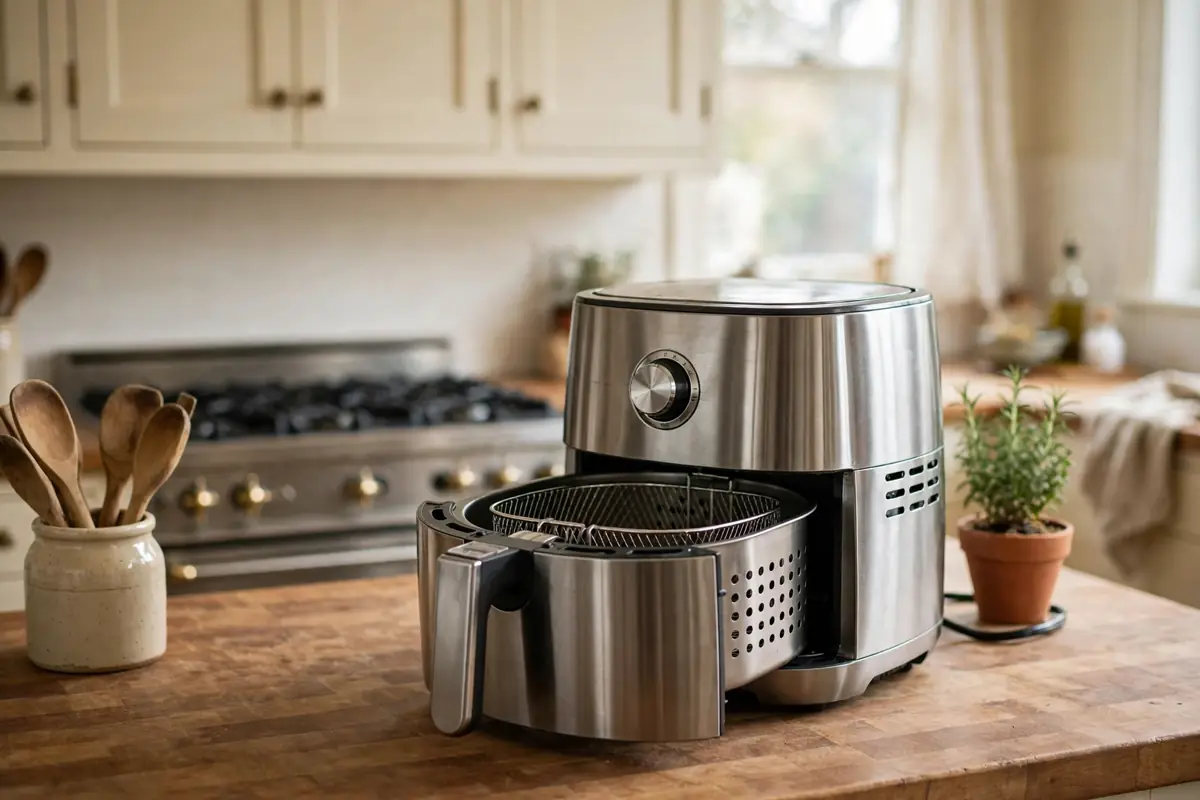
It is Tuesday, and the chicken is almost done, when you pull the basket out and see it. A scratch in the coating. Then another. The basket looked fine when you bought it, and now the black surface is flaking at the corners, and you are standing there wondering what exactly has been flaking into dinner for the last month.
I went looking for the best air fryer non toxic options after the same moment in my own kitchen. Whether you call it the best air fryer non toxic or the best air fryer no teflon, the question is the same: what is the food actually touching? Most air fryer baskets are coated with PTFE, the polymer sold as Teflon. It works well until it does not. And once it starts to wear, the question stops being abstract.
This page is the answer I landed on. Five air fryers where the food touches glass, stainless steel, or a ceramic coating the maker states is PFAS-free. No PTFE anywhere near dinner. Each one is here because its maker says, in writing, what the cooking surface is made of. I checked the spec sheets, the manuals, and the exact model numbers, because a brand name on the box is not enough. The same brand can sell a PFAS-free fryer and a PTFE-coated fryer under nearly the same name.
One honest note before we start: this page has affiliate links. If you buy through one, the site may earn a small commission. It costs you nothing, and it never decides what I recommend. I do not list prices here, because prices move and a stale price is worse than no price. Check the current price before you buy anything.
Top 3 picks
- COSORI TurboBlaze 6-Quart Air Fryer — Best overall. A PFAS-free ceramic basket and crisper plate, a 450°F top end, and the size a family actually uses. Check on Amazon
- Ninja Crispi 4-in-1 Portable Glass Air Fryer — Best glass basket. Food cooks in glass, and the same dish serves dinner and stores the leftovers. Check on Amazon
- GreenPan Bistro 7-Quart 360° Clear View Air Fryer — Best for families. The biggest PFAS-free ceramic drawer here, with a window so you can watch dinner brown. Check on Amazon
How I picked these
I cook every day for a family of four, and I have lived with a coated air fryer basket long enough to know how the story ends. The coating starts slick, then it dulls, then it scratches, and then you are deciding whether to keep using it or buy a new basket. I did not run these five fryers through a lab, and I will not pretend I did. I picked them from verified maker specs, manuals, and what I know from daily use about what an air fryer has to survive: chicken thighs at full heat, frozen fries straight from the bag, a basket that gets washed most nights, and two kids who want dinner now.
A fryer earns a place here if it passes three tests. First, the maker states in writing what the food-contact surfaces are, using the words PFAS-free or PTFE-free, for the exact model. Second, the claim covers every part the food touches, not just the basket. A ceramic basket with a PTFE-coated crisper plate does not pass. Third, the fryer has to be a good fryer, not just a clean one. A safe coating on a machine that cooks unevenly is still a bad buy.
Scores are my own judgement, not a copied rating. If the coating question is not what worries you, my main guide to the best air fryers covers the whole category, coatings included.
The best non-toxic air fryers at a glance
| Product | Food-contact surface | Capacity | Max temp | Best for | Check on Amazon |
|---|---|---|---|---|---|
| COSORI TurboBlaze 6-Quart | PFAS-free ceramic | 6 qt | 450°F | Best overall | Check on Amazon |
| Ninja Crispi 4-in-1 | TempWare glass | 4 qt + 6-cup | 450°F | Best glass basket | Check on Amazon |
| GreenPan Bistro 7-Quart Clear View | PFAS-free ceramic | 7 qt | 400°F | Best for families | Check on Amazon |
| Yedi Evolution 6.8 Quart | Ceramic, PTFE-free | 6.8 qt | 400°F | Best value | Check on Amazon |
| Our Place Wonder Oven | Stainless steel | 13 qt | 450°F | Best air fryer oven | Check on Amazon |
The everyday basket pick
Most kitchens want a normal basket fryer that happens to have a clean coating. Not a new form factor, not a science project. Just the drawer that slides out, the fries that come out crisp, and a basket you do not have to think twice about. That is the Cosori.

The glass basket
The glass air fryer is the newest form on this page, and the simplest idea. Instead of asking what a coating is made of, it removes the coating question entirely. The food sits in a glass dish. Glass is glass. There is nothing to flake, nothing to wear through, and you can watch dinner cook through the side of the dish.
The Ninja Crispi is the one that made the form make sense. A small heating pod sits on top of a glass container, and the same container goes from cooking to the table to the fridge. If you have ever scraped leftovers from a fryer basket into a storage tub and then washed both, you understand the appeal at once. Glass has the same advantage here that it has in storage: it does not stain, it does not hold smells, and it goes in the microwave and the dishwasher. I wrote about glass vs plastic for food storage, and the same logic applies to the thing dinner cooks in.

The family-size pick
A family of four eats in batches, and a small basket means cooking dinner twice. The GreenPan Bistro is the biggest PFAS-free ceramic drawer on this page, and it has a trick the others do not: a see-through lid with an interior light, so you can watch the browning without opening the drawer and losing the heat. GreenPan has made ceramic nonstick cookware longer than almost anyone, and its Thermolon ceramic is the coating here, on the drawer and the air fry tray both.

The value pick
The Yedi Evolution is the least famous name on this page, and the best-stocked box. It arrives with a deluxe accessory kit that other brands sell separately: a basket divider, an 8-inch pizza pan, a rack with skewers, a cupcake pan, parchment papers, mitts, and a recipe book. The basket is ceramic-coated, and Yedi's own manual states it plainly: PFOA-free, PTFE-free, BPA-free, lead free, and cadmium free. The body is stainless steel all the way around, which is why it looks more expensive than it is.
If the budget is the deciding factor, the best air fryers under $100 roundup keeps the cost down across the whole category. The Yedi sits in that company on value, with the kit doing a lot of the work.

The oven-style pick
Some kitchens do not want another basket. They want one box that toasts the morning bread, air fries the evening chicken, and bakes a small tray of cookies in between, and they want the inside of that box to be steel. The Wonder Oven is that box. Its interior is stainless steel, its air fryer basket and wire rack are steel, and the maker states that the interior and all included accessories are made without PFAS, including PTFE. The one exception is the bake pan, which is aluminum with a ceramic nonstick coating. Use the steel basket or your own steel pan and there is no coating in the picture at all.

What "non-toxic" actually means
"Non-toxic" is a marketing word. There is no legal definition for it on an air fryer box, and no certification behind it. What matters is the material statement underneath the word, and that is where the alphabet soup starts. Here is the plain version.
PFAS is the family name for a large group of man-made chemicals, sometimes called forever chemicals because they break down very slowly in the environment and in the body. They repel water, grease, and oil, which is why they ended up in so many products, from rain jackets to food packaging to nonstick coatings.
PTFE is one member of that family. It is the polymer in the slick black coating sold as Teflon, and it is the coating in most air fryer baskets. Saying a basket is PTFE is saying what it is made of. Saying a basket is PFAS-free is saying the whole family is absent, PTFE included.
PFOA is a different chemical again. It was used as a processing aid to make PTFE, not as part of the finished coating. US manufacturers phased it out by 2015 under an EPA stewardship program, and in December 2023 the International Agency for Research on Cancer classified PFOA as carcinogenic to humans. That classification is about PFOA, the processing chemical. It is not a finding about the PTFE coating on a modern pan.
This is why "PFOA-free" on a box tells you less than it sounds like. A basket can be honestly PFOA-free and still be coated in PTFE, which is itself a PFAS. If PFAS is your concern, look for the word PFAS-free, or PTFE-free, and look for it against the exact model you are buying.
What the evidence shows. The FDA authorizes PTFE for food contact, and an intact coating at normal cooking temperatures is considered low risk. The documented risk is heat. Above roughly 500°F (260°C), PTFE begins to break down and release fumes. Breathing those fumes causes polymer fume fever, sometimes called Teflon flu: a temporary flu-like illness with fever, chills, and a cough that usually clears within a day or two. An empty coated pan left on high heat can reach that temperature within minutes. That is the real risk, and it is a risk of overheating, not of cooking dinner.
Air fryers mostly top out between 400°F and 450°F, so normal air frying sits below the breakdown point. The margin is thinner than most people think, and a worn, flaking coating is a coating that should be replaced, not kept in service. If your current basket is scratched through to the metal underneath, the honest answer is a new basket or a new fryer, not another month of dinners off a damaged surface.
What ceramic does differently. A ceramic nonstick coating is mostly silica, the main ingredient in sand and glass, applied as a thin layer and cured with heat. It contains no PFAS by nature, which is why makers who want a PFAS-free claim reach for it. The trade is durability. Ceramic loses its slickness with use, faster with metal utensils, cooking sprays, and high heat. A ceramic basket is a coating with a lifespan, and it needs gentle care to get the most out of it.
What stainless steel and glass do differently. Nothing, which is the point. Stainless steel has no coating to wear out, and glass is inert. The trade is that food sticks more and cleanup takes more effort. Steel takes scrubbing without complaint. Glass takes the dishwasher without complaint. Neither one asks you to trust a coating.
I go through the wider health question, oil and all, in my guide to are air fryers healthy? The short version is that the fryer is not the problem most people think it is, and the coating is the part worth choosing carefully.
Stainless steel vs ceramic vs glass
Three materials answer the coating question, and they answer it in different ways. The right one depends on what you cook and how much scrubbing you are willing to do.
Stainless steel is the no-coating answer. Food touches bare metal. Nothing wears out, nothing flakes, and the basket or tray lasts as long as the fryer does. The cost is sticking. Fish skin, cheese, and anything sugary will grab onto steel, and you will scrub it off. Stainless steel behaves the same way on the stove: I compared stainless steel and aluminum cookware, and the lesson carries over. Steel rewards a little oil and a hot surface, and it forgives scrubbing that would ruin a coating. If you already cook with stainless pans and like them, a steel basket or a steel-interior oven will feel familiar. If you hate scrubbing, it will not.
Ceramic is the easy-clean answer. Food releases well when the coating is new, and cleanup is a wipe and a rinse. The cost is lifespan. Every ceramic coating wears, and the slickness fades over months of daily use, not years. Treat it gently and it lasts longer: soft sponge, no metal utensils, no cooking spray, hand wash when you can. Three of the five picks on this page use ceramic, because for most families the easy cleanup is worth the eventual replacement. Just go in knowing the basket is a wear item, like a baking sheet, and plan to replace it when food starts sticking.
Glass is the watch-it-cook answer. Nothing to wear out, nothing to flake, and you can see dinner browning through the dish. The cost is weight and fragility. A glass container full of food is heavy, and glass breaks if you drop it on a tile floor. Glass also holds heat differently from metal, so the Crispi's pod design heats from above rather than surrounding the food the way a drawer does. For reheating, small batches, and anything you want to serve in the dish it cooked in, glass is hard to beat. For a full family dinner in one round, a basket fryer still wins on capacity.
Which one for which job. Everyday family cooking: ceramic basket, the Cosori or the GreenPan. Reheating and small portions: glass, the Crispi. A second oven that also air fries: stainless steel, the Wonder Oven. A full kit on a budget: ceramic again, the Yedi. No material wins every job, and that is fine. Pick for the job you do most.
Which air fryers are non toxic
The five fryers on this page are non-toxic in the sense that matters: their food-contact surfaces are glass, stainless steel, or a ceramic coating the maker states is PFAS-free. But the category changes fast, and the skill that matters is checking any fryer yourself, because the next model you see in a store will not be on this page.
Read the spec sheet, not the box. The box says "non-toxic" in big letters. The spec sheet, the manual, or the product page says what the basket is actually made of. Look for the words PFAS-free or PTFE-free attached to the basket and the crisper plate or tray. If the listing says only "nonstick" with no material named, assume PTFE. If it says only "PFOA-free," it has told you nothing about PTFE.
Match the exact model number. Cosori sells the TurboBlaze with a PFAS-free ceramic coating and the Pro LE with a ceramic coating and no PFAS-free claim, under the same brand and a similar look. Ninja sells glass-basket fryers and PTFE-coated basket fryers side by side. The model number on the rating label is the truth. Check it against the maker's page before you buy, and check it again when the box arrives.
Check every part the food touches. A ceramic basket with a PTFE-coated crisper plate is not a PFAS-free fryer. Check the tray, the plate, the rack, and the bake pan, one by one. The Wonder Oven is the honest example here: steel basket, steel rack, ceramic-coated bake pan, each stated separately.
Check the recall lists. A clean coating does not make a fryer safe if the model has a fault. Before you buy any air fryer, search the model number against the CPSC recall database. The Gourmia air fryer oven recall is a reminder that even big sellers get it wrong sometimes, and a two-minute check beats finding out after the fact.
Air fryer oven stainless steel
If you want the most steel and the least coating, an air fryer oven is the form to look at. The basket fryers on this page use ceramic coatings or glass. An oven-style fryer gives you a stainless steel interior and a steel mesh basket, and the food never touches a coated drawer at all.
The Wonder Oven is the pick for that job, and it is the only oven-style fryer on this page because it is the one whose maker states the PFAS-free claim for the whole interior, accessories included. But the form has its own things to check. Many air fryer ovens still ship with nonstick-coated baking pans and drip trays, even when the basket is steel. Check each accessory the way you would check a basket. And an oven-style fryer takes more counter space than a basket fryer for the same cooking capacity, because the box is bigger than the food inside it. Measure the counter before you buy, and leave clearance around it. Hot air needs somewhere to go.
An oven-style fryer also changes what you can cook. A basket is best for things that tumble: fries, wings, vegetables. An oven with racks is best for things that lie flat: toast, a small tray of cookies, a piece of fish on a rack. If your cooking is mostly flat things, the oven form earns its counter space. If it is mostly fries and wings, a basket does the same job in less room.
What to check before you buy
The coating statement first. PFAS-free or PTFE-free, in writing, for the exact model, covering the basket and the crisper plate. Everything else on this list comes second, because a fryer that fails this test does not belong on this page at all.
The size second. A family of four needs 6 quarts or more in a basket fryer to cook dinner in one round. Smaller than that and you are cooking in two rounds, which is fine for snacks and sides but tiring for a weeknight dinner. For an oven-style fryer, the quart number measures the whole interior, not the rack space, so look at the rack dimensions instead.
The top temperature third. 450°F crisps chicken skin and finishes fries properly. 400°F cooks the same food, but the browning is slower and the skin is less crisp. If crisping is the reason you want an air fryer, the 50 degrees matter. If you mostly reheat and roast vegetables, they matter less.
The washing fourth. Dishwasher-safe baskets save a nightly chore. Hand-wash-only baskets need a sink routine. Neither is a dealbreaker, but know which one you are buying, because a fryer you resent washing is a fryer that stops getting used.
The weight fifth. An 18-pound fryer lives where you put it. A pod-style fryer like the Crispi moves to the table, to a holiday kitchen, or into a cupboard between uses. If your wrists complain about lifting a full glass dish, that matters more than any performance number.
The warranty sixth. Two years beats one year, and a real return window beats a restocking fee. A ceramic coating is a wear item, so the warranty is the safety net for the part most likely to disappoint you.
Looking after them
Ceramic baskets. Wash with warm water, mild soap, and a soft sponge. No metal utensils, no scouring pads, no cooking spray: the propellant in sprays leaves a residue that bakes onto ceramic and ruins the release. Hand washing keeps a ceramic coating going longer than the dishwasher does, even when the maker says the dishwasher is fine. When food starts sticking where it used to slide, the coating is done. Replace the basket, not the whole fryer, if the maker sells spares.
Glass containers. Dishwasher safe, microwave safe, freezer safe. The one rule is thermal shock: do not move glass straight from the freezer into a hot oven, and do not put a hot glass dish on a cold wet counter. Let it come to room temperature first. A chip on the rim is the end of a glass container. Do not keep using it.
Stainless steel baskets and interiors. Scrub freely. A paste of baking soda and water lifts anything steel will not give up to soap. Dry steel after washing to avoid water spots, and wipe the interior of an oven-style fryer while it is still slightly warm, when grease comes off easily. Steel does not need babying. That is the point of it.
Every fryer. Empty the crumb tray, wipe the heating element area when it is cool, and do not run a fryer with a damaged basket. A coating that is flaking into food is a coating that has finished its working life.
Questions people ask
Which air fryers are non toxic?
The ones whose food-contact surfaces are glass, stainless steel, or a ceramic coating the maker states is PFAS-free. The five fryers on this page all qualify, each in a different way. The check is the maker's spec sheet for the exact model, not the word "non-toxic" on the box.
What is the best air fryer with a glass basket?
The Ninja Crispi. It cooks in thermal-shock resistant glass containers, the crisper plates are nano-ceramic, and the same dish cooks, serves, and stores the leftovers. It is the only glass-basket fryer from a major brand with a PFAS-free statement behind it.
What is the best PFAS free air fryer?
For most kitchens, the COSORI TurboBlaze. Its basket and crisper plate both carry a PFAS-free ceramic coating on the spec sheet, it reaches 450°F, and 6 quarts fits a family batch. For the largest family batches, the GreenPan Bistro is the PFAS-free ceramic pick with the biggest drawer.
Is a ceramic coating safe?
Ceramic nonstick is silica-based, made from a sand derivative, and it contains no PFAS. It is safe to cook on. The honest limit is durability: ceramic wears with use, and a worn coating should be replaced rather than kept in service. Avoid cooking sprays and metal utensils, and hand wash when you can.
Are air fryers healthy?
An air fryer cooks with hot air and a little oil instead of a pot of oil, which is the healthy part. The coating question is separate from the cooking method, and it is the part this page answers. I go through the whole question in my guide to are air fryers healthy?
Do nonstick air fryers cause cancer?
No good evidence links an intact PTFE coating at normal cooking temperatures to cancer. The chemical in the cancer headlines is PFOA, a processing aid that was phased out of US production by 2015 and is not the coating itself. The documented risk from a PTFE coating is overheating it above 500°F, which releases fumes that cause a temporary flu-like illness. That is a real risk, and it is a reason to keep a coated basket in good condition and to replace it when it wears out.
When should I replace an air fryer basket?
When the coating flakes, peels, or scratches through to the metal underneath, or when food starts sticking where it used to release. A basket with a damaged coating is finished, even if the fryer still works. Check whether the maker sells a replacement basket before you replace the whole fryer.
Is stainless steel better than ceramic?
Steel lasts longer and takes any scrubbing. Ceramic releases food better and cleans faster. Steel is the better choice if you hate replacing things. Ceramic is the better choice if you hate scrubbing. Neither is the wrong answer, and the best kitchens often have both.
The bottom line
If you buy one fryer, buy the COSORI TurboBlaze. It is the most complete answer on this page: a PFAS-free ceramic basket and crisper plate, a 450°F top end, 6 quarts for a family, and a 2-year warranty. It cooks dinner the way a basket fryer should, and the coating question is settled by the spec sheet, not by trust.
If you buy a second, buy the Ninja Crispi. It is the glass answer: the 6-cup container reheats one portion properly, the 4-quart handles a batch of wings, and the same dish that cooks dinner holds the leftovers. Together they cover the week: the Cosori for family dinners, the Crispi for everything small.
And if you buy nothing, you still have the useful part. Read the spec sheet, not the box. Look for PFAS-free or PTFE-free against the exact model number. Check every part the food touches, not just the basket. And retire a basket when its coating wears out, because the cheapest fryer in the kitchen is the one you already own, used properly, until it is genuinely done.