Air Fryer vs Deep Fryer: Which One Wins in a Family Kitchen?
A deep fryer makes the crispiest fries you will ever eat at home. An air fryer makes fries almost as good with a spoonful of oil. Here is the honest trade.
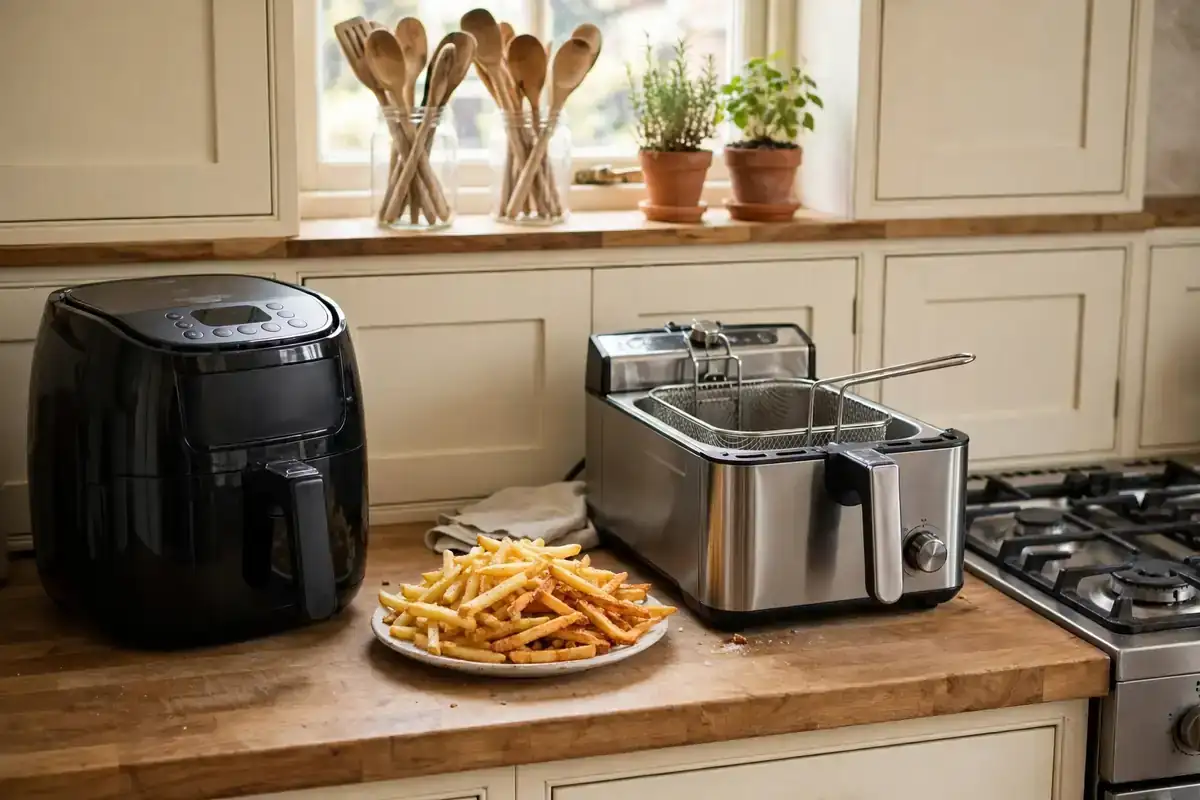
It is Friday night and the kids want fries. You have two ways to make them. One is a basket and a spoonful of oil. The other is a pot of oil, a thermometer, and a kitchen that smells like a chip shop until Sunday. The air fryer vs deep fryer question sounds like a health question, and it is, but it is also a question about what kind of cook you are on a Friday night: the one who wants dinner in twenty minutes, or the one who wants the crispiest fries you can make at home.
I cook every day for a family of four, and I have made fries both ways. The deep fryer makes the crispiest fries you will ever eat at home. The air fryer makes fries almost as good, with a spoonful of oil and no pot to deal with afterwards.
One honest note before we start: this page has affiliate links. If you buy through one, the site may earn a small commission. It costs you nothing, and it never decides what I recommend. Prices I quote were checked on November 16, 2026, and prices move, so check the current price before you buy anything.
The short answer
The air fryer wins for everyday cooking. It makes fries, wings, and nuggets almost as crisp as a deep fryer, with about a tablespoon of oil instead of a pot of it, and the cleanup is a basket in the sink. The deep fryer wins for the foods an air fryer cannot do: wet batter, donuts, tempura, anything that needs to swim. If you fry once a week or more and you love battered food, keep the deep fryer. If you fry for weeknight dinners and you want the crisp without the oil, buy the air fryer.
What an air fryer actually does
An air fryer is a small convection oven with a better name. A heating element at the top warms the air. A fan blows that hot air around the food at high speed. The food sits in a perforated basket, so the hot air reaches it from every side at once. That fast-moving hot air dries the surface of the food and browns it.
The browning is the Maillard reaction, the same chemical reaction that browns toast and sears a steak. It starts when the surface of the food gets hot enough, above about 280°F. Nothing about that is frying. Frying means cooking in hot oil. An air fryer cooks in hot air.
The small size is what makes it work. A regular oven heats a large box of air. An air fryer heats a small box of air, and the fan moves it fast. Most air fryers run between 350°F and 400°F for everyday cooking, and most food is done in 5 to 25 minutes.
The air fryer I would buy first is the Ninja AF101. It is a 4-quart basket, which holds two pounds of fries, a full side for four people in one batch, or four chicken breasts without stacking. It runs from 105°F to 400°F on 1,550 watts, with four programs: air fry, roast, reheat, and dehydrate. The basket is ceramic-coated aluminum, not a standard PTFE nonstick. I compared five fryers in detail in my guide to the best air fryers, and the AF101 is the one I would hand to anyone buying their first.

Best overall air fryer
Ninja AF101 Air Fryer, 4-Quart
One 4-quart basket, four programs, and nothing to learn. The ceramic coating wipes clean, and 105°F to 400°F covers everything from drying apple slices to crisping chicken skin.
+ Ceramic-coated basket, no PTFE nonstick
− 4 quarts means batches for a family of five or more
| Capacity | 4 qt (2 lb fries) |
| Power | 1,550 W |
| Temp range | 105–400°F |
| Programs | Air fry, roast, reheat, dehydrate |
The fryer I would hand to anyone buying their first air fryer.
What a deep fryer actually does
A deep fryer cooks food by dropping it into hot oil. The oil sits between 350°F and 375°F for most frying, hot enough to crisp the outside fast and cook the inside through. The food goes in a mesh basket, the basket goes down into the oil, and the oil does the work from every side at once. That is why deep-fried food is so evenly crisp. Nothing is sitting on a surface. Everything is surrounded by heat.
The oil is doing two jobs. It carries heat to the food far faster than air can, and it dries the surface as the water in the food turns to steam and escapes. That escaping steam is the bubbling you see. While the food is steaming hard, oil cannot get in. When the steam slows down, oil starts soaking in. That is why food left in the oil too long comes out greasy, and food pulled out at the right moment comes out crisp.
The deep fryer I would buy for a family is the T-fal 3.5L Deep Fryer with Oil Filtration. It holds 3.5 litres of oil, just under a gallon, and fries 2.65 pounds of food in one batch, enough for up to six people. It runs on 1,700 watts with an adjustable thermostat from 300°F to 375°F. The part that matters most is the oil filtration system: after cooking, it drains the oil through a filter into a sealed box underneath, so the oil is stored clean and ready for next time without being poured anywhere.

The family deep fryer
T-fal 3.5L Deep Fryer with Oil Filtration
A 3.5-litre pot with a basket, an adjustable thermostat, and an oil filtration system that drains and filters the oil into a sealed box for next time. It fries 2.65 pounds of food in one batch.
+ Oil filtration drains and stores the oil for reuse
− 3.5 litres of oil to heat, store, and eventually throw away
| Oil capacity | 3.5 L (just under a gallon) |
| Food capacity | 2.65 lb (up to 6 people) |
| Power | 1,700 W |
| Temp range | 300–375°F adjustable |
Fries for up to six people in one batch.
Do air fryers use oil?
A little. Most foods need about a tablespoon, and some need none at all. Deep frying the same food takes several cups. That is the whole health case in one comparison.
Oil is the most calorie-dense thing in the kitchen, so when food absorbs less oil, it carries fewer calories. Switching from deep frying to air frying can cut the calories a food picks up from frying by up to 80%. That number is not a promise about your dinner. It is the size of the difference the cooking method makes.
The air fryer does not remove the fat that is already in the food. Bacon cooked in an air fryer is still bacon. The fryer takes away the oil you would have added. It cannot take away the fat that came with the food.
There is one more thing the oil question hides. An air fryer makes fried food so easy that some kitchens end up eating it more often. Fries on Tuesday because they take twelve minutes. If the fryer turns fried food from a weekend treat into an everyday habit, the oil saved per serving gets eaten up by the extra servings.
Does an air fryer need oil?
Not always. Fatty foods cook in their own fat. Chicken thighs, salmon, sausages, anything with its own fat, need nothing added at all.
Lean foods and vegetables crisp better with a light coat. Chicken breast, broccoli, sweet potato, anything with a dry surface will brown better with oil on it. A teaspoon tossed through a bowl of cut vegetables is enough. Without it, the hot air dries the surface out before it browns, and you get tough instead of crisp.
The oil you use matters too. Every oil has a smoke point, the temperature where it starts to break down and smoke. Extra virgin olive oil smokes at around 350°F to 375°F, which is right in the middle of normal air fryer temperatures. Refined avocado oil holds to around 520°F. A brush or a refillable spray bottle with plain oil does the same job without the residue that aerosol sprays leave behind.
Health: the honest comparison
This is the section most people came for, so here it is plainly. Air frying is healthier than deep frying, and the food matters more than the method. I wrote the full answer, with the evidence laid out plainly, in my guide to are air fryers healthy. This is the short version, side by side with the deep fryer.
The oil is the biggest difference. A deep fryer cooks food in 3.5 litres of oil, and the food absorbs some of it. An air fryer cooks the same food with about a tablespoon. Less oil absorbed means fewer calories, and the gap is large: up to 80% fewer calories from frying.
Reused oil is the second difference. Deep fryer oil gets heated and reheated, and oil that has been heated many times breaks down. Deep-fried food carries trans fats, especially from restaurants, where the oil has been heated all day. Trans fats raise the bad kind of cholesterol and raise the risk of heart disease. Air frying sidesteps that almost entirely, because there is barely any oil to go bad.
Acrylamide is the question where neither machine wins clearly. It forms when starchy food cooks at high heat, above about 250°F, and the amount grows with temperature and time. The darker the food, the more it holds. That is true in an oven, in a deep fryer, and in an air fryer. The studies disagree on which fryer makes more of it. Cook starchy food to golden, not brown, whichever machine you use.
The coating question belongs to the air fryer, not the deep fryer. Most air fryer baskets have a nonstick coating. PTFE, the coating sold as Teflon, is stable and inert below 500°F. Most air fryer cooking happens at 350°F to 400°F, well below the line. If the coating question bothers you, there are fryers with no coating at all. I compared them in my guide to the best non-toxic air fryers, and the glass option is the Ninja Crispi air fryer, which cooks in borosilicate glass containers with nothing to break down and nothing to wear out.
Taste and texture: where deep frying still wins
I am not going to pretend the air fryer wins everything. There are foods where hot oil is simply better, and a reader who buys an air fryer expecting deep fryer results for those foods will be disappointed.
Wet batter is the biggest one. Beer batter, tempura batter, anything liquid that has to set around the food. In a deep fryer, the batter hits hot oil and sets in seconds, crisp all over. In an air fryer, wet batter drips straight through the basket before it can set. You get a mess in the drawer and bare food on top. If you love battered fish, onion rings in wet batter, or tempura, the deep fryer is the only machine of the two that does the job.
Donuts are the same story. A donut needs to float in hot oil to puff and brown evenly. An air fryer makes a baked donut, which is a fine thing, but it is not a fried donut.
The deep fryer also wins on evenness for big batches. Food surrounded by oil browns on every side at once, with no shaking and no flipping. An air fryer needs a shake halfway through, and the pieces on top always brown first.
What the air fryer matches, honestly, is the everyday crisp: fries, nuggets, frozen foods, roasted vegetables, chicken pieces with a dry coating. For those, the difference between the two machines is small, and most people at the table cannot tell which machine made the fries. The gap is real for batter and donuts. For everything else, it is close enough that the oil saved is worth more than the crisp lost.
Speed on a weeknight
The air fryer is ready in about three minutes. The food goes in, the timer goes on, and fries are done in twelve to fifteen minutes. Chicken breasts take about twenty. Dinner for four lands in half an hour from a cold start, with one basket to wash.
The deep fryer needs the oil heated first. Plan on around fifteen minutes to bring 3.5 litres of oil up to 375°F. The cooking itself is fast once the oil is hot. Fries take three to four minutes in hot oil. The total time from a cold start is still longer than the air fryer, because of the heat-up, and the cleanup afterwards is longer too.
The FryDaddy is the exception. It holds only four cups of oil, so it heats in a few minutes, and it is the fastest deep fryer to get going. But it fries four servings at most, and it has a fixed temperature with no dial.
On a weeknight, the air fryer wins on speed. On a weekend afternoon, when time is not the pressure, the deep fryer's heat-up does not matter nearly as much.
Size and batches
The Ninja AF101 holds two pounds of fries, four chicken breasts, or a full tray of vegetables in one layer. That is dinner for four, in one batch, as long as the meal is one thing.
The T-fal fries 2.65 pounds of food in one batch, enough for up to six people. A main and a side still cook in turns, because there is one pot of oil, but each batch is bigger than the air fryer's.
For a family of four, the air fryer and the T-fal are close on capacity. The T-fal edges ahead on batch size. The air fryer edges ahead on turnaround, because there is no oil to heat between batches.
The oil: buying, reusing, throwing away
This is the section that decides the purchase for more people than taste does, because oil is a chore and a cost that never goes away.
A fill of the T-fal takes 3.5 litres of oil, just under a gallon. That is a real amount of oil to buy, to heat, to store, and eventually to throw away. The filtration system helps: it drains the oil through a filter into a sealed box, so the oil stays clean between cooks and you are not pouring hot oil through a sieve into a jug.
Filtered oil can be reused a few times. Strain it, store it in a cool dark place, and use it again. Throw it away when it goes dark, thick, foamy, or smelly, or when it smokes at a lower temperature than it used to. Never pour used oil down the drain. It hardens in the pipes and causes blockages that cost far more than the oil did. Let it cool, pour it into a sealed container, and put it in the bin.
The FryDaddy uses four cups of oil and stores it in the fryer under a snap-on lid. Less oil to buy, less to throw away, and nothing to pour.
The air fryer uses about a tablespoon per batch, sometimes none. There is no oil to store, no oil to filter, no oil to throw away. Over a year of weekly frying, that is gallons of oil the air fryer never buys.
Cleaning
The air fryer is the easier clean. The basket and the crisper plate come out, and hot water, a soft sponge, and a drop of washing-up liquid take ninety seconds. Wash it after every use. Food left in the basket bakes on with the next cook, and baked-on food is what ruins a coating. Most baskets are dishwasher safe, but hand washing is gentler on the coating.
The deep fryer is the harder clean, and the T-fal's filtration system is the honest answer to it. The oil drains itself into the storage box, so you are not handling hot oil. The basket, bowl, lid, and oil box are all dishwasher safe. What is left is wiping down the outside, and dealing with the oil smell, which lingers in the kitchen longer than any air fryer smell does. A deep fryer without filtration is a much worse clean: hot oil to pour, a greasy pot to scrub, and oil splatter on the counter and the wall behind it.
The FryDaddy is the simplest deep fryer to clean. No basket, just a scoop. Wipe the nonstick inside and out, snap the lid on, and the oil stays in the fryer until next time.
Safety around hot oil
Hot oil is the one real hazard in this comparison, and it deserves a straight paragraph.
A pot of oil at 375°F burns badly if it spills, and it splatters when wet food goes in. Keep children and pets out of the kitchen while the fryer is hot. Pat food dry before it goes in, because water in hot oil spits. Never leave a deep fryer unattended while it is on. Never move a fryer full of hot oil. And never throw water on an oil fire. If oil catches fire, put the lid on to smother it and turn the heat off.
The T-fal helps with a locking lid, cool-touch handles, and automatic shut-off. The FryDaddy has a magnetic plug that pulls free if the cord is tugged, so the fryer stays put instead of tipping.
An air fryer has no hot oil at all. The basket is hot, and the air coming out of it is hot, but there is nothing to spill and nothing to catch fire. For a kitchen with small children, that difference alone is worth more than any crisp.
Cost
The Ninja AF101 was $119.99 on Amazon as of November 16, 2026. The T-fal 3.5L Deep Fryer was $149.95 on the same day. The Presto FryDaddy was $44.99. All three prices were verified on the day I wrote this, and they move, so check the current price before you buy.
The purchase price is only the start. The deep fryer has a running cost the air fryer does not: oil. Every fill of the T-fal is 3.5 litres, and even reused a few times, oil is a regular purchase. The air fryer's running cost is a tablespoon of oil and a little electricity. Over a year of weekly frying, the air fryer is the cheaper machine to own by a clear margin.
If the budget is the deciding factor, the FryDaddy is the cheapest way into real deep frying, and the air fryer has good answers under a hundred dollars too. I put those together in my guide to the best air fryers under $100.

The small, cheap deep fryer
Presto FryDaddy Electric Deep Fryer
Four cups of oil, four servings of fries, no basket to clean, and a snap-on lid that stores the oil in the fryer until next time.
Air fryer vs deep fryer side by side
| Ninja AF101 Air Fryer | T-fal 3.5L Deep Fryer | |
|---|---|---|
| How it cooks | Hot air + fast fan, perforated basket | Food dropped into 3.5 L of hot oil |
| Oil per batch | About 1 tablespoon | 3.5 litres per fill |
| Food per batch | 4 qt (2 lb fries) | 2.65 lb (up to 6 people) |
| Power | 1,550 W | 1,700 W |
| Temp range | 105–400°F | 300–375°F adjustable |
| Preheat | About 3 minutes | Around 15 minutes for a full pot |
| Wet batter | No, it drips through the basket | Yes, donuts, tempura, beer batter |
| Cleanup | Basket in the sink, 90 seconds | Oil filtered into a box, parts in the dishwasher |
| Check on Amazon | Check on Amazon | Check on Amazon |
Which one for which job
Weeknight fries, nuggets, and roasted vegetables: the air fryer. Twelve minutes, a spoonful of oil, one basket to wash. Ninja AF101 Air Fryer
Wet batter, tempura, and battered fish: the deep fryer. Only hot oil sets a wet batter. The air fryer cannot do this job at all. T-fal 3.5L Deep Fryer
Donuts: the deep fryer. A donut needs to float in hot oil to puff and brown. An air fryer makes a baked donut, which is not the same thing. T-fal 3.5L Deep Fryer
A big batch for a crowd: the deep fryer. 2.65 pounds in one batch, and the oil cooks faster than air once it is hot. T-fal 3.5L Deep Fryer
A kitchen with small children: the air fryer. No pot of hot oil, nothing to spill, nothing to catch fire. Ninja AF101 Air Fryer
Deep frying on a budget: the FryDaddy. Four cups of oil, four servings, and the cheapest real deep fryer worth owning. Presto FryDaddy Electric Deep Fryer
Reheating fried leftovers: the air fryer. It brings back the crisp that a microwave takes away, in a few minutes. Ninja AF101 Air Fryer
Buying tips
Buy the size for Tuesday, not Christmas. The biggest dinner happens twice a year. Tuesday happens every week. A 4-quart air fryer feeds four. A 3.5-litre deep fryer feeds six. The T-fal is about 18 inches long and needs a permanent home on the counter or a shelf. The FryDaddy is 8.5 inches across and stores easily.
Check the model number before you buy, new or second hand. Air fryers have been recalled more than once, and the recall is always tied to a specific model number, not a brand. Cosori recalled about two million older fryers in 2023. Gourmia recalled its air fryer ovens too, and I wrote about what to do if you own a recalled Gourmia air fryer oven.
For a deep fryer, check three things: an adjustable thermostat, so you can turn the oil down for delicate food; a filtration system or an easy way to strain and store the oil; and dishwasher-safe parts, because a greasy pot you have to scrub by hand is a pot you will stop using.
For an air fryer, check the coating. Most baskets are ceramic-coated or PTFE nonstick. Ceramic is PFAS-free and wipes clean. PTFE is tougher against scratches but needs care: never heat a nonstick coating past 500°F.
Check the circuit. A 1,700-watt fryer and a 1,550-watt fryer both want their own outlet. Do not run either on a power strip shared with a kettle or a microwave.
Care cheat sheet
Air fryer: wash the basket after every use, hot water and a soft sponge. Shake the basket halfway through cooking. Skip the aerosol spray. Use an oil that can take the heat, or none at all. Replace the basket when the coating flakes.
Deep fryer: filter the oil after every use, while it is still warm. Wipe the outside down. Wash the basket and bowl in the dishwasher. Throw the oil away when it goes dark, thick, or smelly. Never pour oil down the drain.
Both: let the machine cool before you clean it. Register the appliance with the maker when you buy it, so a recall notice reaches you.
Questions people ask
Do air fryers use oil?
A little. Most foods need about a tablespoon, and some need none at all. Deep frying the same food takes several cups.
Does air fryer need oil?
Not always. Fatty foods cook in their own fat. Lean foods and vegetables crisp better with a light coat, and a teaspoon tossed through is usually enough.
Can you put oil in an air fryer?
Yes, a little, on the food, not in the drawer. Toss the food in a teaspoon of oil before it goes in the basket. Never pour oil into the bottom of the drawer, or it smokes.
Is air frying healthier than deep frying?
Yes, by a wide margin on oil alone. An air fryer uses about a tablespoon where a deep fryer uses a pot, and the food absorbs far less fat.
Can an air fryer do battered food?
Dry coatings, yes. Wet batter, no. Wet batter drips through the basket before it can set. Beer batter, tempura, and donuts need a deep fryer.
How often should you change deep fryer oil?
Filter it after every use and reuse it a few times. Throw it away when it goes dark, thick, foamy, or smelly, or when it smokes at a lower temperature than it used to.
The bottom line
If you buy one fryer, buy the air fryer. It is the one you will use on a Tuesday, it makes weeknight food almost as crisp as a deep fryer with a spoonful of oil instead of a pot of it, and there is no hot oil to store, filter, or throw away. The Ninja AF101 Air Fryer is the one I would buy first: a 4-quart ceramic-coated basket, four simple programs, and nothing to learn before dinner.
If you love battered food, buy the deep fryer too, or instead. The T-fal 3.5L Deep Fryer fries for six, filters its own oil, and does the jobs the air fryer cannot touch: wet batter, tempura, donuts. And if the budget is tight, the Presto FryDaddy is real deep frying for the price of a takeaway, with four cups of oil and no basket to clean.
And if you already own a deep fryer, you do not have a problem. You have the weekend machine. The air fryer takes the weeknights. If the buy-or-not question is still open, my guide to are air fryers worth it works through the maths.