What Is the Difference Between Stainless Steel and Aluminum Cookware?
Aluminum heats fast and evenly, stainless steel is tougher and never reacts with food. Here's how the two actually differ on the stove, and which pan to grab for each job.
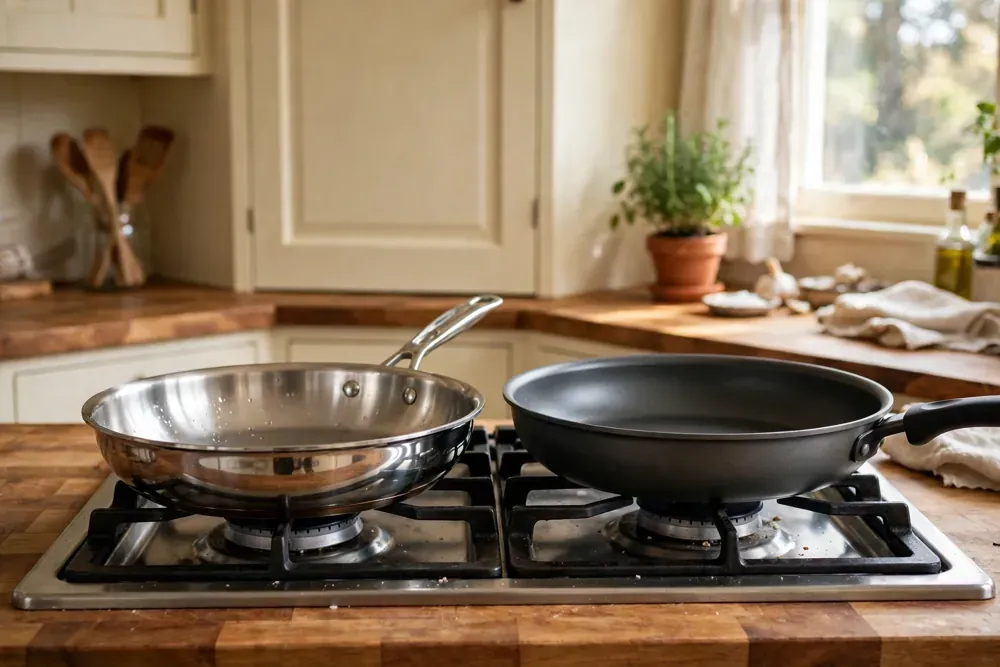
You are standing in front of two pans. One is heavy, shiny, and costs more than you expected. The other is light, cheap, and heats up before you have finished pouring the oil. Both claim to be the right pan for dinner. Both cannot be right for everything.
I cook every day for a family of four, and I own both kinds. I reach for each one for different reasons, and I have learned the difference the way most people do: by burning things, sticking things, and scrubbing a pan I should never have put a tomato sauce in.
This is the plain version of what each metal does, where each one fails, and which pan to grab for the job in front of you.
The short answer
Aluminum heats fast and evenly. Stainless steel heats slowly and unevenly on its own, but it is tougher, it does not react with food, and it lasts longer.
If you want one sentence to remember: aluminum is the better heater, stainless steel is the better pan. Most good cookware is actually both, with aluminum hidden inside stainless steel. More on that below.
What stainless steel cookware actually is
Stainless steel is mostly iron, mixed with chromium and a little nickel. The chromium is the important part. It forms a thin invisible layer on the surface that stops the iron from rusting. That is why the pan stays shiny after years of use.
The numbers on the box mean something. "18/10" means 18 percent chromium and 10 percent nickel. That is the food-grade steel you usually find on the inside of a good pan, and it is also called 304 steel. "18/8" is similar, with a little less nickel. "18/0" has no nickel at all. That last one matters for induction hobs, because it is magnetic.
A stainless steel pan is almost never one solid piece of steel. A cheap one is a single thin layer, and it cooks badly. A good one is layered. The usual build is called tri-ply: a layer of stainless steel on the inside, a layer of aluminum in the middle, and a layer of stainless steel on the outside. The aluminum in the middle does the heating. The steel on the outside does the surviving.
Some pans have the aluminum only in the base, as a disc stuck to the bottom. That is called disc-bottom or encapsulated base. It heats the bottom well, but the sides stay cold. Full tri-ply carries the aluminum all the way up the sides, so the whole pan heats, not just the middle.
What aluminum cookware actually is
Aluminum is a soft, light metal. On its own it is too soft for a pan that gets used every day, so cookware makers use alloys. The common ones are called 3003 and 3004. They are aluminum mixed with small amounts of other metals to make it stronger.
You will meet aluminum in three forms.
Bare aluminum is the raw metal, silver-grey and light. It is the cheapest kind, and also the one with the most problems. It reacts with food, it stains, and it dents if you look at it wrong.
Hard-anodized aluminum starts as the same metal, then goes through an electrochemical bath that turns the surface into aluminum oxide. That layer is much harder than the metal underneath, and it barely reacts with food. It is dark grey or black, and it feels almost like a different material. Most good aluminum pans today are hard-anodized.
Nonstick aluminum is usually an aluminum pan with a coating on top, most often PTFE, the material sold as Teflon. The aluminum does the heating. The coating does the releasing. The coating is the part that wears out.
Aluminum also hides inside stainless steel pans as the core layer. When you buy a good stainless steel pan, you are usually buying an aluminum pan wearing a steel jacket.
Heat: the biggest difference
This is where the two metals are furthest apart, and it explains almost everything else.
Heat moves through aluminum about fifteen times faster than through stainless steel. The measured number for pure aluminum is around 235 watts per meter-kelvin. For stainless steel it is around 15 or 16. The aluminum alloys used in real pans are a little lower, roughly 170 to 225, but the gap stays huge.
What that means in your kitchen is simple. An aluminum pan heats up fast, and the heat spreads across the whole surface. A stainless steel pan heats up slowly, and the heat stays where the burner is. Put a thin stainless steel pan on a gas hob and you get a hot ring in the middle and cold edges. Food in the middle burns while food at the edge stays pale.
Stainless steel has one advantage here. Once it is hot, it holds its heat. It is heavy and dense, so it does not cool down much when cold food hits it. That is useful for searing. Aluminum is light, so it loses heat fast when you add a cold steak. It recovers quickly because it conducts well, but the first moment matters.
So aluminum wins on even heating and quick response. Stainless steel wins on holding heat steady. Neither wins on its own. That is why the best pans combine them.
How they cook differently
Searing and browning belong to stainless steel. A hot stainless steel pan gives meat a deep brown crust, and the browned bits left stuck to the bottom, called fond, dissolve into a sauce when you add wine or stock. That stuck-on browning is not a flaw. It is the whole point of the pan. Aluminum can sear too, but it cools faster when the meat goes in, and it does not build fond the same way.
Eggs and delicate foods belong to aluminum, especially nonstick aluminum. An egg slides around a nonstick aluminum pan with almost no oil. The same egg in a stainless steel pan sticks unless the pan is properly preheated and oiled. That is not a defect in the steel. It is how the metal works. Steel needs heat and fat to release food. Aluminum with a coating does not.
Sauces belong to stainless steel. Tomato sauce, wine reductions, lemon butter sauce: all acidic, all fine in steel. Aluminum handles them badly, which is the next section.
Boiling water is a draw with a small edge to aluminum. An aluminum stockpot brings water to a boil faster. A stainless steel stockpot takes longer but holds a steady rolling boil. For pasta night, either works. For a big pot of stock that simmers for hours, I reach for stainless steel, because it will not react with anything I throw in.
Baking and roasting lean aluminum. Sheet pans and roasting pans are almost all aluminum because it is light and heats evenly. A heavy stainless steel roasting pan is tiring to lift out of the oven when it is full of a chicken and potatoes.
Reactivity: the tomato test
This is the difference most people discover by accident. You simmer a tomato sauce in a bare aluminum pan for an hour. The sauce tastes faintly metallic. The pan has dark grey marks that will not scrub out. What happened is simple chemistry. Aluminum reacts with acid. Tomatoes, wine, vinegar, citrus, and rhubarb are all acidic enough to pull tiny amounts of metal into the food and stain the pan.
Stainless steel does not do this. You can simmer tomato sauce in it all afternoon. You can deglaze with red wine. You can leave lemon juice in it. The steel does not care. This is the single best reason to own at least one stainless steel saucepan, even if the rest of your pans are aluminum.
Hard-anodized aluminum is much better here than bare aluminum. The anodized layer is a hard oxide skin, and it resists acid well under normal cooking. A tomato sauce in a hard-anodized pan for a normal cooking time is fine. But the layer is not permanent. Years of metal utensils, abrasive scrubbing, and dishwasher detergent wear it down. Once the raw aluminum shows through, the reactivity comes back.
Nonstick coatings also protect the aluminum underneath, until they do not. A scratched nonstick pan with bare aluminum showing is a pan to retire, not a pan to keep using for tomato sauce.
Weight and handling
Pick up a stainless steel frying pan with one hand and you feel it. A 30 cm stainless steel pan weighs around twice what the same size aluminum pan weighs. That weight is not just an inconvenience. It affects how you cook. Flipping food with a flick of the wrist is easy in aluminum and hard in steel. Pouring from a full stainless steel stockpot takes two hands and some care.
For anyone with weak wrists, arthritis, or small hands, this matters more than any performance number. A pan you cannot lift safely is a pan you will not use. Aluminum wins here without a contest.
The weight of stainless steel does have a use. A heavy pan sits flat on the hob and does not slide around. A very light aluminum pan can skate across a glass cooktop when you stir. Good aluminum pans solve this with thicker bases, which adds a little weight back.
Durability and lifespan
A stainless steel pan is the closest thing to a pan you buy once. It does not dent easily. It does not warp under normal heat. It does not chip, because there is no coating to chip. Scratches from metal utensils are cosmetic. You can scrub it hard, put it in the dishwasher, and heat it empty by accident, and it will survive. I expect a good stainless steel pan to last decades. My oldest one is older than my youngest child, and it cooks the same as the day it arrived.
Aluminum is softer. Bare aluminum dents if it falls off a shelf. Thin aluminum warps on high heat, and a warped pan wobbles on a flat hob and heats unevenly forever after. Nonstick coatings wear out. Even a good one lasts a few years of daily use, not decades. Hard-anodized aluminum lasts longer than bare or nonstick aluminum, but the anodized layer still wears down over time, especially in the dishwasher.
This is the real cost difference. A stainless steel pan costs more on the day you buy it. An aluminum pan costs less, but you buy it again. Over ten years, the steel pan is usually cheaper.
Cleaning and care
Stainless steel is the easiest metal to clean aggressively. Burnt food comes off with hot water, baking soda, and a scrub. White spots from hard water wipe away with vinegar. Brown rainbow stains, which come from overheating, come off with a paste cleaner like Bar Keepers Friend. The pan can go in the dishwasher. It might come out with water spots, but it will be clean.
There are two things to avoid. Do not use steel wool every day, because it scratches the surface over time and makes food stick more. And do not leave salty water sitting in the pan for hours, because salt can pit the steel.
Aluminum needs a gentler hand. Bare aluminum discolors in the dishwasher and can come out grey and dull. Hard-anodized aluminum should be hand washed. Dishwasher detergent is strongly alkaline, and it attacks the anodized layer a little every time. Metal utensils scratch nonstick coatings. Stacking pans without a cloth or paper towel between them scratches the coating too.
The rule I use at home: steel gets scrubbed, aluminum gets washed gently and dried straight away.
Health and safety
This is the part people worry about most, so let me say plainly what the evidence actually shows.
Aluminum can move into food while you cook. That is called leaching. How much moves depends on the pan and the food. Bare aluminum with tomato sauce for an hour leaches the most. Hard-anodized aluminum with ordinary food leaches very little. The European Food Safety Authority sets a tolerable weekly intake of 1 milligram of aluminum per kilogram of body weight. Aluminum from good quality cookware in normal use falls far below that level.
Your body also absorbs only a small fraction of the aluminum you swallow, somewhere between a fraction of one percent and five percent, and healthy kidneys clear it. The people who should be careful are those with kidney problems, because they clear aluminum more slowly.
The old worry that aluminum cookware causes Alzheimer's disease does not hold up. That idea came from the 1960s. Major health bodies, including the Alzheimer's Association, have looked at the evidence and found no consistent link between ordinary aluminum exposure and dementia. The cookware question and the Alzheimer's question are separate, and the second one is not supported by the evidence.
There are two real risks worth knowing. The first is cheap imported aluminum cookware made from recycled scrap metal. In 2025, the US Food and Drug Administration issued alerts about some of these pans containing lead. Buy from makers you recognise, and skip the unbranded pan that costs almost nothing.
The second is a worn-out pan. A hard-anodized or nonstick pan with deep scratches, flaking, or bare metal showing should be replaced. The surface was doing the protecting. Once it is gone, leaching goes up and food starts sticking.
Stainless steel has its own small note. Tiny amounts of nickel and chromium can move into food, especially with long cooking of acidic food. For most people this is nothing. For people with a nickel sensitivity, it can be noticeable, and they often do better with cast iron or carbon steel. If you have a nickel allergy and a stainless steel pan gives you trouble, that is likely why.
Nonstick coatings have one rule: do not overheat them. The coating starts to break down above about 500°F, which is 260°C. A pan left empty on high heat gets there fast. Never preheat a nonstick pan empty, and never use it under a broiler.
Induction and other hobs
A magnet tells you everything. Hold a fridge magnet to the bottom of the pan. If it sticks firmly, the pan works on induction. If it slides off, it does not.
Most stainless steel pans work on induction if the outer layer is a magnetic grade, usually 430 steel. Some all-304 stainless steel pans do not, because 304 steel is not magnetic. Check the base before you buy, or bring a magnet to the shop.
Aluminum on its own never works on induction, because aluminum is not magnetic. An aluminum pan works on induction only if the maker bonded a steel plate to the bottom. Many do now, and they say so on the box. If the box does not say induction compatible, assume it is not.
On gas and electric hobs, both metals work fine. On a glass cooktop, heavy stainless steel is kinder to the glass than a light pan that slides, but either works if the base is flat. A warped aluminum pan is the real problem on glass, because only part of the base touches the heat.
Cost
Aluminum is cheaper to buy. A usable aluminum frying pan costs a fraction of a good stainless steel one. That is why most starter kitchens are full of aluminum.
Stainless steel costs more up front, and the price climbs steeply with quality. A fully clad tri-ply pan from a good maker is a serious purchase. But it is also a purchase you make once. Spread over twenty years of daily use, it is the cheaper pan.
My own kitchen reflects that math. The aluminum pans are the ones I replace every few years. The stainless steel pans are the ones I will still own in ten years.
The hybrid: clad cookware
If this article has a hero, it is the clad pan. A tri-ply pan is stainless steel on the inside, aluminum in the middle, and stainless steel on the outside. You get the steel cooking surface, which does not react with food and builds fond. You get the aluminum core, which spreads heat fast and evenly. And you get the steel exterior, which takes the knocks.
When you are shopping, check how far the aluminum goes. A disc-bottom pan has the aluminum only in the base. It is cheaper, and it heats the bottom well, but the sides stay cool and food sticks to the cold edges. A fully clad pan carries the layers all the way up the sides to the rim. It costs more, and it cooks more evenly.
Five-ply pans add more layers, usually extra aluminum or a copper core, but the idea is the same. More layers mostly mean a heavier pan and a higher price. For a family kitchen, tri-ply is the sweet spot.
Which pan for which job
Searing meat: stainless steel. High heat, a good crust, and fond for the sauce.
Frying eggs: nonstick aluminum. Low heat, a little butter, no sticking, no stress.
Simmering tomato sauce: stainless steel. Acid is no problem, and you can leave it for hours.
Boiling pasta or potatoes: either, with a small edge to aluminum for speed.
Making a pan sauce: stainless steel. Deglaze the browned bits with wine or stock.
Cooking fish: nonstick aluminum, or well-preheated stainless steel with enough oil. Fish is the food that punishes a cold steel pan fastest.
Stir-frying: aluminum or carbon steel, because you want fast heat changes. A heavy stainless steel pan is slow to respond when you turn the heat down.
Baking: aluminum sheet pans. Light, even, and cheap enough to own several.
Stock and soup: stainless steel stockpot. Long cooking, acidic ingredients, and it will not react with anything.
Buying tips
Buy the heaviest pan you are comfortable lifting. Weight is the simplest sign of quality in both metals. A light stainless steel pan is usually a thin one, and it will have hot spots. A light aluminum pan is usually a thin one, and it will warp.
Check the base with a magnet if you cook on induction. Do it before you buy, not after.
Look at the handles. They should be riveted, not screwed, and they should stay cool enough to hold with a towel. A handle that wobbles on day one will break in a year.
Buy lids that fit tightly. A loose lid lets steam escape and slows cooking. Glass lids let you see without lifting, which is genuinely useful for rice and sauces.
Ignore the number of pieces in a set. A set of twelve pans sounds generous, but it is usually eight pans you will never use and four you will. Buy the three pans you actually cook with, in good quality, and add the rest later.
Care cheat sheet
Stainless steel: preheat the pan first, then add oil, then add food. Let meat sit before you try to move it. It releases when it is ready. Deglaze with liquid while the pan is hot. Clean with baking soda and a soft scrub. Bar Keepers Friend for stains. Dishwasher is fine.
Aluminum, hard-anodized: medium heat is enough, because it heats fast. Hand wash with mild soap. Dry it straight away. No metal utensils on nonstick, and no dishwasher for anodized pans.
Aluminum, nonstick: never preheat empty, never use high heat, never use metal utensils. Replace it when the coating is scratched through or food starts sticking no matter what you do.
Both: never plunge a hot pan into cold water. The sudden change can warp aluminum and stress steel. Let it cool for a few minutes first.
Questions people ask
Can you put aluminum pans in the dishwasher?
You can, but you should not. Dishwasher detergent dulls bare aluminum and wears down the anodized layer. Hand washing takes a minute and doubles the life of the pan.
Is stainless steel really nonstick?
No, and anyone who says so is selling something. Stainless steel is a sticking surface. It releases food when the pan is hot enough and there is enough fat. Learn the preheat and the oil, and sticking stops being a problem.
Does aluminum cause Alzheimer's?
The evidence does not support that link. Major health bodies have reviewed it and found no consistent connection between ordinary aluminum exposure and dementia. Buy good quality pans, do not cook acidic food for hours in bare aluminum, and the question mostly goes away.
Which one lasts longer?
Stainless steel, by years. A good tri-ply pan can last decades. An aluminum pan, even a good one, has a coating or a surface layer that wears. Expect a few years of daily use from nonstick aluminum, longer from hard-anodized, and decades from steel.
Can I use metal utensils on stainless steel?
Yes. That is one of its best features. Use wood or silicone on nonstick aluminum, and use whatever you like on steel.
Is clad cookware worth the price?
For the pans you use every day, yes. A fully clad frying pan and a fully clad saucepan cover most of what a family kitchen does. You do not need a full clad set. Two good clad pans beat ten cheap ones.
The bottom line
If you buy one pan, make it a fully clad stainless steel frying pan. It sears, it makes sauces, it handles acid, and it will still be in your kitchen in twenty years. It is the hardest working pan there is.
If you buy a second pan, make it a nonstick aluminum one for eggs, fish, and anything delicate. The two together cover nearly everything a family cooks.
And if you already own both, you do not have a problem. You have a system. The trick is knowing which one to reach for, and now you do.